
Tornado safety for campers and hikers: what to do in a tent, a car or on the trail
At about seven in the evening on July 14, 2000, a tornado reached Green Acres Campground at Pine Lake, Alberta, on a busy summer Friday. The campground sits low, below a hill and near the water, and the people in its trailers had little view of the sky to the west. A severe thunderstorm warning had been in force since a little after six. The tornado warning was issued a few minutes after seven, once the police had reported the tornado, and by then it had already crossed the campground. Twelve people were killed and more than a hundred injured as trailers were overturned and torn apart.
Most tornado advice is written for people at home. Campers, hikers and paddlers face a different problem: a tent, a trailer or a car offers little or no protection, the nearest sturdy building may be some distance away, and the warning may never reach you if you are out of phone range. This guide covers where and when tornadoes happen in the United States and Canada, how to get the warning in the field, the signs that one is close, and what to do in a campground, in a car, on the trail and on the water. Reading the general forecast is covered in reading backcountry weather, and the straight-line windstorms that do similar damage over a wider area are covered under derechos.
On a tornado day, stay home
Check the forecast before a trip in tornado country. If tornadoes are forecast for the area, or a tornado watch is issued, stay home, or head home if you are already out. On other days in tornado season, keep emergency alerts turned on, and where there is no phone signal, check the forecast each day on a satellite messenger. A tent, trailer or RV is not a shelter.
Where and when tornadoes happen
The United States has more tornadoes than any other country, around 1,200 in a typical year according to the Storm Prediction Center, give or take a few hundred. Canada recorded about 65 a year on average between 1991 and 2020, and the true number is probably higher, because many fall in forest and farmland where nobody sees them. Tornadoes have been recorded in every US state and across southern Canada, but most fall in a few regions, each with its own season.
The southern and central Plains
From Texas through Oklahoma and Kansas to Nebraska, the peak runs from May into early June. This is the open country around Palo Duro Canyon and Caprock Canyons in the Texas Panhandle.
The northern Plains, the upper Midwest and the Prairies
In the Dakotas, Minnesota, Iowa and Wisconsin, the peak is June and July. North of the border, Canada’s season is summer: June through August accounts for most of the year’s tornadoes, July most of all, across the Prairies from Alberta to Manitoba. Parks in this belt include Badlands, Theodore Roosevelt, Grasslands, Riding Mountain, Whiteshell and Itasca.
The Southeast
From Arkansas and Louisiana east through Mississippi, Alabama and Tennessee to Georgia and the Carolinas, the season starts earlier than on the Plains, in late winter and early spring, and there is a second, smaller season in November and December. Tornadoes in this region are often hidden by rain, hills and trees, and more of them come at night: a National Weather Service study of the Mid-South found that 42 percent of its tornadoes occurred after dark. Parks here include Devils Den, Hot Springs, Fall Creek Falls, Cloudland Canyon and Congaree.
The Ohio Valley, the Great Lakes and southern Ontario and Quebec
From Illinois east through Indiana, Ohio, Kentucky and Michigan, and north into southern Ontario and Quebec, tornadoes are less frequent than on the Plains but far from rare, mostly from late spring through summer. Ontario has the highest yearly average of any province. Parks in this belt include Starved Rock, Indiana Dunes, Hocking Hills and Point Pelee.
Any time of day, and in the mountains
Tornadoes are most common in the late afternoon and evening, when thunderstorms are strongest, but they occur at any hour. They are also less bound by terrain than many people believe. They cross rivers, lakes, hills and valleys, and they have crossed the Appalachians, the Rockies and the Sierra Nevada. On July 21, 1987, a tornado rated F4 crossed the Continental Divide in the Teton Wilderness south of Yellowstone at about 10,000 feet (3,000 m) and flattened forest along a path about 24 miles (39 km) long. Nobody was hurt. Mountain tornadoes are rare, but being in the mountains is no protection from one.
Watches, warnings and getting them in the field
Both countries use the same two levels.
A tornado watch means conditions are right for tornadoes to form in a large area over the next several hours. If one is issued for where you are going, stay home. If you are already out, it is the time to pack up and head home, or into town, before the storms build.
A tornado warning means a tornado has been seen, or radar shows rotation that can produce one, and it is heading toward the area named. A warning means get into a sturdy building now, without waiting to see the tornado.
In the United States, watches come from the Storm Prediction Center and warnings from the local National Weather Service office. In Canada, Environment and Climate Change Canada issues both.
Most people get warnings on their phone, and in the field the signal is the weak link.
- Phone alerts. Wireless Emergency Alerts in the United States and Alert Ready in Canada push tornado warnings to compatible phones in the warning area, with a loud tone, even if you have no weather app. Both need a working cell signal at the moment the warning goes out. In a valley, a canyon or a remote park, that may not be the case. Check that emergency alerts are turned on in your phone’s settings before the trip, and keep the volume up at night.
- Satellite messengers. Where there is no signal, a two-way messenger such as the Garmin inReach Mini 2 can download a forecast, which tells you whether severe storms and tornadoes are expected, and can call for help. It does not sound tornado warnings by itself, so check the forecast on it each morning, and again if storms start to build.
- Weather radio. NOAA Weather Radio in the United States and Environment and Climate Change Canada’s Weatheradio broadcast on the same channels. A radio with an alert feature, left on in camp, stays silent until a warning is issued for your area and then sounds an alarm loud enough to wake you. Few people carry one, but it is a useful extra on a car-camping trip in tornado season. Coverage is incomplete in remote country.
- Sirens. Outdoor warning sirens are meant for people outdoors in and near towns. Many campgrounds have none, a siren can be inaudible inside a trailer in heavy rain, and a storm can cut the power to one. At the Little Sioux Scout Ranch in Iowa in 2008, the siren in the nearest town sounded only briefly before the storm cut the town’s power.
At Pine Lake, the tornado warning came after the tornado had struck. Warnings still sometimes come late or not at all, especially for tornadoes that form quickly. That is one more reason to act on the watch, and not wait for a warning.
Signs that a tornado is close
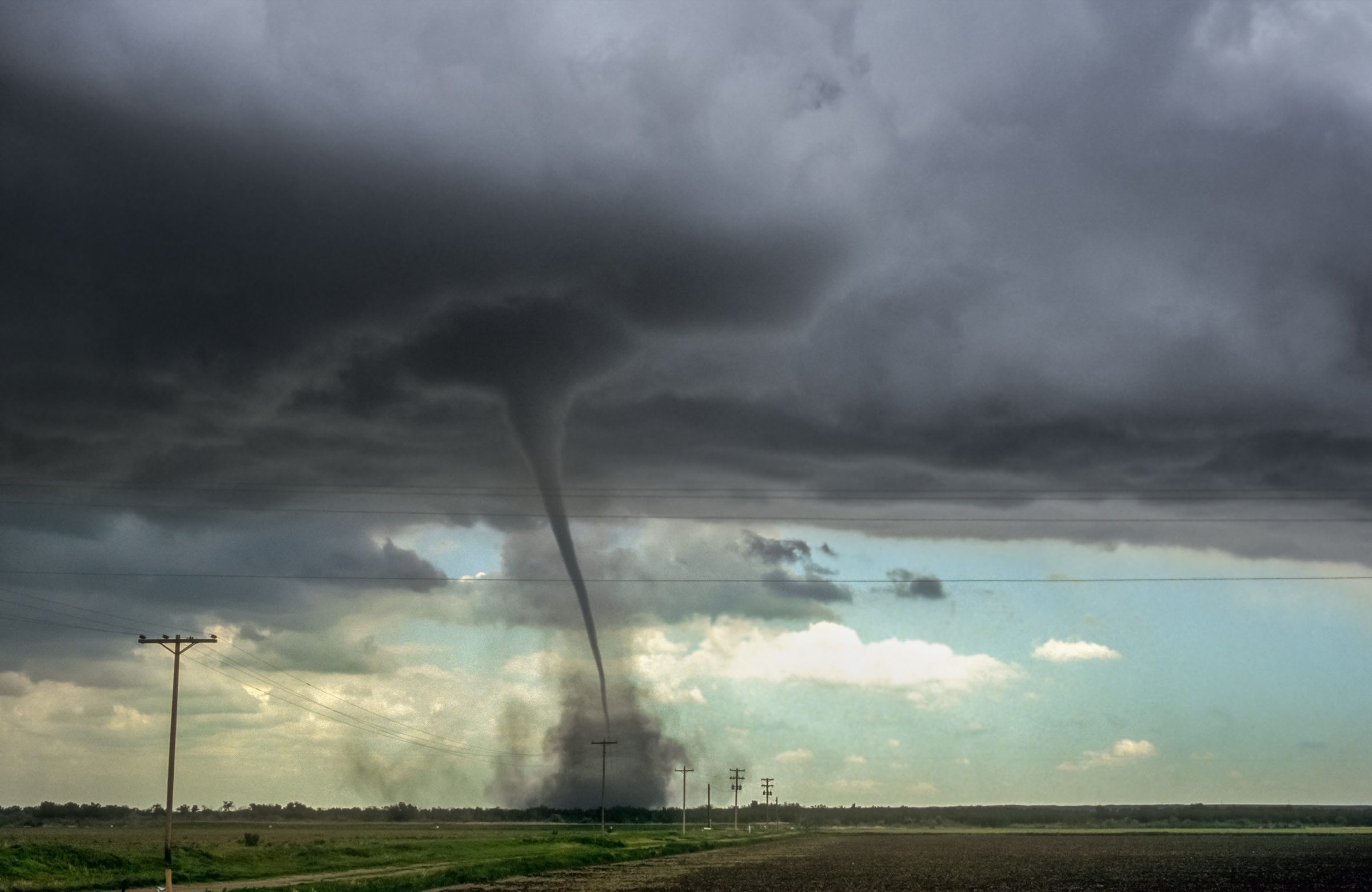
Many tornadoes are hard to see. They can be wrapped in rain, hidden by hills or trees, or invisible in the dark. The weather service lists these signs, any one of which is reason to take shelter at once:
- A loud, continuous roar or rumble that does not fade after a few seconds the way thunder does. Survivors often compare it to a freight train.
- A rotating, persistent lowering of the cloud base, called a wall cloud, especially one with rising or swirling cloud fragments beneath it.
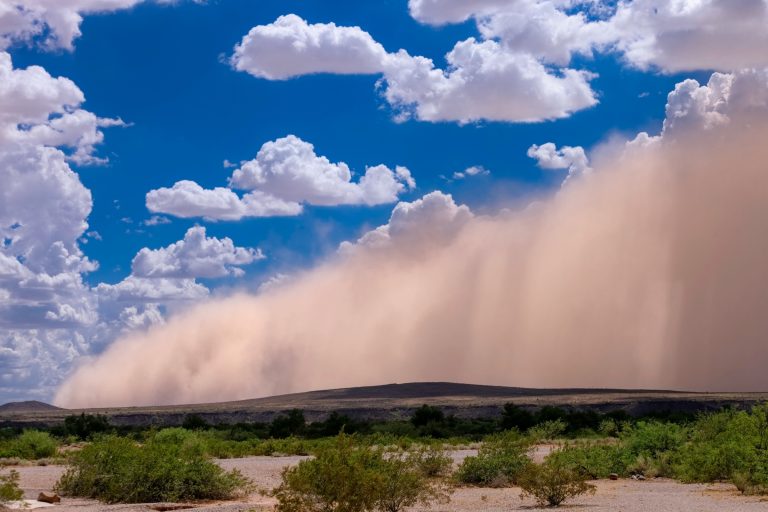
- Whirling dust or debris on the ground under a cloud base, even when no funnel reaches down to it.
- Hail or heavy rain followed by a dead calm or a fast, intense shift in the wind.
- At night, small, bright, blue-green to white flashes at ground level near a thunderstorm. These are power lines being snapped, not lightning.
Environment Canada adds an extremely dark sky with green or yellow cloud, and a rumbling or whistling sound. A green tint is often reported before tornadoes, but it is not a reliable sign either way, so do not wait for one. How to read a building thunderstorm in general is covered in reading the clouds.
Planning a trip in tornado season
The decision that matters most is made before you leave home, because once a warning is issued you may have minutes.
Check the forecast, and stay home on a tornado day. In the United States, the Storm Prediction Center’s convective outlook shows, one to three days ahead, where severe storms and tornadoes are likely and how likely they are. In Canada, Environment and Climate Change Canada’s alerts and special weather statements do the same job, and severe-storm risk is often flagged a day or more ahead. If the outlook or the local forecast mentions tornadoes for where you are going, put the trip off. It costs one outing. Check again the morning you leave, and on a multi-day trip, every day you can.
Use the park’s own forecast. Every park and national monument guide on this site has its own current forecast, and it leads with the weather alerts in force there, tornado watches and warnings included, from the National Weather Service in the United States or Environment and Climate Change Canada. Open the guide for the park you are heading to and choose “See the current forecast”.
Know the name of where you are. Warnings name counties in the United States and forecast regions in Canada. When an alert or a radio names an area, you need to know whether it is yours. Look up the county or forecast region of the park before you go.
Leave a trip plan. After the Pine Lake tornado, the campground’s registration office was gone, and a Red Deer fire official later said rescuers had no way of knowing how many people had been staying there or who was missing. A plan left with someone at home says where you were, with whom and when you were due back, so a search can start sooner and in the right place. Leave Word is our tool for that.
In a campground: tents, trailers and RVs
The weather service is blunt about this: a tent is not safe, and neither is a mobile home. Travel trailers, campers and RVs are lighter and less well anchored than a mobile home, and most tornadoes can destroy even a tied-down mobile home. Survivors of Pine Lake described people being pulled out of trailers and struck by vehicles carried in the wind.
When a warning is issued for your area, or you see or hear the signs above:
- Leave the tent, trailer or RV at once and go to the nearest permanent building: in most campgrounds that is the washroom or shower block, the office or a visitor centre. Put on shoes first; take a headlamp, your phone and nothing else.
- Once inside, go to the lowest floor and the most interior room, away from windows and doors. Stay out of picnic shelters and big open halls: the weather service warns that rooms with a wide roof span and few supports are hazardous even in weak tornadoes. Crouch low, face down, and cover your head and neck with your arms. A sleeping bag or a jacket over you helps against flying debris, and so does a bike or climbing helmet if you have one.
- If you cannot reach a building in time, a car is not a good place to be but it is better than a tent or a trailer; see the next section. Or follow the open-country advice below and get into the lowest ground you can find, away from the trailers and vehicles that the wind can throw.
- With a group, count heads before you leave and again when you arrive. At night, a camp leader should go tent to tent; an alert on one phone does not wake the next tent.
A campground building is far better than a tent, but it is not a storm shelter. At the Little Sioux Scout Ranch in Iowa in 2008, which had no basement or in-ground shelter, most of the deaths and injuries came when the tornado destroyed the buildings the scouts had taken cover in, and in one of them a brick fireplace collapsed. That is why the forecast, and staying home on a tornado day, matter more than anything you can do once the warning comes.
In a vehicle
Driving to or from a trailhead in tornado weather is common, and a car is not safe in a tornado. The weather service’s guidance:
- If you can get to a sturdy building, drive there. If the tornado is still far away and traffic is light, you may be able to drive out of its path by moving at right angles to the direction it is travelling. Do not try to outrun it by driving the way it is going.
- Never shelter under a highway overpass or bridge. The wind accelerates through the gap and carries debris with it, and people have been blown out from under them.
- If you are caught, with debris flying, pull off the road, away from traffic. Either stay in the car with the seat belt on, put your head down below the windows and cover it with your hands and a coat or blanket, or, if there is ground clearly lower than the road nearby, leave the car and lie flat in it, covering your head.
Both last-resort choices have killed people and saved people, and the weather service does not rank one above the other. What reduces the risk is not being on the road: on a day with tornadoes in the forecast, do not set out, and if a watch is issued while you are out, drive home early or wait in a building in town until the storms have passed.
On the trail or in open country
On most trails there is no building in reach. The odds of a tornado crossing one person on a trail are small, and on a tornado day the commoner dangers are lightning, hail, flash floods and falling trees. On a day with tornadoes in the forecast, stay home. On an ordinary summer day when thunderstorms build anyway, the plan is the same as for any storm: be off exposed ground and back near the car by the time they arrive. The timing rules in lightning safety in the backcountry apply in full.
If a tornado is approaching and there is nothing better:
- Get away from trees and vehicles, which break, fall and fly. In forest, move away from the tallest trees and any dead ones, toward a clearing, a low bank or a gully.
- Find the lowest ground you can reach, such as a ditch, a ravine or a hollow below the surrounding surface.
- Lie flat, face down, and cover the back of your head and neck with your arms. Keep your pack on, since it gives your back some protection from debris.
- Watch the water. A ditch or a wash in a heavy storm can fill fast. If water starts to run in it, move to higher ground beside it; flash floods covers the signs.
This conflicts with the lightning advice, which is not to lie flat, because ground current spreads through it. The two threats call for different positions. With a tornado coming at you, flying debris is the greater danger, so get low and flat. Once it has passed, stand up and go back to the lightning rules, because the storm is often still overhead.
In camp in the backcountry, the choice of site matters more than anything you can do in the moment. Use the overhead scan in choosing a safe backcountry campsite: no dead trees or large dead limbs within reach of the tent, and not in a drainage that could flood.
On the water
A tornado over water is a waterspout. Most waterspouts are the weaker fair-weather kind, which form under building cumulus cloud on calm, warm days, often in late summer and fall on the Great Lakes and along the Gulf and Atlantic coasts. They can still overturn a canoe or a small boat. The rarer kind is a tornado that forms over water or moves onto it from land, and it is as dangerous there as anywhere.
- On a day with severe storms forecast, stay close to shore and keep crossings short, so that you can land within minutes.
- If you see a funnel or a waterspout, head away from it at right angles to its track and for the nearest shore, not the one you were heading for.
- Once ashore, get away from the water and from the boat, which the wind can lift, and follow the open-country or campground advice above.
The capsize and cold-water skills in canoe and kayak safety apply if the wind reaches you on the water first.
After the tornado passes
- Stay put for a few minutes. Tornadoes often come in groups, from the same storm or the next one in the line. Check the radio or your phone for further warnings before you move.
- Check everyone for injuries, starting with anyone who is not moving or not answering. Serious bleeding comes first: firm, direct pressure, and a tourniquet on a limb when pressure will not stop it. At Little Sioux, the scouts’ own first-aid training was credited by the local fire chief with saving lives. Backcountry first aid: what to do in the first ten minutes covers the order of work, and wound care and splinting cover what comes after.
- Watch where you step. Wear sturdy shoes and gloves. Debris fields are full of broken glass, nails and sheet metal.
- Keep clear of downed power lines, and treat every one as live. Leave a damaged building, and do not go back into one, if you smell gas or see it leaning or cracked.
- Count heads, and report who is missing to the first responders, with where they were last seen.
- On the trail, expect fallen trees across the route and a slow walk out. If someone is hurt and you cannot get them out, signal for rescue.
Common mistakes
- Riding out a warning in a tent, trailer or RV. It feels like shelter and gives almost none; people are thrown from trailers and struck by them. As soon as a warning is issued, go to the nearest permanent building, such as the washroom block or the office.
- Waiting to see the tornado. Many are wrapped in rain, hidden by terrain or invisible at night, and by the time you see one there may be no time left. Act on the warning, or on the roar and the debris, without waiting for a funnel.
- Going anyway when tornadoes are forecast. The morning is often warm and sunny, and the storms build later in the day, when a hiker or camper may have no sturdy building nearby. If tornadoes are forecast for the area or a watch is issued, stay home, or head home if you are already out.
- Assuming the phone will warn you. A phone in a valley or a remote park may have no signal when the warning goes out, and a silenced phone wakes nobody. Keep the volume up at night, and where there is no signal, check the forecast each day on a satellite messenger and head home if tornadoes are forecast.
- Sheltering under an overpass. The wind speeds up through the gap and the debris goes with it. Drive to a building if there is time; if not, follow the vehicle advice above.
- Taking cover in a pavilion or a big open hall. Wide roofs with few supports fail even in weak tornadoes. Choose a small interior room on the lowest floor of a permanent building.
- Assuming the hills, the lake or the river protects you. Tornadoes cross all of them, and one has crossed the Rockies at 10,000 feet (3,000 m). Take a warning seriously wherever you are camped.
- Going straight back to camp. Another tornado may follow, and the damage hides live wires and broken glass. Wait for the warning to end, then move carefully, in shoes and with a light.
What to carry
Most of this is already in a camper’s kit.
- A phone with emergency alerts turned on, charged, and with the volume up at night.
- A satellite messenger on trips beyond phone signal, such as the Garmin inReach Mini 2, to check the forecast each day and to call for help.
- A headlamp and shoes where you can reach them in the dark.
- The first-aid kit you already carry. If yours cannot control serious bleeding, the My Medic MYFAK Large with a tourniquet added is one that can.
- Optional, for car camping: a weather radio with an alert feature, set to the county or region you are in.
Key takeaways
Tornadoes fall mostly in a few regions and seasons: the southern Plains in May and early June, the northern Plains, the upper Midwest and the Prairies in June and July, and the Southeast in spring and again in late fall, often at night. They are rare in the mountains but not unknown there. Before a trip in any of these places, check the outlook, learn the county or region name the warnings will use, and make sure a warning can reach you: by phone where there is signal and, where there is none, by checking the forecast on a satellite messenger.
If tornadoes are forecast for where you are going, or a watch is issued, stay home or head home. If a warning comes anyway, leave the tent, trailer or RV, which is not a shelter, for the nearest permanent building. In a car, drive to a building if there is time, and never stop under an overpass. On the trail, if a tornado comes anyway, get away from trees and vehicles, into the lowest ground you can find, face down with your head covered. Afterwards, wait for the next warning to pass, treat serious bleeding first, and count heads.
Tornado counts, seasons, the definitions of watches and warnings, the warning signs and the advice for vehicles, mobile homes, wide-span buildings and open ground follow the NOAA Storm Prediction Center and the National Weather Service; the Mid-South night-time figure is from a study by the National Weather Service office in Memphis. Canadian counts and seasons follow Western University’s Northern Tornadoes Project, and the Canadian warning signs follow Environment and Climate Change Canada. The account of the July 14, 2000 Pine Lake tornado follows anniversary reporting by Global News, CTV News and the Red Deer Advocate; the account of the June 11, 2008 Little Sioux Scout Ranch tornado follows the National Weather Service office in Omaha and Associated Press reporting; the account of the July 21, 1987 Teton-Yellowstone tornado follows the Storm Prediction Center and published accounts of the storm. This is general education and not a substitute for local forecasts, warnings and ranger advice.
Wilderness Experts is reader-supported. As an Amazon Associate we earn from qualifying purchases; when you buy through links on our site we may earn a commission at no extra cost to you. It never changes what we recommend.