
The Lake Timiskaming tragedy, 1978: what went wrong, and what every paddler can learn from it
On June 11, 1978, four leaders and 27 boys aged 11 to 14 from St. John’s School of Ontario paddled north from Temiscaming, Quebec, at the start of a three-week, 525-mile (845 km) canoe trip to James Bay. The morning was sunny and warm. By three o’clock that afternoon all four canoes had capsized on Lake Timiskaming, and by nightfall 12 of the boys and one of the leaders were dead. The waves that afternoon were never more than about 18 inches (45 cm) high, and the storm that hit the lake that evening came after the survivors were ashore. Every one of them was wearing a life jacket. They died of hypothermia brought on by the cold.
Most canoeing deaths come from a short chain of ordinary decisions, each of which would have seemed reasonable at the time. Timiskaming is one of the clearest examples on record, because the chain was written down in detail: by the coroner’s inquest that followed, and by the journalist Robert Collins, who interviewed the survivors, the leaders and the families for a long account in the February 1979 Reader’s Digest. The quoted passages below are from his article, which you can read in full here (PDF). This guide follows that day link by link and sets each one against what should be done instead.
Why this story is here
Our founder, Ray Richards, attended St. John’s School of Ontario the year after the accident at age 11. His mother read the Reader’s Digest article, which despite covering the tragedy, heaped praise upon the school and its outdoor focus, and decided it was the right place for him. One of his classmates was Darren Croft, whose brother Simon had died on the trip, and Ray often stayed with the Croft family. St. John’s training went well beyond canoe trips. For example, after paddling season had finished, every week of the winter there was a long snowshoe run, building up to a 26-mile (42 km) race that started before dawn and finished after dusk. The canoeing rules and general safety focus brought in after the accident are described at the end of this guide. The school gave Ray the foundation for a lifelong interest in the outdoors while in enjoying it safely, and he continued learning as he took up hiking and kayaking. Much of that experience runs through this site. More about Ray and why we exist.
What happened on June 11
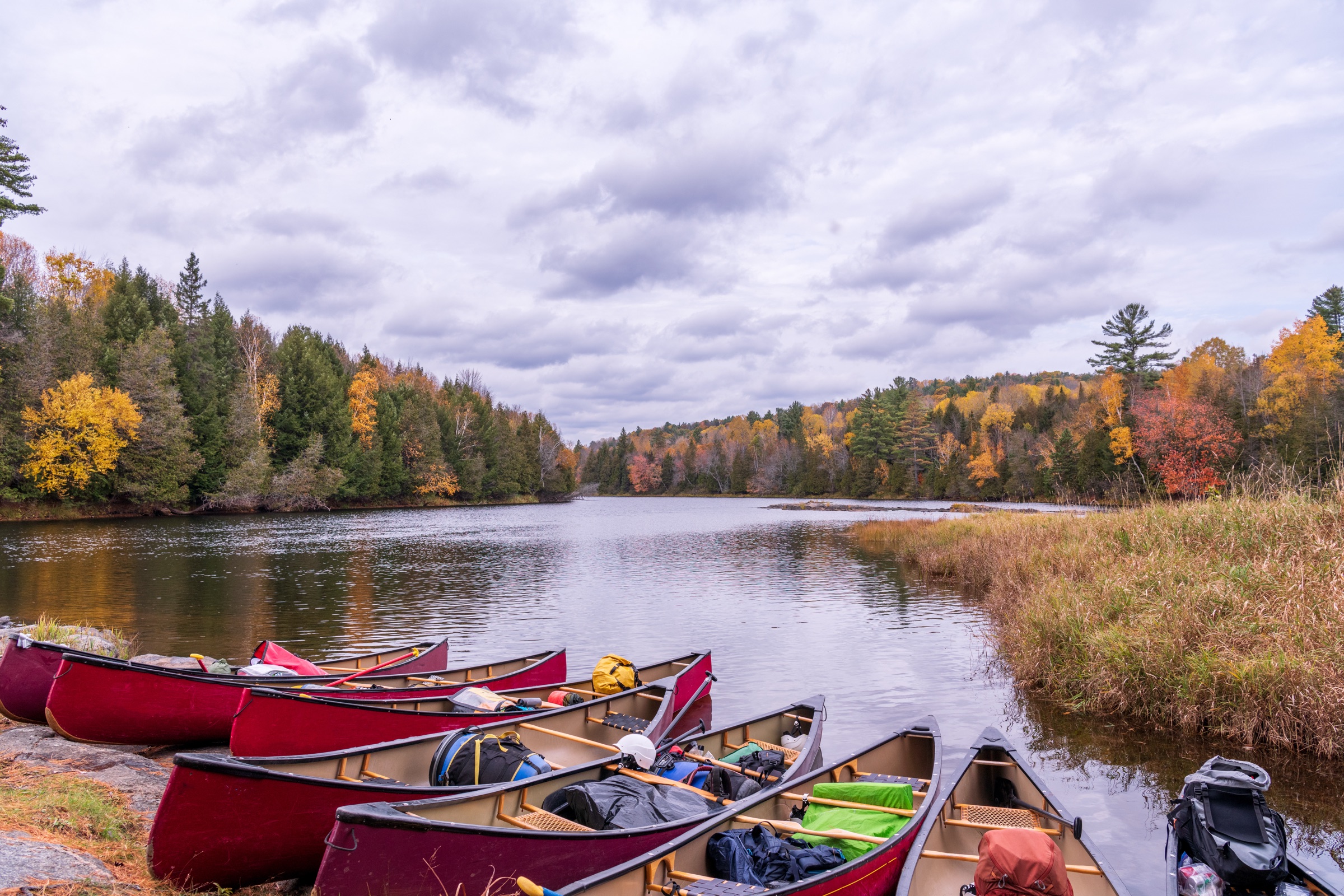
The group had driven through the night from the school at Claremont, northeast of Toronto, to a departure point 225 miles (360 km) to the south. They ate breakfast on the bank, loaded four brand-new 22-foot (7 m) wood-and-canvas canoes, each carrying between seven and eight people and all their gear, said a prayer and pushed off at 8:15 a.m. with the wind behind them. Lake Timiskaming runs about 80 miles (130 km) along the Ontario–Quebec border, and the plan was to follow it north toward the rivers that lead to Moosonee.
Canoe No. 1 was steered by Richard Bird, 29, the trip leader, a mathematics professor with five major trips behind him. Peter Cain, 27, a teacher who had been on five St. John’s canoe trips, steered No. 2. Mark Denny, 20, a university student and volunteer, steered No. 3. The fourth was steered by a 24-year-old teacher who had arrived from England a little over a year before. He had never steered a canoe, and he had been swimming for only two years.
They covered 17 miles (27 km) by noon and stopped on the Quebec shore for a 45-minute lunch. When they set off again at 1:05 p.m. the wind had picked up, and Bird led them across the lake toward the Ontario shore, about a mile (1.6 km) away, to travel in its shelter. The waves were about a foot (30 cm) high. Around 2 p.m. the fourth canoe was swung side-on to the waves and rolled over. Over the next hour every attempt to help capsized another boat, until all four crews were swimming.
Fifteen boys and three leaders reached the Ontario shore. Twelve boys and Mark Denny died, including all seven boys in the fourth canoe. The survivors spent the night in the rain at the foot of a cliff, with a few salvaged packs and no way to call for help. They were found by chance the next morning, when a helicopter pilot crossing the lake saw the overturned canoes, then the bodies. Here is how each part of that afternoon came about.
A fine morning on a long lake
Nothing about the morning looked dangerous. The temperature was heading for the mid-70s °F (mid-20s °C), and the tail wind was helping them along. The danger was the shape of the lake. A long, narrow lake lined up with the wind builds waves along its whole length. At noon a cottager on the Quebec shore, David Radway, saw the group go by, “making good time with a full following wind.” He and his neighbours knew what that wind could do:
“There was no sign of storm, but Radway and other lake dwellers knew that capricious Timiskaming can turn lethal if a strong wind whoops down its length. In minutes it can form waves that swamp large boats. Timiskaming claims relatively few lives only because, according to one man, ‘people are afraid of that lake!'”
Bird had researched the route for five days, carried detailed maps and phoned ahead about the river sections he expected to be hard. He did not phone anyone at Ville Marie, the town whose residents knew the lake best. The lake was expected to be an easy start, so easy that the planners had considered skipping it.
What to do instead. Treat the easy-looking part of a route with the same research as the hard part. Before any big open water, ask the people who live beside it how it behaves and what a wind from each direction does to it. On long lakes, the safe hours are usually early morning and evening, when the wind is lightest; plan crossings for those hours and stay close to shore through the middle of the day. Check the forecast for wind speed and direction, not only for rain, and make a go or no-go call at every crossing, not just at the launch. The full go or no-go process is in our canoe and kayak safety guide, and planning for conditions on a route is in our trip planning guide.
A steersman learning on the job
The fourth canoe had trouble holding its course all morning. Its steersman had worried aloud before the trip about his ability, and the other leaders had told him he would learn. That was how the St. John’s schools had always trained their leaders: pass on the essentials by word of mouth and let new people learn on the trip. On the crossing, the learning ran out:
“‘Port side, back paddle!’ he ordered. Port side struggled hard but the current was too strong. Steadily it forced their bow around until they lay parallel to the waves, as though locked at anchor. They sat helpless, bewildered. The canoe began to rock.”
A canoe lying side-on, or broadside, to the waves is the most likely to roll, because every wave lifts one side and drops the other. Holding the bow into the waves, or at an angle to them, takes steering strokes that have to be automatic before you need them. The leaders had also noticed that the wind “tended to swing the bows” of the new canoes, and a review of James Raffan’s 2002 history of the trip, Deep Waters, says the canoes had been built with extra freeboard, higher sides than standard, which gives the wind more hull to push on.
What to do instead. Put your strongest paddlers in the sterns, and do not take a group across open water with a steersman who cannot hold a heading in the conditions you expect. New steersmen learn on sheltered water, close to shore, in light wind. If one boat in a group is struggling, the group stays near shore or waits; it does not cross. If you ever find yourself broadside to building waves, keep everyone seated, still and centred, with nobody leaning out or reaching, and work the bow back toward the waves. On Timiskaming it was people shifting their weight, as much as the waves, that rolled two of the canoes.
Every rescue put another canoe over
The fourth canoe swamped and righted itself, and its crew clung to it, waiting for help. Help came, and it went wrong in the same way three times. Denny turned his canoe back toward them:
“But in the midst of the turn, a boy heavily shifted position to dodge a splash of water. The canoe wobbled, took water and . . . ‘Mr. Denny’s gone over!’ a boy shrilled in Thomson’s ear. The deadly chain reaction had begun — a fatal string of events, any one of which by itself would scarcely have rated a second thought.”
Bird and Cain did the sensible thing first: they paddled to shore, left their smallest boys and some baggage there, and came back lighter. They picked up five boys from Denny’s crew and took them ashore. Then, as Bird’s canoe took on Denny and his last two boys, it rolled too. Cain searched for the fourth canoe for nearly half an hour without finding it, came back exhausted to the nine swimmers around Bird’s canoe and threw them a line. Denny, by then badly chilled, began climbing into Cain’s canoe:
“‘Don’t take anybody in!’ warned Bird. ‘Just tow him ashore!’ Too late. Denny was already halfway in. Cain heaved him the rest of the way. Denny, his reflexes deadened from cold, half rose. ‘Sit down!’ yelled Cain. Denny did, but involuntarily began to stand again. The last canoe rolled over.”
Each rescue was a reasonable decision on its own. Together they turned one swamped canoe and eight people in the water into four swamped canoes and 13 people in the water, with no boat left to help any of them.
What to do instead. The rescue boat is the group’s lifeline, and your first job is to ensure it stays upright. In waves, an open canoe can rarely take a swimmer aboard over the side without risking a capsize, and a chilled swimmer cannot help with the balance. Have swimmers hold the stern or the side while you tow them, or get them to hold their own boat while you empty it with a canoe-over-canoe rescue, a skill every crew should have practised in warm water before the trip. Everyone in the rescue boat stays seated and still, and nobody shifts to dodge a splash. Count heads out loud the moment a boat goes over, so that nobody is searching for a crew that is already safe or missing one that is not.
Climbing in instead of hanging on
Several times that afternoon, a canoe that had been righted and partly bailed went over again because too many people tried to get into it at once. Cain’s crew managed to roll one canoe upright, and a strong boy climbed in and began to paddle it toward shore:
“If the others had clung to the side they might have made it. Instead, several tried to climb in. It rolled over again.”
What to do instead. A swamped canoe floats, and holding on to it costs far less energy and heat than swimming. One person climbs in to paddle or bail while the others hold the sides, spread around the boat, with their weight in the water. They take turns if they need to, one at a time. Every crew should agree on this on land, before the trip, because a cold, frightened person in the water will try to climb out of it.
Swimming for a shore that was too far
The fourth canoe’s crew had capsized about 270 yards (250 m) from shore. They tried to push the canoe in and could not make headway against the wind and current, so their steersman decided they should swim for it. He sent the two strongest boys first, then the others in turn, and set off last with the two smallest. None of the seven boys survived. He came to on the rocks with no memory of getting there.
“‘Try, try — you have to help yourself!’ Thomson pleaded. Todd Michell turned to help the smaller Kenny. But all were losing strength. They had been in the water perhaps 40 minutes. Thomson’s vision blurred. He felt sleepy. That was the last he remembered of being on the lake.”
Later, with 13 people in the water, the remaining swimmers were about 75 yards (70 m) from shore. Collins called it “an easy goal for fresh swimmers in calm warm weather. But they were tired, chilled to the bone and the wind and current were thwarting their attempts to reach shore.”
What to do instead. Stay with the boat unless the shore is a few strokes away, the boat is gone, or it is drifting toward something worse. Distance over water is badly underestimated, and cold water takes away your ability to swim long before it makes you unconscious. If you do leave the boat, go together and go early, while you still have the strength, rather than after half an hour of struggling to push it. Our cold-water immersion guide covers what to do in the water minute by minute.
The life jackets held them up, but not their heat
Everyone wore a life jacket, and the life jackets did their job: the next morning the pilot who found the first bodies saw “life jackets still holding the heads up.” What killed them was hypothermia, the steady loss of core body heat in cold water. Collins explains it in terms that are still correct:
“The least-understood peril of a boating accident is hypothermia — the swift numbing effect caused by the lowering of the body’s inner temperature. With a drop of only a few degrees the victim loses coördination and awareness of his surroundings. His speech and thoughts go awry. A child succumbs sooner than an adult. It was happening now.”
The air was warm and the sun was out, and one boy had taken his shirt off to get a tan. The water of a deep northern lake in mid-June was much colder than the air. The boys were small and lean, and they had been paddling hard since early morning. Some of them had been in the water for close to an hour by three o’clock. You can read the signs of hypothermia in the account: hands too weak to hold on, swimmers who stopped trying, a leader who “half rose” in a canoe without meaning to.
What to do instead. Dress for the temperature of the water, not the air. A life jacket keeps your head up; it does not keep you warm, and only getting out of the water does that. Plan every crossing around how long it would take to get a swimmer out, because in cold water you have about ten minutes of useful strength. Children, small adults and anyone already tired lose heat fastest. Once someone is out, treat them for hypothermia even if they say they are fine: get them out of the wind, out of wet clothes and insulated, as in our hypothermia guide.
Nobody knew they were in trouble
The 18 survivors spent the night on the Ontario shore under plastic sheeting, sharing sleeping bags two to a bag, with 30 pounds (14 kg) of granola and a box of candy between them. No one knew anything had gone wrong, and nobody expected to hear from the group for days. They laid out an “H” for help with life jackets and prepared to wait a week. They were found because a helicopter pilot happened to fly over the lake the next morning and notice two overturned canoes. It was mid-afternoon before anyone spotted the survivors.
What to do instead. Leave a written trip plan with someone at home: your route, your group, your campsites and a time by which you will check in, and what they should do if you do not. On remote water, carry a way to call for help that does not depend on someone happening to pass: a personal locator beacon or a satellite messenger, kept on a person, not in a pack in the boat. Our Leave Word tool builds the trip plan and sends it to your contact, and signaling for rescue covers being seen once help is looking.
Tired before the first stroke
The group had driven through the night and started paddling at 8:15 the next morning after little or no sleep. None of them had paddled since the previous August, and there had been no training paddles before the trip. Bird had not slept at all the night before, and in the water he felt his strength going. Fatigue did not tip the first canoe over, but it shortens every margin afterwards: the strength to hold a heading, the strength to hold on, the clear thinking to stop a rescue going wrong.
What to do instead. Start a trip rested, and make the first day short and sheltered. Put the hardest open water later in the trip, once the group has its paddling legs and you have seen how each boat handles. If the plan only works with an overnight drive and a full day on the water, change the plan.
The inquest’s findings, as a checklist
The Quebec coroner, Stanislas Déry, held an inquest at Ville Marie in late June. He found nothing in the evidence to support a criminal charge against anyone, but he called the trip “an exaggerated and pointless challenge” and made 15 findings about how it had been prepared and run. Collins lists nine of them. James Raffan, the author of Deep Waters, gives all 15 in his booklet for trip leaders, Wilderness Crisis Management (PDF), each paired with the risk it overlooked. His reading of them matches the chain in this guide: no one of them would have decided the outcome on its own, and it was the combination that made a disaster close to inevitable. Here they are in the coroner’s order, each followed by the question it raises for any group before a trip:
- No chain of command arranged in advance. Who is in charge if something goes wrong, and who takes over if that person is in the water?
- No means of communication between the canoes. How will the boats keep in sight of each other and signal for help, and where do they regroup?
- No means of communication with the outside. Can we call for help from anywhere on the route, and who is expecting to hear from us?
- No advance route planning. Do we know where we can land and camp along each stretch, including the first day’s?
- No prior knowledge of the country. Have we learned how each section behaves, including the easy-looking parts, from people who know it?
- No emergency plan. Has everyone agreed, on land, what each person does if a boat goes over?
- No medicals before the trip. Has everyone had a medical check, and do the leaders know about any conditions?
- No physical training for the trip. Is everyone fit enough for the distances we plan?
- No one practised paddling directly before the trip. Has every crew paddled together, in these boats, before the trip?
- Little sleep the night before. Will we start rested?
- Pre-trip meals not substantial. Will everyone start the day well fed, with enough food at hand to keep going?
- One steersman of questionable competence. Can every steersman hold a heading in the conditions we expect?
- Bow paddlers not specially trained. Do the bow paddlers know their job, including bracing and calling hazards?
- No rescue equipment. Do we carry throw lines and whatever else a rescue on this water needs?
- Many did not know how to swim. Do we know that everyone can swim, in clothes and a life jacket?
The coroner said many of the boys could not swim. In fact every boy on the trip could, but the school had never checked. That is the point of the list: it is not enough to believe the answers are yes.
How the families responded
None of the bereaved families sued the school. The Crofts and the Kennys were both asked by lawyer acquaintances whether they wanted to:
“‘For what?’ demanded Jean Croft. ‘For the happiest year of our son’s life?'”
Before their son Simon’s funeral, Peter and Jean Croft confirmed their younger son’s place for the fall. Jack and Sheena Suttaby decided on the drive to the school that night, before they knew whether their son Christopher had survived, to enrol his younger brother the next year. Gordon and Janice Black, whose son Owen died, sent back his surviving brother and enrolled another son as well. Parents and teachers also rejected the coroner’s description of the trip as pointless. “Our boy was going to St. John’s for the very thing that cost him his life,” Barrie Nelson’s father told Collins. When the 1978–79 school year began, the school had more students booked than ever, and all but two of the surviving boys had come back. Those two had planned to leave before the accident.
Later retrospectives were much harsher. James Raffan’s 2002 history, Deep Waters, written more than two decades later, blames inexperience and poor planning, and its reviewers read it as concluding that the deaths were no accident. Both accounts can be true at once. The families who knew the school best stood by it, and the inquest still found the planning failures listed above. For a paddler today, the lesson does not depend on which view you take: those failures were fixable, and the school fixed them.
What the school changed
The school, in Collins’ words, “soberly set about mending its ways.” That summer, teacher Mike Maunder, compiled a 120-page handbook on planning and running canoe trips, addressing every deficiency the coroner raised. From then on:
- Every expedition was preceded by a training camp with lectures and tests on cold water and hypothermia, mouth-to-mouth resuscitation, at least ten hours of paddling and at least two practice capsizes.
- Every boy had to pass a swim test: 100 metres (110 yards) in a bathing suit and 50 metres (55 yards) in clothes and a life jacket.
- Every canoe carried an inflatable life raft.
- Steersmen were trained to call “Kneel!” at the first hint of trouble, lowering everyone’s weight and making the canoe much harder to tip.
- Steersmen had to pass a written test, hold a first aid certificate, be trained in lifesaving and have at least 50 days of paddling experience, some of it in the bow. Bow paddlers needed written and practical tests, 25 days of experience and a minimum age of 16.
- Groups carried more adults: the next autumn’s trip for new boys took one adult for every two boys.
None of these rules is unusual today. Most of them are what any good canoe club or outfitter now expects. In 1978 they were missing, and each one matches a link in the chain above.
Key takeaways
Nothing on Lake Timiskaming that afternoon was extraordinary: a warm day, a building wind, waves about a foot (30 cm) high, an inexperienced steersman and a group that had not practised rescues. Respect long lakes and research the easy parts of a route. Put experience in the sterns and keep new steersmen on sheltered water. Keep the rescue boat upright, keep everyone in it seated and still, and do not haul swimmers into an open canoe in waves. Hold on to a swamped boat rather than climbing into it or swimming away from it. Dress for the water, and plan every crossing around how long you could survive in it. Leave a trip plan, carry a way to call for help, and start rested. Then check, rather than assume, that every person in the group can do what the plan needs them to do.
The account and the quoted passages are from Robert Collins, “God Can Bring Good Out of It,” Reader’s Digest (Canadian edition), vol. 114, February 1979, pp. 184–210; read the full article (PDF), hosted by a former student of the school. For a fuller history of the trip and the school, see James Raffan, Deep Waters: Courage, Character and the Lake Timiskaming Canoeing Tragedy (HarperCollins, 2002). The coroner’s 15 findings are as listed in James Raffan, Wilderness Crisis Management; read the booklet (PDF).
Wilderness Experts is reader-supported. As an Amazon Associate we earn from qualifying purchases; when you buy through links on our site we may earn a commission at no extra cost to you. It never changes what we recommend.