
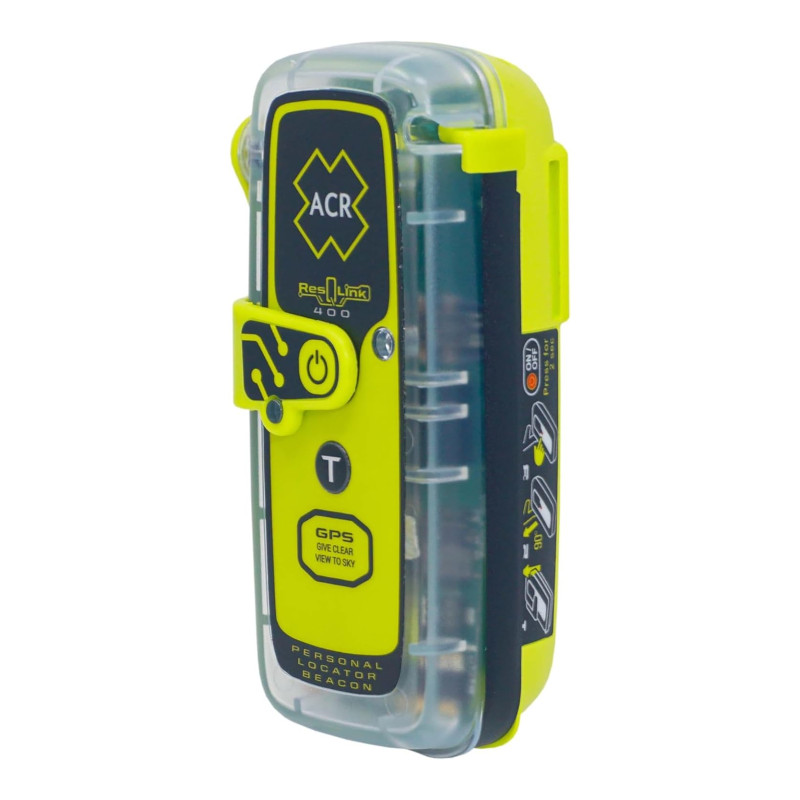
ACR ResQLink 400 review: the subscription-free rescue beacon
When your life is on the line in a remote place, you want the most dependable way to summon rescue, one with no monthly fee to lapse, no messaging to fumble, just a single button wired to the world’s government search-and-rescue satellites. That is exactly what a personal locator beacon is, and the ACR ResQLink 400 is the one serious backcountry travellers trust.
Quick take
The purest, most robust way to call for rescue. No subscription, ever, deploy the antenna, press the button, and a powerful 406 MHz distress signal goes to the government Cospas-Sarsat satellite network that coordinates search and rescue worldwide. It only does one thing, send an SOS, with no two-way messaging or check-ins. But for the expedition traveller who wants the single most dependable emergency beacon and no ongoing fees, it is the gold standard.
What it does
The ResQLink 400 is a personal locator beacon (PLB): a dedicated, one-way emergency distress device. When you deploy the antenna and activate it, it broadcasts a powerful 406 MHz distress signal with your GPS position to the international Cospas-Sarsat / MEOSAR satellite system. The same government-run network that coordinates search and rescue for aircraft and ships, so rescuers are alerted and your location pinpointed anywhere on the globe. A secondary 121.5 MHz homing signal guides rescuers the final distance, and built-in LED and infrared strobes make you visible at night and to aircraft. Crucially, it requires no subscription and no ongoing fees: you register it once (free) with your national authority and it is ready for years. It is compact, buoyant-capable in the View variant, and built to survive abuse.
What verified buyers say
Verified-purchase owners, many of them remote hunters, mariners, and expedition hikers, emphasize:
- No subscription is the draw. The dominant theme: buy it once, register it, and carry it for years with no recurring fees.
- Trusted for real emergencies. Owners value that it uses the government SAR satellite system built for life-or-death alerts.
- Rugged and compact. Reviewers note the tough, simple build and that it clips easily to a pack or PFD.
- Set-and-forget peace of mind. Buyers like that it sits ready with no apps or charging routine, just a long-life battery.
Worth knowing
A PLB does one thing: send an SOS. There is no two-way messaging, no “I’m running late” check-in, and no way for rescuers to ask about your situation, so you cannot convey details or cancel easily once activated, and you get no confirmation help is coming. If you want conversation and non-emergency messaging, a satellite communicator is the better tool (many people carry both). You must register the beacon (free) with your country’s authority, and you need a clear view of the sky to transmit. The sealed battery lasts years but eventually needs professional replacement. Activate it only in genuine life-threatening emergencies.
Who it is for
The ResQLink 400 is for the serious, remote traveller who wants the most robust, no-nonsense rescue signal and refuses ongoing fees: expedition hikers, backcountry hunters, mountaineers, sailors, and bush pilots. If you also want two-way messaging, check-ins, and to keep family updated, choose a satellite communicator instead, or carry both, the beacon as your ultimate fail-safe. It is overkill for casual trips near help, where a phone and a whistle suffice.
Specs at a glance
Type: personal locator beacon (one-way SOS) · Network: 406 MHz Cospas-Sarsat / MEOSAR (government SAR) · Subscription: none required (free registration) · Extras: GPS, 121.5 MHz homing, LED + IR strobe · Best for: remote/expedition travellers wanting the most dependable rescue signal
Wilderness Experts is reader-supported. As an Amazon Associate we earn from qualifying purchases; when you buy through links on our site we may earn a commission at no extra cost to you. It never changes what we recommend.
The Verdict
The ACR ResQLink 400 is the most dependable, fee-free way to call for rescue when it truly matters, a rugged one-button beacon on the government SAR network, ready for years with no subscription. Accept that it only sends an SOS, and it is the ultimate backcountry fail-safe. Want two-way messaging and check-ins as well? See the Garmin inReach Mini 2 and SPOT X , and never leave behind the simplest signals of all, an emergency whistle and mirror.