
Ticks and Lyme disease: how to avoid bites, remove a tick and know when to see a doctor
Canada recorded 4,785 cases of Lyme disease in 2023, 5,809 in 2024 and, in the preliminary count, 7,105 in 2025. In the United States, more than 80,000 cases are reported each year, and an estimate based on insurance records puts the number of people diagnosed and treated at about 476,000. The blacklegged tick that carries it keeps moving north into new parts of Ontario, Quebec and the Maritimes. A tick bite is now a normal risk of a summer hike across much of eastern North America, and for most people the whole defence is an evening tick check and a pair of tweezers.
This guide covers where and when ticks bite, which ticks carry which diseases, how to keep them off you, how to check for them and remove one properly, what to watch for afterwards, and when to see a doctor. Ticks also appear briefly in snakes, spiders and stinging insects, alongside the other small creatures that bite and sting. Mosquitoes, black flies and other biting flies are covered in mosquitoes, black flies and other biting bugs.
Check every evening, remove it the same day
In most cases a tick must be attached for more than 24 hours before it can pass on the bacterium that causes Lyme disease. A thorough tick check every evening of a trip, and a tick removed the day you find it, prevent most infections.
Where and when ticks bite
In the United States, Lyme disease is most common in the Northeast, the mid-Atlantic states and the upper Midwest, which takes in parks such as Acadia and Shenandoah. The western blacklegged tick carries it along the Pacific coast, particularly in northern California. Other ticks, and the other diseases they carry, reach most of the country.
In Canada, the Public Health Agency of Canada names risk areas in southern British Columbia, Ontario, Quebec and the Maritimes. All of Nova Scotia is a risk area, so a trip to Kejimkujik or anywhere else in the province is a trip in tick country. The risk areas grow most years as the blacklegged tick spreads north, so check your provincial map before a trip rather than relying on last year’s.
Ticks do not disappear with the end of summer. The Canadian government’s guidance is that ticks can be active whenever the temperature is consistently above freezing and the ground is not covered by snow. Late spring and early summer bring the most bites, because the nymphs, the young stage, are out then and are small enough to go unnoticed. Adults are active in the fall, on mild winter days and again in early spring, which catches hunters, late-season hikers and anyone who thought tick season was over.
Which ticks carry what
Several kinds of tick bite people in North America, and they carry different diseases. You do not need to identify a tick to remove it, but knowing which ones live where you hike tells you what to watch for afterwards. These are the ones that matter most, as the US Centers for Disease Control and Prevention (CDC) lists them.
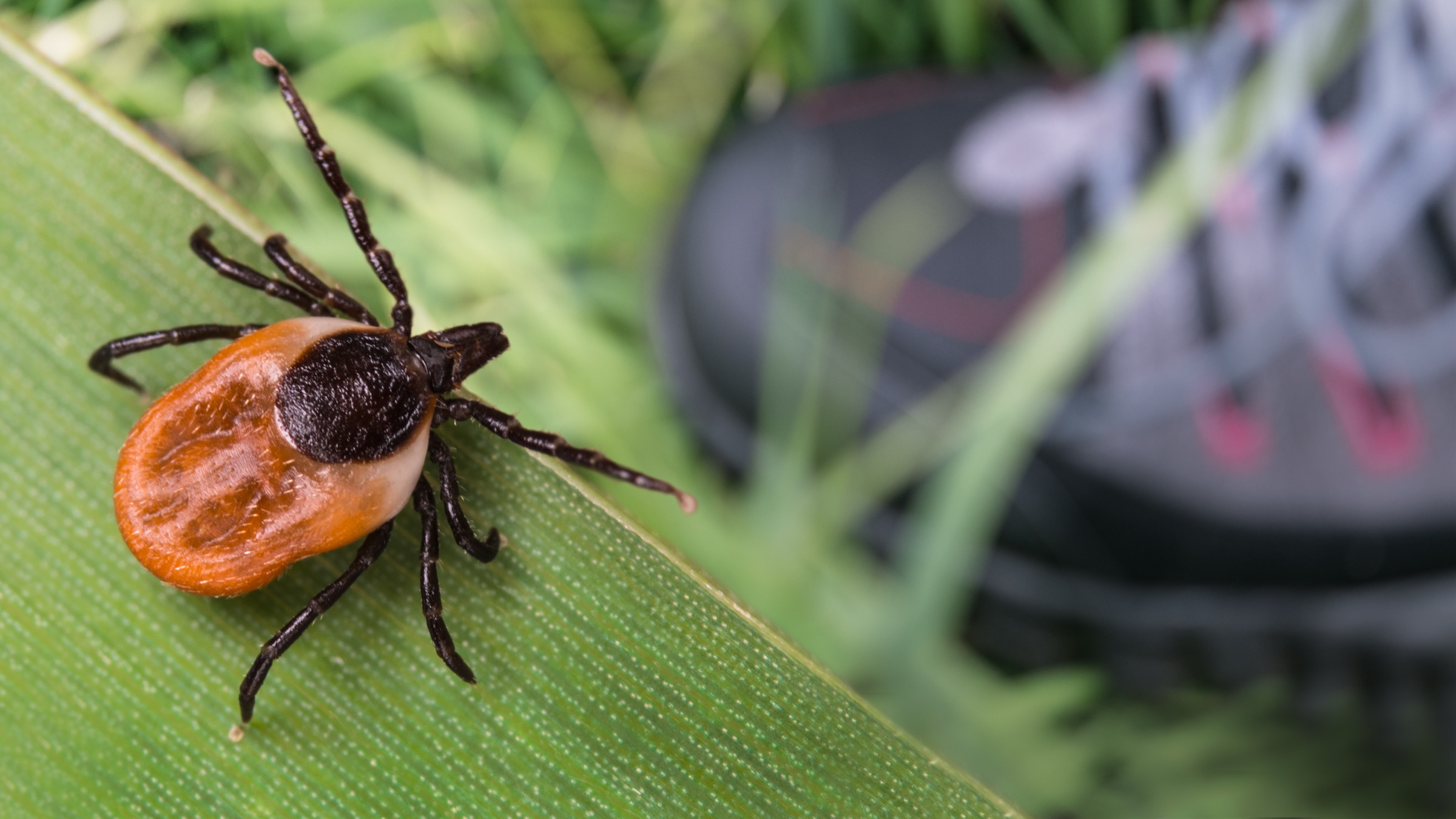
- Blacklegged tick, or deer tick. Widespread across the eastern United States, and the species spreading through eastern Canada. It carries Lyme disease, anaplasmosis, babesiosis, Powassan virus and a few rarer infections. The nymph is about the size of a poppy seed.
- Western blacklegged tick. Along the Pacific coast, including southern British Columbia. It carries Lyme disease and anaplasmosis, among others.
- Lone star tick. Widespread in the South, the Midwest and the Northeast of the United States. It carries ehrlichiosis, tularemia and Heartland virus, and it is the tick most often linked to alpha-gal syndrome, described below. It does not spread Lyme disease.
- American dog tick. Widespread east of the Rocky Mountains, with a related species in the West. It carries Rocky Mountain spotted fever and tularemia.
- Rocky Mountain wood tick. In the Rocky Mountain states and southwestern Canada, between about 4,000 and 10,500 feet (1,200 and 3,200 m), which takes in much of Rocky Mountain National Park and the valleys of Banff. It carries Rocky Mountain spotted fever, Colorado tick fever and tularemia.
- Gulf Coast tick and brown dog tick. The Gulf Coast tick lives mainly in the southeastern United States; the brown dog tick is found everywhere and carries Rocky Mountain spotted fever in the Southwest and along the Mexican border.
Alpha-gal syndrome
A bite from a lone star tick can leave a person allergic to red meat and to other products made from mammals. The CDC calls alpha-gal syndrome a serious, potentially life-threatening allergy. The reaction comes hours after a meal of beef, pork or venison rather than minutes, which is why it is so often missed: hives, stomach pain, nausea, swelling or trouble breathing in the middle of the night, with no obvious cause. More than 110,000 suspected cases were identified in the United States between 2010 and 2022, and the CDC estimates the true number may be as high as 450,000. Anyone who hikes in lone star country and develops a reaction like this should tell their doctor about tick bites.
How a tick gets onto you
Ticks wait on the tips of grass, low shrubs and leaf litter, with their front legs held out, and climb onto anything that brushes past. A tick picked up at the ankle then walks upward, often for some time, before it settles somewhere warm and hidden to feed. Two things follow from that. Most ticks are picked up below the knee, in long grass, brush and the leaf litter at the edge of a trail. And there is usually a window, between the moment a tick climbs on and the moment it bites, in which a tucked-in sock, treated clothing or a quick check will stop it.
The bite itself is painless, and a feeding nymph is about the size of a poppy seed, which is why so many people with Lyme disease never knew they were bitten.
Before the trip: clothing and repellent
Treated clothing
Permethrin is an insecticide applied to clothing, not to skin. Ticks that crawl onto treated fabric are disabled before they reach skin. The CDC recommends treating clothing and gear with a product containing 0.5 percent permethrin, or buying clothing that has been treated at the factory. Treatment you apply yourself lasts through a limited number of washes, so read the label and re-treat as it says; factory-treated clothing gives its own figure on the label. Permethrin is very toxic to cats while it is wet, so keep cats away while you treat clothing and until it has dried.
In Canada, permethrin sprays for treating your own clothing are not approved. Factory-treated clothing that carries a Health Canada Pest Control Product (PCP) number on its label is approved, for people over 16.
Repellent on skin
Use a registered repellent on exposed skin. The CDC lists DEET, picaridin (called icaridin in Canada), IR3535, oil of lemon eucalyptus, para-menthane-diol (PMD) and 2-undecanone. In the United States, look for an EPA registration number on the label; in Canada, a PCP number. The US Environmental Protection Agency’s data show DEET repelling ticks for about two to ten hours, depending on the strength.
Canada sets limits for children. Health Canada allows DEET up to 30 percent for adults and children over 12, and up to 10 percent for children aged 2 to 12 (up to three times a day). For children from 6 months to 2 years it allows up to 10 percent, applied no more than once a day, and no DEET at all for infants under 6 months. Icaridin is not for infants under 6 months, and products with oil of lemon eucalyptus or PMD are not for children under 3. The full rules, and how to use repellent with sunscreen, are in our guide to biting bugs.
What to wear
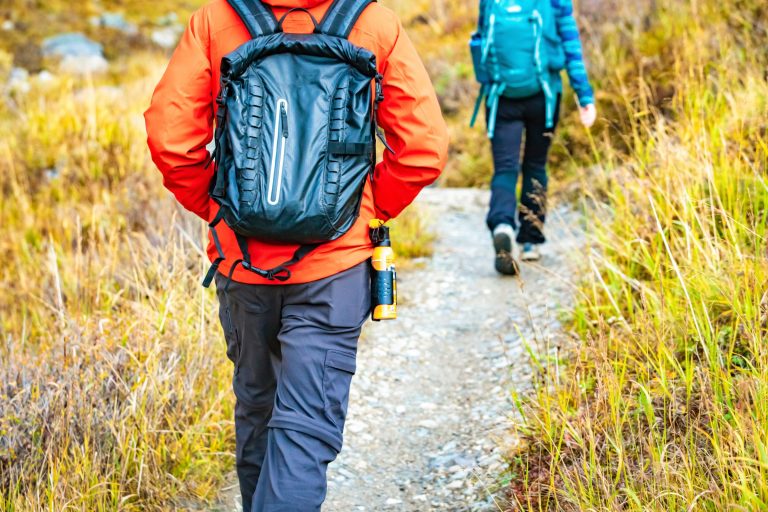
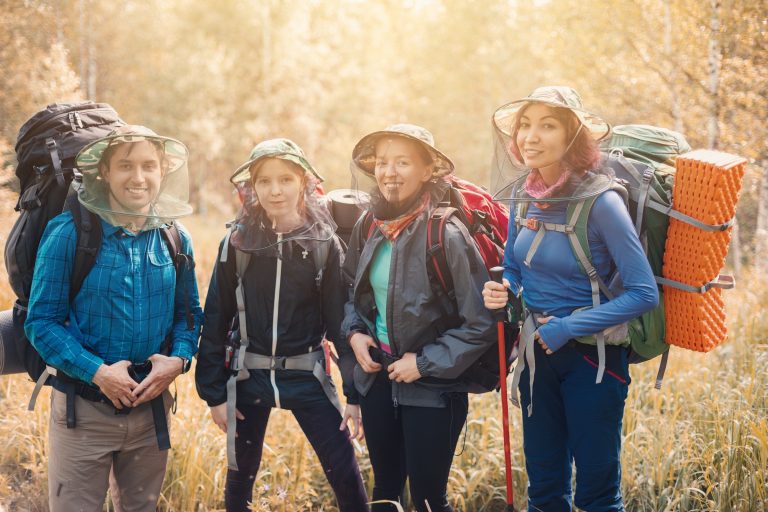
Long trousers tucked into socks, and a long-sleeved shirt tucked into the trousers, give a tick a long walk across fabric before it reaches skin. Light colours make ticks easier to see. A crew-height hiking sock such as the Smartwool Hike Light Cushion Crew (men’s / women’s) is tall enough to hold a tucked trouser cuff in place. The rest of the clothing system is in what to wear in the bush.
On the trail
- Walk in the middle of the trail. Most ticks are waiting in the grass and brush at its edges.
- Do not sit or lie in long grass or leaf litter. Take breaks on rock, a log, a bare patch of ground or a sit pad.
- Glance at your legs at every stop. A tick crawling up a light-coloured trouser leg is easy to flick off before it bites.
- Keep your pack off the ground cover. Set it on rock or bare earth, or hang it.
- Check your dog. Dogs bring ticks into tents and cars, and they need their own tick prevention, which your vet can advise on.
The tick check
The check is the most important part of this guide. Do it every evening of a trip, after any walk through grass or brush, and again when you get home.
Ticks settle in warm, hidden places. The CDC lists the places to check: under the arms, in and around the ears, inside the belly button, behind the knees, in and around the hair, between the legs and around the waist. Use a mirror, or check each other. Feel as well as look: a feeding nymph can feel like a tiny scab. Check children carefully, especially the hairline and behind the ears.
At home, two more steps help. Showering within two hours of coming indoors has been shown to reduce the risk of Lyme disease, and it may wash off ticks that have not yet attached. Tumble-dry your hiking clothes on high heat for 10 minutes to kill any ticks on them, longer if the clothes are damp. If the clothes need washing first, use hot water: cold and medium temperatures do not kill ticks.
Removing a tick
Take the tick off as soon as you find it. Do not wait to reach a clinic.
- Use clean, fine-tipped tweezers. If you have none, ordinary tweezers or your fingers will do.
- Grip the tick as close to the skin as you can, by its head and mouthparts, without squeezing its body.
- Pull it straight out with slow, steady pressure. Do not twist or jerk it.
- If the mouthparts break off, remove them with the tweezers if that is easy. If it is not, leave them alone; the skin will push them out as it heals.
- Clean the bite and your hands with soap and water, rubbing alcohol or hand sanitizer.
- Write down the date and where you were. A doctor will ask both if you become ill.
Do not use heat, a match, nail polish, petroleum jelly, essential oils or anything else to make the tick let go. These irritate the tick, and the CDC warns they can force infected fluid from the tick into the skin.
What to do with the tick depends on where you are. The CDC suggests sealing it in a container or in tape, putting it in alcohol, or flushing it. Canada’s guidance is to photograph it and submit the photo to an identification service such as eTick, and to keep it in a sealed bag or pill bottle if you are going to see a doctor. Either way, do not crush it with your fingers.
After a bite: what to watch for
Watch the bite and your health for the next month. The CDC describes the early signs of Lyme disease as appearing 3 to 30 days after the bite.
- The rash, erythema migrans. It appears in about 70 to 80 percent of infected people, at the site of the bite, after about 7 days on average. It expands slowly over several days and can reach 12 inches (30 cm) or more across. It may feel warm, but it is rarely itchy or painful. Sometimes it clears in the middle as it grows and looks like a target, but often it does not, and a solid red patch counts too. Canada’s guidance describes it as growing to more than 2 inches (5 cm) across over several days.
- Flu-like illness, with or without a rash. Fever, chills, headache, fatigue, muscle and joint aches and swollen lymph nodes.
A small red bump that appears at the bite within a day or two and fades is usually a reaction to the bite itself, not infection. A rash that keeps growing is not.
See a doctor if a spreading rash or a fever develops within a few weeks of a tick bite, and say that you were bitten, when, and where. Lyme disease caught early is treated with a course of antibiotics. Left untreated, it can spread to the joints, the heart and the nervous system, with severe headaches and neck stiffness, more rashes elsewhere on the body, drooping on one side of the face, arthritis with painful swelling (most often in the knees), an irregular heartbeat, and nerve pain, numbness or tingling. Other tick-borne diseases have their own signs, and Rocky Mountain spotted fever in particular can become serious quickly, so treat any fever after a tick bite as a reason to see a doctor, not to wait.
On a long trip
If a fever, a spreading rash or a drooping face appears days into a backcountry trip, plan your exit. These are not emergencies in the first hour, but they are a reason to get to a doctor within days, not at the end of a three-week trip.
The single antibiotic dose after a bite
A single dose of the antibiotic doxycycline, taken soon after a high-risk bite, lowers the chance of Lyme disease. It needs a prescription, and it is not for every bite. The CDC’s guidance to doctors weighs these questions:
- Did the bite happen where Lyme disease is common?
- Was the tick removed within the last 72 hours?
- Was the tick swollen with blood? A flat tick is unlikely to have passed on the infection.
- Was it a blacklegged tick, or could it have been? A tick that cannot be identified still counts.
- Is doxycycline safe for this person? The CDC says it is safe for people of all ages, including young children, but allergy, pregnancy and breastfeeding need a doctor’s judgement.
In Canada, the guidance says only that a health care provider can consider preventive treatment after a tick bite. The practical point is the same on both sides of the border: if you pull a swollen tick off yourself or a child in a Lyme risk area, call a doctor or a nurse line within the 72 hours, with the tick or a photo of it if you can.
Common mistakes
- Waiting to get home to check. A tick attached on the first morning of a weekend trip has had time to transmit by Sunday night. Check every evening in camp, using a headlamp and a partner.
- Checking only the places you can see. Ticks settle in the hairline, behind the ears, behind the knees and around the waistband. Feel through the hair with your fingertips, and use a mirror or a partner for the rest.
- Burning or smothering the tick. Heat, nail polish and petroleum jelly irritate the tick and can push infected fluid into the bite. Use tweezers and a steady straight pull.
- Waiting for a bull’s-eye. Many Lyme rashes are a solid, spreading red patch with no ring. See a doctor about any rash at a bite that keeps growing over several days, or any fever after a bite.
- Assuming the season is over. Adult blacklegged ticks are active in the fall and on mild winter days. Keep the evening check going on any trip when the ground is not frozen or snow-covered.
- Treating skin with permethrin. It is made for fabric and does not work as a skin repellent. Put permethrin on clothing and gear, and a skin repellent such as DEET or picaridin on skin.
- Forgetting the tick on the pack or the dog. Ticks ride home on gear and pets and bite later. Inspect both before they go into the tent or the car, and dry the clothes on high heat when you get home.
What to carry
- Fine-tipped tweezers or a tick-removal tool, in the first-aid kit and not buried at the bottom of it. The Surviveware Small and the My Medic MYFAK Large both include a pair; add one to any kit that does not.
- Repellent with DEET, picaridin or another registered active ingredient, at a strength suited to the youngest person in the group.
- Treated clothing where it is available to you, or long trousers, a long-sleeved shirt and tall socks in a light colour.
- A small mirror for checking where you cannot see. A signal mirror from your survival kit does the job.
- A small zip bag or pill bottle for a tick you want a doctor to see, and a pen to note the date.
- A headlamp for the evening check, such as the Black Diamond Spot 400.
Key takeaways
Ticks are now a normal part of hiking across much of the eastern United States, the West Coast and southern Canada, and the risk area grows most years. They are active whenever the ground is not frozen or under snow, with the most bites in late spring and early summer, when the poppy-seed-sized nymphs are out.
Keep them off with treated clothing where it is available, repellent on skin, trousers tucked into socks, and the middle of the trail. Check your whole body every evening, including the hairline, ears, armpits, waist, groin and backs of the knees, because a tick removed within a day rarely passes on Lyme disease. Pull it straight out with fine tweezers and nothing else, clean the bite, and note the date and place. If you pull a swollen blacklegged tick off someone in a Lyme risk area, call a doctor within 72 hours about a single preventive dose. For the next month, see a doctor about any spreading rash or any fever, and say you were bitten.
Tick species and the diseases they carry, the time a tick must be attached to transmit Lyme disease, US case figures, the signs and symptoms of Lyme disease, alpha-gal syndrome, tick removal, the tick check, showering and drying clothes, permethrin and the list of repellents follow the US Centers for Disease Control and Prevention; the questions for a single preventive dose of doxycycline follow the CDC’s guidance to clinicians. Canadian case counts, risk areas, tick activity, tick removal and preventive treatment follow the Public Health Agency of Canada. Repellent limits for children follow Health Canada, and permethrin rules in Canada follow the Public Health Agency of Canada; repellent duration follows the US Environmental Protection Agency. This is general education and not a substitute for advice from a doctor.
Wilderness Experts is reader-supported. As an Amazon Associate we earn from qualifying purchases; when you buy through links on our site we may earn a commission at no extra cost to you. It never changes what we recommend.