
Wildlife photography at a safe distance: lenses, seasons and the rules in the parks
Between May and July 2015, five people were injured by bison in Yellowstone. Three of them were taking photographs, from 3 to 6 feet (1 to 2 m) away, and two of those had turned their backs on the animal to get it into the frame. Every one of the five was closer than the park’s required distance of 25 yards (23 m). When the US Centers for Disease Control and Prevention looked at the cases, it compared them with 1980 to 1999, when photography was part of 10 of 35 bison encounters and most of the people hurt had been at least 10 feet (3 m) away, and it pointed to phone cameras and selfies as part of the reason people were getting closer.
Wildlife is one of the main reasons people carry a camera into the parks, and the best wildlife photographs are made from a distance the animal accepts. This guide covers the distances the parks require, how much lens it takes to work from them, reading an animal’s warning signs, the seasons when the rules tighten, photographing from the road, why baiting, calling and drones are out, and staying safe while your attention is on the viewfinder. The response to each species once an encounter goes wrong is in avoiding and handling wildlife encounters. Getting to and from a dawn or dusk location safely is in photographing alone at dawn and dusk.
If you make it move, you are too close
Keep at least 100 yards (91 m) from bears, wolves and cougars, and at least 25 yards (23 m) from all other large animals, more in Canada’s national parks and Alaska. If an animal stops feeding, looks at you, or moves because of you, back away, whatever the distance.
The distances the parks require
The minimums differ between the United States and Canada, and between parks. Where a park sets a distance, it is a rule, not advice.
US national parks
Yellowstone asks visitors to stay at least 100 yards (91 m) from bears, wolves and cougars, and at least 25 yards (23 m) from all other animals, bison and elk included. If an animal moves closer to you, the park’s instruction is to back away to keep the distance. Rocky Mountain National Park uses the same 25 yards, described as about two bus lengths, for elk and bighorn sheep.
Denali goes further for bears: at least 300 yards (275 m), and 25 yards (23 m) from all other animals, dens and nests. If a bear comes within 25 yards (23 m) of you while you are beside a vehicle, get in it.
Canada’s national parks
Parks Canada’s distances are larger for hoofed animals and include coyotes with the large carnivores. In Banff, they are 100 m (110 yards), about ten bus lengths, from bears, wolves, cougars and coyotes, and 30 m (33 yards), about three bus lengths, from deer, elk, sheep and moose. Jasper has set the same distances as a legal requirement by park order, adding caribou and mountain goats to the 30 m group, with an exception for people who stay completely inside a legally parked vehicle. Parks Canada’s own test is simple: if you make them move, you are too close.
Everywhere else
Outside the parks, use the same numbers. They are minimums for an animal that is calm and aware of you, not a line to walk up to. A sow with cubs, an animal on a carcass, a bull in the rut or any animal that has nowhere to go needs much more room.
Lenses: let the glass close the gap
At these distances, the lens decides what kind of photograph you can make. The width of the scene in the frame is easy to work out: on a full-frame camera, it is the distance multiplied by 36 and divided by the focal length in millimetres.
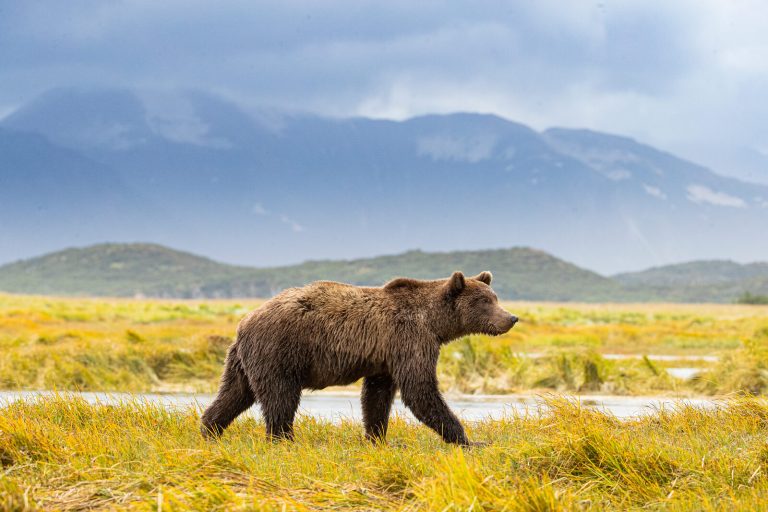
- At 100 yards (91 m), with a 600 mm lens, the frame takes in a strip about 18 feet (5.5 m) wide. That is room for a bear in its surroundings, which is often the better photograph. A tight portrait needs more lens, a teleconverter, or a crop.
- At 100 yards (91 m), with a 400 mm lens, the strip is about 27 feet (8.2 m) wide.
- At 25 yards (23 m), with a 400 mm lens, it is about 7 feet (2.1 m) wide: tight enough for a head-and-shoulders portrait of an elk or a bison.
- At 100 yards (91 m), with a phone’s 5x lens, which on recent phones is about 120 mm in full-frame terms, the strip is about 90 feet (27 m) wide, and a bear is a small shape in a landscape.
A camera with a smaller APS-C sensor shows a narrower view with the same lens, about as if the lens were 1.5 times longer (1.6 on Canon), which is why it is a popular choice for wildlife. A long zoom in the 100 to 400 mm or 150 to 600 mm range, on either kind of camera, covers most wildlife work, and long lenses can be rented for a trip.
The phone figure is the useful one to remember. A phone is not a wildlife camera at park distances. With a phone, photograph the animal in its place, the bison in the valley or the bear on the far slope, and let the photograph be about that, instead of walking closer to fill the frame.
Use a support, not your feet
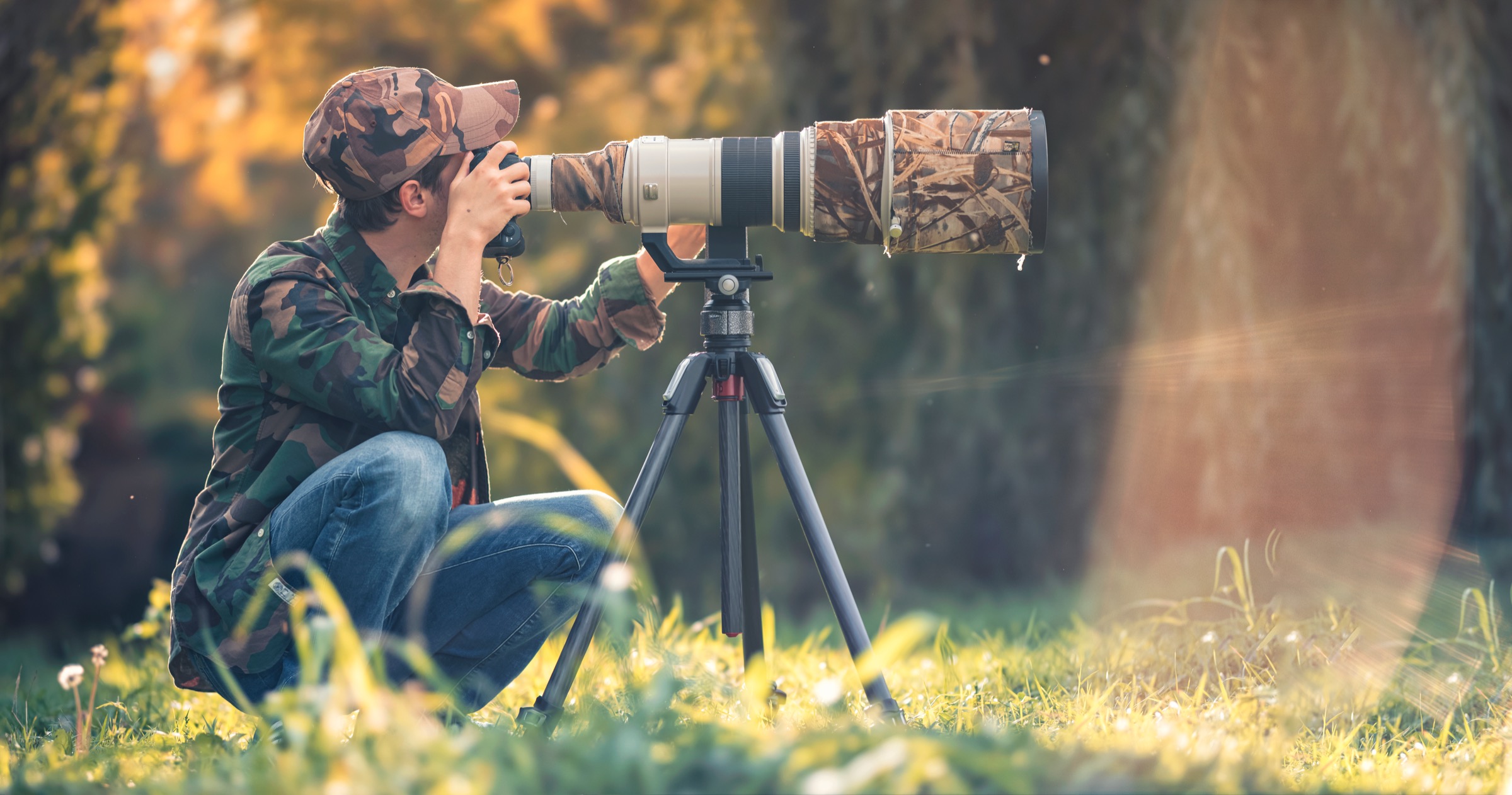
A long lens magnifies shake as well as the subject. A monopod, a beanbag on a car window or a trekking pole held against the lens gives a sharper photograph than walking closer for a shorter lens. A pole such as the Black Diamond Trail works as a monopod in a pinch.
Reading the animal
Animals show stress before they act on it, and a photographer watching through a long lens is better placed than anyone to see it. Look at the whole animal, not just the eye you are focusing on.
- Any animal. It stops feeding, lifts its head, turns to face you, or moves away. You are too close. Back off until it goes back to what it was doing.
- Bison. Yellowstone lists the signs: head bobbing while staring at you, pawing, bellowing, or a raised tail. Leave now, and do not turn your back to keep shooting.
- Moose. Raised hackles on the hump, ears laid back, and licking of the lips. A long lens may show you these signs from a safe distance; if you can see them without one, you are far too close.
- Elk. Bulls in the fall rut charge people and cars that come too close, and cows in spring defend calves hidden in the grass nearby. An elk that turns toward you or comes toward you is the cue to put a car or a large tree between you.
- Bears. A bear that stops feeding to watch you, huffs, pops its jaws or swats the ground is stressed. Back away. The response if it comes toward you is in meeting a bear that has seen you.
The seasons when the rules tighten
The most photogenic times of the year are also the most dangerous ones.
- Spring calving, May to early July. Yellowstone warns that cow elk are especially fierce and protective around their calves at this time, and the same is true of moose and bison cows. A newborn on its own is usually not abandoned: its mother is nearby, often watching you. Photograph it from where you are, briefly, and leave.
- The bison rut, late July through August. Bulls fight, and they are unpredictable around people and cars.
- The elk rut, September and October. Yellowstone describes the bulls as highly stressed and unpredictable, and they charge cars and people who come too close. Rocky Mountain National Park closes off-trail travel in several of its elk meadows from 5 p.m. to 10 a.m. for the fall mating season, so check the park’s current closures before planning a dusk shoot.
- The moose rut, September and October, when bulls are at their most aggressive, and late winter, when hungry, deep-snow moose have little patience for people.
- Spring and fall for bears, when they are feeding hard after leaving their dens and before going back in. Never approach a bear that is feeding, and leave the area of a carcass at once.
Photographing from the road
A large share of wildlife photographs in the mountain parks are made from a vehicle, and the vehicle is a good place to make them from. Most animals near roads are used to cars and will tolerate one far better than a person on foot.
Banff’s guidance is to slow down, stay in your vehicle, and move on. If you stop, pull over only where it is safe to do so, turn on the hazard lights, stay inside, take a quick photo and drive on. If a crowd of cars builds up around an animal, a “wildlife jam”, move on: it is dangerous for people and for the animal. Jasper has also restricted roadside wildlife viewing by park order, so check its current bulletins before a trip. In any park, never stop in a traffic lane, and never get out to walk toward an animal at the roadside.
A beanbag on the window sill steadies a long lens, and turning the engine off stops the vibration.
No feeding, baiting, calling or chasing
In Canada’s national parks, it is illegal to feed, entice or disturb any wildlife, and Parks Canada says those charged must appear in court and face heavy fines. Its rules also say plainly: never take selfies with wildlife. In US national parks, feeding wildlife is prohibited, and so is disturbing or harassing it.
The same principle applies to the techniques that bring an animal closer for a photograph. Baiting an animal with food, a fake mouse or a scent, calling it with a recording, following it, surrounding it with a group, or blocking its path all change what it does for the sake of a picture. An animal that learns people mean food becomes a problem animal, and in the parks a problem animal is often moved or killed. “A fed bear is a dead bear” is a slogan because it is so often true.
Drones
Recreational drones are prohibited in all of Canada’s national parks, and flying one can bring a heavy fine. In the US national park system, launching, landing or operating a drone has been closed under a service-wide policy since 2014, with a violation punishable by a fine and up to six months in jail. Flying a drone at wildlife can also be charged as harassment. Provincial, state and other public lands have their own rules, so check before flying anywhere, and never fly toward an animal or a nest.
Birds and nests
Birds are the subject most wildlife photographers start with, and Audubon publishes a guide to doing it ethically. Its main points:
- Keep away from nests. A parent kept off the nest by a photographer leaves eggs and chicks to cold, heat and predators.
- Do not use recorded calls to lure birds in.
- Do not bait predatory birds, including with fake mice, which changes their behaviour in harmful ways.
- Use flash sparingly, and not on owls and other night birds at night, when it can stop them hunting or avoiding obstacles.
- Do not fly drones at birds, especially at nests.
- Protect the location of sensitive species. Remove the GPS data from photographs of owls and other rare or sensitive birds, name only the general area in a caption, and resist pressure to share the exact spot.
Staying safe behind the viewfinder
A camera narrows attention to a small rectangle, which is exactly the problem around large animals.
- Never turn your back on a large animal to photograph it, including for a selfie. Two of the three photographers in the 2015 Yellowstone cases had done exactly that.
- Look up from the camera regularly. Every few minutes, look all the way around. A second animal can walk up behind you while you watch the first.
- Do not follow the crowd in. Four of the five Yellowstone injuries in 2015 happened when three or more people approached a bison together. A group gives people a false sense of safety and leaves the animal fewer ways out.
- Keep an escape route. Know where the car, a large tree or a rock is, and never put yourself between an animal and its young, its food, water or the only way out.
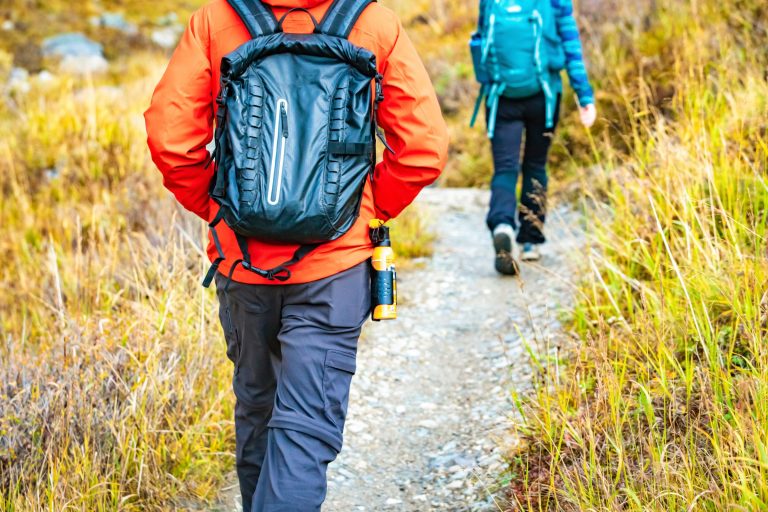
- Carry bear spray on your body, in a holster on your belt or chest, not in the camera bag you may be several steps from. How to carry and use it is in bear spray: how to carry it and use it under pressure.
- Make noise on the walk, and be quiet at the spot. Surprising a bear at close range on the trail is the encounter to avoid.
Common mistakes
- Walking closer to fill the frame. It is how most photographers get hurt, and it is illegal inside the minimums. Stay at the distance and use more lens, a crop, or a wider photograph of the animal in its place.
- Turning around for a selfie. It puts your back to the animal at the distance where it is most likely to charge. Do not take selfies with large animals at all.
- Measuring from the animal you are watching. A second bison, a calf in the grass or a bear in the trees behind you is closer than you think. Look all the way around before you settle in, and again every few minutes.
- Treating a habituated animal as tame. Elk in a townsite and bison beside the road still charge. Keep the same distance from an animal that ignores people as from one that does not.
- Getting out at a wildlife jam. It draws more people, blocks traffic and teaches the animal to stay by the road. Stay in the car, take a quick photo and drive on.
- Leaving bear spray in the camera bag. The bag is often set down a few steps away. Wear the spray in a holster, where you can draw it in a second or two.
- Posting the exact location of a den, nest or owl roost. It brings a crowd that can drive the animal away. Name the general area, and strip the GPS data from the files.
What to carry
- The longest lens you can carry and hold steady, or a camera with a smaller sensor, and a monopod, beanbag or trekking pole to steady it.
- Binoculars, to find and watch animals before you decide whether to photograph them.
- Bear spray in a holster in bear country, such as the Sabre Frontiersman.
- A headlamp for the walk in or out at dawn and dusk, such as the Black Diamond Spot 400.
- Warm, quiet clothing in muted colours for long waits; the layering system is in what to wear in the bush.
Key takeaways
Keep at least 100 yards (91 m) from bears, wolves and cougars and 25 yards (23 m) from other large animals in US national parks, 300 yards (275 m) from bears in Denali, and 100 m (110 yards) from bears, wolves, cougars and coyotes and 30 m (33 yards) from deer, elk, sheep and moose in Canada’s national parks. If an animal changes what it is doing because of you, you are too close, whatever the distance.
Let the lens do the approaching: at 100 yards, even a 600 mm lens shows a bear in its surroundings, and a phone shows it as a small shape in a landscape, which can still be a good photograph. Learn the warning signs of each animal, and give the most room in the calving season and the ruts. Photograph roadside animals from inside the car and move on. Never feed, bait, call or chase an animal, never fly a drone in a national park, and keep away from nests. Look up from the camera often, never turn your back on a large animal, and carry bear spray on your body.
The 2015 Yellowstone bison injuries, the comparison with earlier years and the role of photography follow “Notes from the Field: Injuries Associated with Bison Encounters, Yellowstone National Park, 2015” in the CDC’s Morbidity and Mortality Weekly Report (2016). Yellowstone’s distances, bison warning signs, elk seasons and bison rut follow the National Park Service; Rocky Mountain National Park’s distances and elk meadow closures, and Denali’s distances and vehicle rule, follow those parks. Parks Canada’s distances, roadside viewing guidance, rules on feeding and disturbing wildlife and on selfies, fines and the drone prohibition follow Banff and Jasper national parks; the US drone closure follows National Park Service Policy Memorandum 14-05 and park guidance. The moose warning signs follow the US Air Force’s guidance at Joint Base Elmendorf-Richardson, Alaska, and the guidance on birds and nests follows the National Audubon Society’s guide to ethical bird photography. Lens field widths are calculated. This is general education and not a substitute for the rules of the park you are visiting.
Wilderness Experts is reader-supported. As an Amazon Associate we earn from qualifying purchases; when you buy through links on our site we may earn a commission at no extra cost to you. It never changes what we recommend.