
Bear spray: how to carry it and use it under pressure
When researchers went through two decades of bear encounters in Alaska where someone used bear spray, they found that 98 percent of the people carrying it came through uninjured, and the three who were hurt had relatively minor injuries. That is a remarkable record for a simple can carried on your belt. It comes with a condition, though: the spray only works if it is in your hand, with the safety off, within the two or three seconds a charge takes. Most of what goes wrong with bear spray goes wrong before anyone presses the trigger.
This guide covers how bear spray works, why it is the recommended tool over a firearm for most people, how to choose a can, where to carry it, when and how to use it, what to do afterwards, and the practical problems of cold, heat, expiry, flying and crossing the border. Reading the bear and deciding how to respond, including when to play dead and when to fight, is covered in avoiding and handling wildlife encounters. Keeping bears out of camp in the first place is in how to protect your food and camp from animals. This article is simply about the bear spray itself.
Bear spray is not a repellent
Never spray it on yourself, your tent, your pack or your gear the way you would use bug spray. It works only as a cloud fired at an animal. The residue left on surfaces does nothing to keep bears away, and the smell can draw them in to investigate.
How bear spray works
Bear spray is a pressurized can of capsaicin and related capsaicinoids, the compounds that make hot peppers hot, suspended in a carrier and fired as a fast, wide cloud rather than a stream. The Interagency Grizzly Bear Committee describes it leaving the can at over 70 mph (110 km/h) and reaching 20 to 30 feet (6 to 9 m).
A bear that runs into the cloud gets it in the eyes, nose, mouth and lungs. The effect is intense burning, involuntary closing of the eyes and difficulty breathing. It does not injure the bear permanently, and that is part of why it works: a bear in sudden, overwhelming discomfort almost always breaks off and leaves, and it has not been wounded into something more dangerous.
The cloud matters as much as the chemistry. A charging bear is a fast, low, moving target, and nobody hits one reliably with a narrow jet under stress. A cloud that fills the space between you and the bear does not need to be aimed precisely; the bear has to come through it to reach you.
Why spray rather than a firearm
People carry firearms in bear country for a variety of reasons: hunters for example. Some work alone in remote country for weeks. Many simply trust a tool they know. The efficacy studies are still worth understanding, because they come from the same researchers, in the same state, using the same kind of records.
In the Alaska bear spray study, it stopped the bear’s undesirable behaviour in 92 percent of encounters with brown bears, 90 percent with black bears, and 98 percent of people carrying it were uninjured. In a companion study of firearms, long guns stopped aggressive behaviour 76 percent of the time and handguns 84 percent, but people were injured in 56 percent of the incidents, and bears were killed in 61 percent.
The reasons are practical. A firearm has to hit a small, fast target in a vital spot in about two seconds — and a hit that does not stop the bear leaves you with a wounded, enraged animal at arm’s length. Spray has to be fired into the space in front of you. It does not endanger the people beside you the way a gun does. Further, carrying a firearm is not permitted in Canada’s national parks, where bear spray is the standard tool.
The National Park Service’s position is simple: bear spray is highly effective and easy to use without much experience, and it is the recommended tool. If you carry a firearm for other reasons, carry spray as well, and make the spray your first line of defence.
Choosing a can
Buy bear spray, not pepper spray. Personal defence pepper spray is made for people at arm’s length. It is weaker, fires a narrow stream and runs out quickly. The can has to be labelled specifically for deterring bears.
In the United States, buy an EPA-registered product labelled for bears. Park guidance from Grand Teton and the Interagency Grizzly Bear Committee sets out what to look for on the label:
- 1 to 2 percent capsaicin and related capsaicinoids;
- at least 7.9 ounces (225 g) of product in the can;
- a range of 25 feet (7.6 m) or more;
- a spray duration of at least 6 seconds, enough for several bursts or more than one bear.
In Canada, bear spray is regulated as a pest control product. It is legal when the label clearly says it is for use on animals (bear spray or bear repellent) and the container holds 500 ml (about 17 fl oz) or less. Parks Canada recommends a can with a safety clip and a spray time of about ten seconds.
Beyond the label, look for a trigger with a positive safety clip that you can remove with one thumb, and a holster that comes with the can or is sold for it. The can is only half the product; the holster is how it gets into your hand. Our SABRE Frontiersman review covers one widely available can that meets these criteria, with a range of about 35 feet (11 m).
Buy one for each person. Parks Canada’s advice is that at least one person in a group should carry spray and that it is best if everyone has their own. The bear may reach the one without a can, and the person carrying it may be the one it reaches first.
Carrying it where it counts
A bear charge covers the distance from first sight to contact in a few seconds. In that time you can draw from a holster and fire. You cannot take off a pack, open a pocket and find the can.
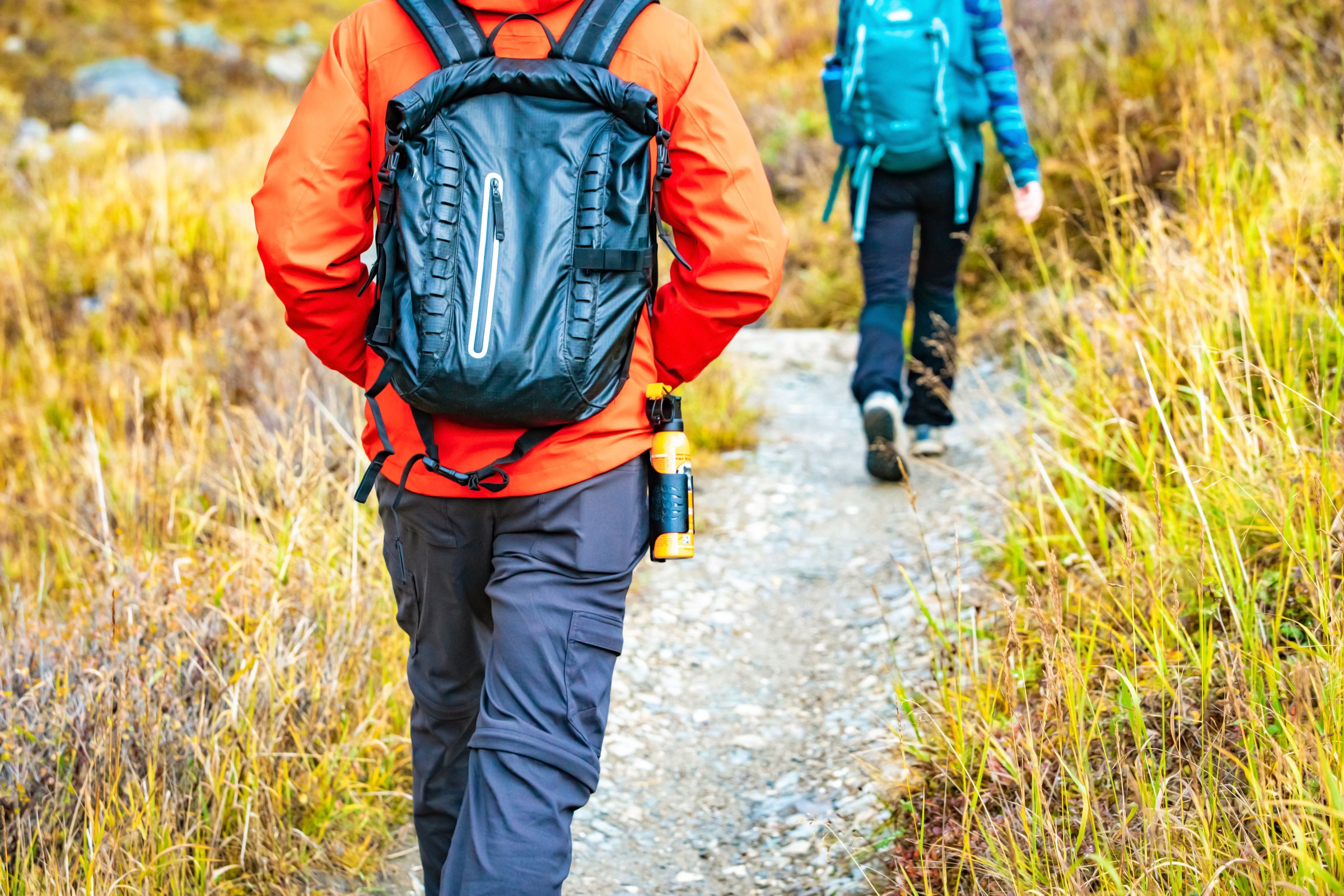
- On your body, on the outside. A belt holster or a chest holster, every hour you are on the trail. The park service is explicit: never keep it in your backpack while hiking.
- On your dominant side. Parks Canada recommends placing it where your dominant hand can reach it without thinking, on the right hip for a right-handed person.
- Clear of your hipbelt. A belt holster on your trouser belt ends up under your pack’s hipbelt, where you cannot get it out. Mount it on the hipbelt itself or use a chest holster that sits in front of the shoulder straps. Check it with the loaded pack on, before you set out.
- Clear of layers. A jacket that hangs over the holster is another delay. Wear the holster over your outer layer, or on the chest, in cool weather.
- In camp. Keep a can in the kitchen area and one in the tent, next to your headlamp, where you can find both in the dark.
- On a bike. Parks Canada suggests a water bottle cage or a bar mount, where you can reach it without stopping.
When to spray
Spray is for a bear that is charging or attacking, not for a bear that is simply there. A bear that has not noticed you, or one standing its ground at a distance, is a bear to back away from calmly, as described in avoiding and handling wildlife encounters. Have the can out and the safety off while you do it.
The park service advises using spray when a charging bear is within about 60 feet (18 m). Parks Canada puts the effective range at about 16 feet (5 m) and describes the moment as a bear closer than a bus length. The two fit together. Start spraying as the bear closes, from the far end of the can’s range, so that a cloud is already hanging in the air by the time the bear arrives at the near end. A bear that runs into a cloud is stopped more reliably than one you try to hit at the last moment.
Many charges are bluffs, and bears often veer off or stop short. You will not know which kind you are facing until it is over, and waiting to find out is how the gap closes to nothing. Once a bear is charging you and in range, spray.
How to spray
- Draw and remove the safety. Pull the can from the holster and flick off the safety clip with your thumb. If you are backing away from a bear that has seen you, do both before it charges.
- Hold it with both hands if you can. The can recoils slightly and the trigger takes a firm press.
- Aim slightly down, in front of the bear. The park service advises pointing at a slight downward angle. The cloud expands and rises, and a bear runs low; aiming at the ground in front of it puts the cloud where its head will be.
- Fire in bursts and adjust. Parks Canada recommends short bursts of about a second to build a wall of spray between you and the bear. Watch where the cloud goes and correct toward the bear’s path.
- Keep going if it keeps coming. Be ready to spray several times or to empty the can. A can that still has spray in it after the bear reaches you did not do its job.
Mind the wind. Strong wind shortens the spray’s reach and can carry the cloud off target, and rain, snow and cold reduce its distance. Stand upwind of the bear if you have any choice at all. In the Alaska study, wind interfered with accuracy in about 7 percent of incidents, and the spray still reached the bear every time. Wind is a reason to aim lower and fire sooner, not a reason to hold fire. In a headwind, expect some spray to come back at you, and keep your eyes as narrow as you can while you fire.
After you spray
Once the bear breaks off, leave the area. Do it calmly and steadily, keep the can in your hand with the safety off, and keep watching the bear. Do not follow it, even to see where it went. A bear that has been sprayed may return, and the effects on it fade over time.
If a bear makes contact despite the spray, the guidance on playing dead or fighting back in avoiding and handling wildlife encounters applies, and it depends on whether the attack is defensive or predatory.
Afterwards, replace the can. A partly used can has an unknown amount left in it, and it may be the one you reach for next time. In a national or provincial park, report the encounter to the park, whether or not you sprayed. Rangers use the reports to track bears that are becoming bold and to close trails before someone else gets hurt.
If you get it on yourself
It happens. In the Alaska study, about 14 percent of people using spray reported being affected by it themselves, mostly with minor irritation, and in a few cases badly enough to be nearly incapacitated. The Interagency Grizzly Bear Committee notes that contact causes involuntary eye closing and pain that can last up to 45 minutes.
- Get into fresh, moving air, upwind of where you sprayed.
- Flush your eyes with plenty of cool, clean water, and keep flushing. Do not rub them.
- Wash exposed skin with cool water, and soap if you have it. Hot water opens the pores and makes the burning worse.
- Take out contact lenses once your hands are clean.
- Seek medical care if pain or vision problems do not ease after an hour, or if someone was sprayed at very close range, which can damage the eye.
Remember that you still have a bear in the area. Keep the can within reach while you deal with it.
Practising the draw
Almost nobody gets to practise on a real charge, so the practice has to happen at home. The park service recommends practising drawing the can and removing the safety before you go.
- Drill the draw with your hiking kit on. Loaded pack, holster where it will be on the trail. Draw, remove the safety, bring the can up and aim. Repeat until it is one smooth motion.
- Practise with an inert can. The major makers sell training cans that fire a harmless spray the same way. Firing one shows you the range, the width of the cloud, how the wind moves it and how quickly a can empties, which is far shorter than most people expect.
- Do not test-fire your live can on the trail. It wastes spray you may need, and the residue on the ground attracts bears to the spot.
- Talk it through with your group. Agree who sprays first, and that nobody runs. Running can trigger a chase, and it puts people between the can and the bear.
Cold, heat and expiry
Cold. Bear spray is a pressurized aerosol, and cold lowers the pressure, which shortens the range and slows the spray. The park service notes that snow, rain and cold weather decrease spray distance. In cold weather, prefer a chest holster, which sits close to your body’s warmth, over one on the hipbelt, and tuck the can inside your jacket at rest stops, when you are not moving through bear country. Keep it in your sleeping bag or tent at night.
Heat. Heat raises the pressure. Grand Teton National Park warns against storing bear spray in a vehicle because the can may burst. Do not leave it on a dashboard, in a closed car in the sun or beside a stove or campfire.
Expiry. Every can is printed with an expiry date, because the propellant slowly leaks and the ingredients degrade. Parks Canada advises against using a can that has expired or is close to it. Check the date before each season, and replace the can rather than trusting it. An expired can is a good one to practise with.
Flying, driving and crossing the border
You cannot fly with it. In the United States, the TSA lists bear spray as prohibited in both carry-on and checked baggage. Parks Canada likewise says it is not permitted on commercial airlines, even in checked luggage. Plan to buy it at your destination. Most gateway towns near bear country sell it, and many parks and outfitters rent it, often with a place to return or recycle it before you fly home.
Driving. Keep the safety clip on. Parks Canada suggests carrying it in the trunk or in a sealed container, so that an accidental discharge does not fill the cabin. That is also the answer to the heat problem: out of the sun, and never left in a closed vehicle for a day.
Crossing the border. Canada treats bear spray as a pest control product, and a can that is labelled for people, for personal protection or self-defence, is treated as a prohibited weapon and can be seized. A can clearly labelled for use on animals may be allowed, but the decision rests with the border officer. The simplest course is to buy bear spray on the side of the border where you will use it, and to declare any can you are carrying.
Common mistakes
- Carrying the spray in the pack. It feels carried, and in a charge you will not get the pack off in time. Wear it in a holster on the hipbelt or chest, and check with the loaded pack on that you can draw it without looking.
- Buying one can for the group. It saves money and weight, and the bear may go for the person without it, or the carrier may be the one it reaches. Put a can on every adult, and a second can in camp.
- Leaving the safety on until the charge. Hikers keep the clip on as a precaution and lose the second it takes to find it with shaking hands. Once a bear has seen you and you are backing away, have the can out with the safety off.
- Waiting until the bear is almost on you. People hold fire hoping for a bluff, and a bear covers the last stretch before a late burst has spread into a cloud. Start spraying as a charging bear comes into range, so it runs into spray already in the air.
- Aiming at the bear’s head. The cloud rises and the bear runs low, so a head-high shot passes over it. Aim slightly down, at the ground in front of the bear, and adjust with each burst.
- Spraying it on gear like repellent. People treat it like bug spray and coat the tent or pack, which leaves a smell that can attract bears. Use it only as a cloud aimed at an animal, and keep your camp scent-free as described in our food storage guide.
- Carrying an expired or cold can. An old can, or one left to chill overnight, may fire weakly or fall short. Check the date each season, replace expired cans, and in cold weather wear it in a chest holster and sleep with it.
- Never having fired one. A first-time user is surprised by how short the can’s duration is and how the wind moves the cloud. Fire an inert training can, or an expired can in a safe open place, before your first trip.
What to carry
- Bear spray in a holster, one per person, in date. Our SABRE Frontiersman review covers one widely available can.
- A bear-resistant food container where the rules or the country call for one, such as the BearVault BV500. Spray is the last line of defence; food storage keeps you from needing it.
- A headlamp within reach at night, next to the can in the tent. The Black Diamond Spot 400 is our pick for most trips.
- A way to call for help. If someone is hurt, a satellite messenger such as the Garmin inReach Mini 2 or an ACR ResQLink PLB is how the evacuation starts.
- Clean water for flushing, in case the wind brings the spray back at you.
Key takeaways
Bear spray has the best record of any bear deterrent: in the Alaska research, 98 percent of people carrying it were uninjured, and it stopped brown and black bears around nine times in ten. It works as a fast, wide cloud of capsaicinoids that a charging bear has to run through, which makes it far easier to use under stress than a firearm, and safer for the people around you. Buy a can labelled for bears, never personal pepper spray: EPA-registered in the US, with at least 7.9 ounces (225 g) of product and a range of 25 feet (7.6 m) or more, and labelled for animals in Canada.
Carry it in a holster on your hipbelt or chest, on your dominant side, where you can draw it with a loaded pack on, and give every person their own. Spray a charging bear as it comes into range, aiming slightly down in front of it, in short bursts that build a wall, and keep spraying if it keeps coming. Then leave the area without following the bear, replace the can and report the encounter. Practise the draw at home, keep the can warm in the cold and out of hot cars, replace it when it expires, and remember that you cannot fly with it and should buy it on the side of the border where you will use it.
Efficacy figures follow Smith and colleagues’ studies of bear spray (2008) and firearms (2012) in Alaska, published in the Journal of Wildlife Management. Product criteria and carrying and use guidance follow the National Park Service, Grand Teton National Park, the Interagency Grizzly Bear Committee and Parks Canada. Air travel rules follow the TSA and Parks Canada; Canadian import rules follow the Canada Border Services Agency and Health Canada. Rules vary by park and change over time, so check with the park before your trip. This is general education and not a substitute for local instruction.
Wilderness Experts is reader-supported. As an Amazon Associate we earn from qualifying purchases; when you buy through links on our site we may earn a commission at no extra cost to you. It never changes what we recommend.