
Human waste in the backcountry: catholes, latrines, and packing it out
Everyone poops, and in the backcountry there is no flush to make it someone else’s problem. Done carelessly, human waste fouls camp, spreads gut illness through a group, and contaminates the water you and everyone downstream depend on. Done properly, it disappears into the soil or your pack and leaves the place exactly as you found it. This guide covers the whole job: choosing a method, digging a clean cathole, building a group latrine, packing waste out where the rules require it, and handling toilet paper, urine, and the special cases from snow to slot canyons.
This is the deep-dive companion to the “cat hole” section in our guide to backcountry hygiene and sanitation, and it puts real detail behind the “dispose of waste properly” rule in our Leave No Trace guide. For the digging tool itself, see our guide to camp shovels and entrenching tools. Get this one habit right and you prevent most of the illness, and nearly all of the mess, that spoils time outdoors.
Why it matters
Human feces carry pathogens: bacteria like E. coli, protozoa like Giardia and Cryptosporidium, and viruses that cause the diarrhea most likely to cut a trip short. When waste is left on the surface, buried too shallow, or dropped too close to a stream, those pathogens reach water and hands, and from there they reach mouths. On popular routes the problem compounds fast: a single badly chosen spot becomes a dozen, and soon a whole drainage is contaminated. Proper disposal does three things at once. It protects your own health and your group’s, it protects the water supply for everyone downstream, and it keeps wild places clean and pleasant instead of turning them into open toilets. The goal every time is simple: maximize decomposition and keep waste away from water, and leave no sign that anyone went there.
Choosing your method
Before you go, find out what the land manager requires, because the right method depends entirely on where you are. There are three:
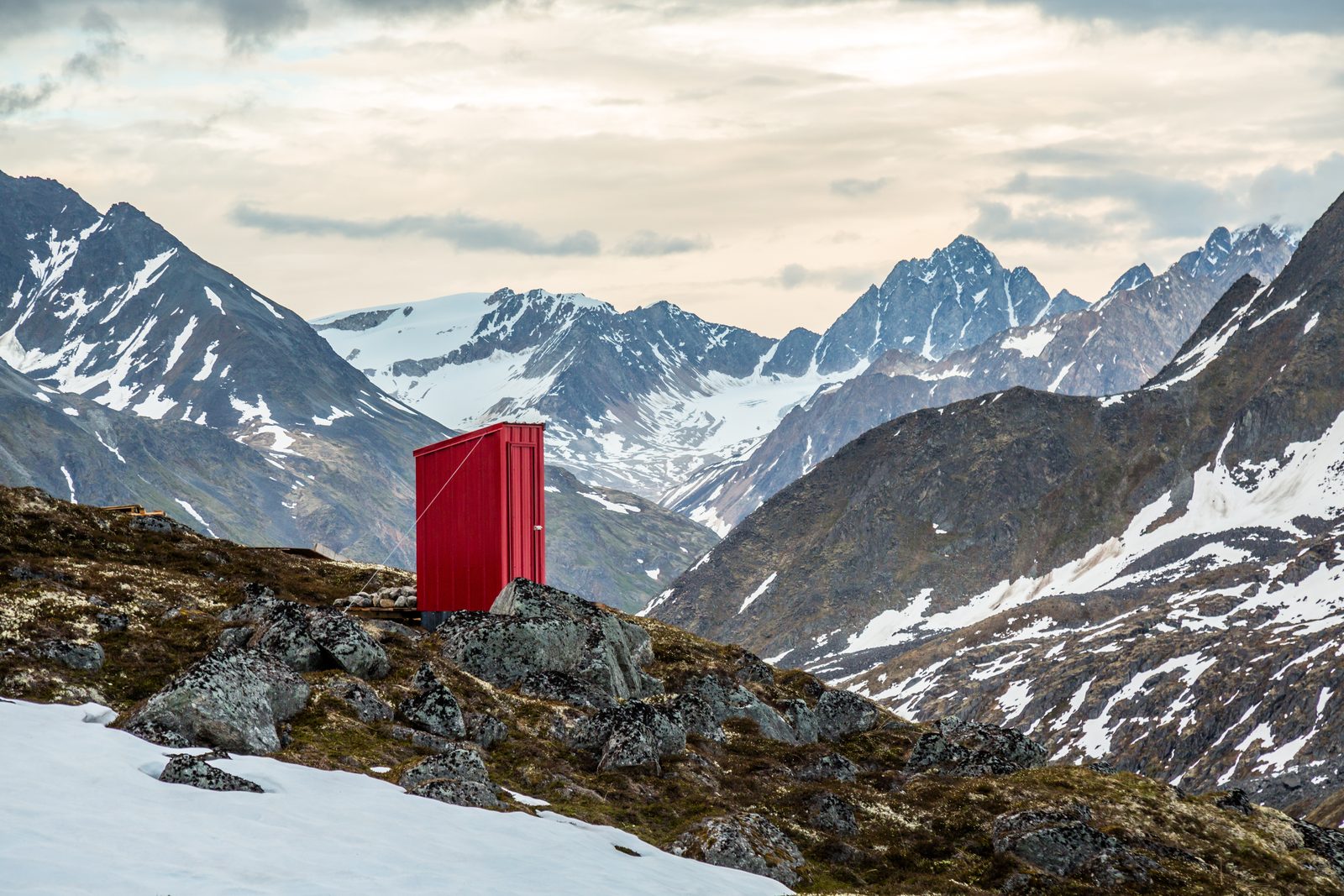
- Use the facility. Where there is an outhouse, pit toilet, vault toilet, or established latrine, use it, even if it is unpleasant. Concentrating waste in one managed spot is far better than scattering it.
- Dig a cathole (or a group latrine). In most forest, meadow, and lower-elevation terrain with good organic soil, a properly sited cathole is the standard, and a shallow latrine trench serves a larger group in one place.
- Pack it out. In alpine zones, deserts, narrow river canyons, snow, and any heavily used or specially regulated area, burial does not work or is banned, and you carry solid waste out in a sealed kit.
When in doubt, pack it out: it is never wrong, only heavier. The sections below cover each method in turn.
The cathole: your default
A cathole is a small hole you dig, use once, and fill in. It is the most widely accepted method because, sited and dug correctly, it holds waste where soil organisms break it down and where it cannot reach water or people. Four numbers do the whole job.
- Distance: at least 200 feet (60 m) from water, camp, and trails. That is roughly 70 big adult steps. At that distance the soil can filter pathogens before they reach a stream, lake, or spring, and no one else stumbles onto the site. Measure it honestly; pacing it out beats guessing.
- Depth: 6 to 8 inches (15 to 20 cm). This is the biologically active layer where microbes work fastest. Deeper is not better: bury waste too far down and it mummifies instead of breaking down.
- Soil: dark and organic. Look for rich, living topsoil rather than pale mineral sand or clay. The organisms in dark humus are what decompose the waste. A sunny spot speeds things along.
- Spread them out. Do not dig a second cathole next to the first. Scatter sites widely so no patch of ground is overloaded, and never reuse a spot.
The technique: pick a private, durable spot that meets the four rules, ideally with something to hold on to or a log to sit against. Cut a plug of soil with a trowel and set it aside on a rock or leaf so you can replace it cleanly. Do your business into the hole. When finished, use a stick to mix a little soil into the waste (this speeds decomposition), then backfill with the original dirt, tamp it down, and disguise the spot with leaves, needles, or a rock so it looks untouched. Pack out or bury your toilet paper as described below, and wash or sanitize your hands. On the trowel itself, keep the digging tool out of your kitchen and cook gear, since it has been in the waste zone.
The cathole spec, memorized
Dig it 6 to 8 inches (15 to 20 cm) deep and at least 200 feet (60 m) (about 70 big steps, 60 m) from any water, trail, or camp, in dark organic soil. Use it, mix in a little dirt, backfill, and disguise it. In alpine, desert, snow, narrow canyons, and heavily used areas, the rule flips to pack it out.
Building a latrine for groups
A latrine is simply a long cathole, and it is the right tool when a group is camped in one place long enough that scattered individual catholes would riddle the area, or when young children, a large party, or a multi-night basecamp make one managed spot more sanitary than many random ones. In lightly used backcountry, though, individual catholes are usually preferred: a latrine concentrates a lot of waste in one place and decomposes slowly, so use one sparingly and only when it genuinely beats the alternative.
To build one, apply the same siting rules as a cathole, at least 200 feet (60 m) from water, trails, and camp, in deep organic soil, then dig a trench instead of a hole:
- Dig the trench 6 to 8 inches (15 to 20 cm) deep and 4 to 6 inches (10 to 15 cm) wide, and as long as the group and the stay require. A foot or two of length is plenty for a small party.
- Keep the excavated soil piled alongside with a scoop or trowel left in it.
- After each use, everyone throws in a few inches of soil to cover their deposit, control odor and flies, and start decomposition. Work from one end to the other so the trench fills evenly.
- Screen it for privacy behind brush or a tarp, and keep it well downhill and downwind of the kitchen and tents.
- When you break camp, fill the trench completely, tamp it, and disguise the surface so no trace remains.
Toilet paper and hygiene products still get packed out, not thrown in the trench, for the reasons below. A latrine handles solid waste and a thin cover of soil, nothing else.
When you must pack it out
In many places burial simply does not work, and packing waste out is either the smart choice or the law. High alpine zones are cold and thin-soiled, so waste can sit for years without breaking down. Deserts are dry and biologically slow, and slot canyons funnel everything toward scarce water. Narrow river corridors concentrate heavy use along a thin band of beach and water. Snow hides waste that reappears, ugly and intact, at melt. In all of these, and on many permit-controlled peaks and rivers, land managers require you to carry solid human waste out. Well-known examples include the Mount Whitney zone, high on Denali, the Colorado River through the Grand Canyon, and the Zion Narrows.
The tool for this is a commercial waste bag, often called a WAG bag (Waste Alleviation and Gelling). A typical kit is a puncture-resistant bag holding a gelling powder that solidifies liquid, breaks down solids, and controls odor, plus a zip-top outer transport bag, toilet paper, and a hand wipe. You go directly into the bag (many people set it inside a small folding seat, a wide-mouth bucket, or a dug hole for stability), add the powder if it is not pre-loaded, seal it into the outer bag, and carry it out to a trash can. The treated waste is landfill-safe. WAG bags are odor-controlled enough to ride in an outside pack pocket or a dedicated dry bag for several days. Carry one or two even when you do not expect to need them, because frozen ground, an unexpectedly fragile site, or a sudden bout of illness can turn pack-out into the only responsible option.
Toilet paper, wipes, and hygiene products
Toilet paper is the most common litter found near backcountry campsites, because animals dig up shallow-buried paper and wind scatters it. You have two acceptable options. The cleaner one is to pack it out: seal used paper in a zip-top or opaque bag (a strip of duct tape on the outside hides the contents) and carry it to a trash can. This is required wherever you are packing out solid waste anyway. The alternative, allowed in many forested areas, is to bury plain white unscented paper deep in the cathole, well mixed with soil, using as little as possible. Never burn toilet paper: people have started wildfires this way, and it rarely burns completely.
Some go paperless with a smooth stone, snow, or a handful of vegetation as a “natural” wipe, or rinse with water from a dedicated squeeze bottle, which saves waste but demands careful hand hygiene afterward. Two things always get packed out, no exceptions: wet wipes (even “flushable” ones do not break down and often contain plastic) and menstrual products such as tampons and pads, which do not decompose and strongly attract wildlife with their odor. Bag them the same way you bag toilet paper. A reusable menstrual cup, emptied into a cathole and rinsed, greatly cuts what you have to carry.
Urine
Urine is nearly sterile and poses little health risk, so it does not need burying. It does have an impact worth managing. The salt in it attracts deer, goats, and other animals, which will dig at and defoliate salty vegetation and soil to get it, damaging plants and, in fragile alpine tundra, the ground itself. So aim urine at durable, non-living surfaces: bare rock, gravel, pine needles, or dirt, rather than plants. In sensitive alpine areas this actually reverses the usual advice, and peeing on a broad rock is best because it protects the tundra from digging animals. Keep urine the standard 200 feet (60 m) from water, and well away from camp so the smell does not build up. Diluting a concentrated spot with a little water helps in high-traffic areas. In the rare places that require you to pack out urine as well, follow the local rule.
Special environments and cases
- Snow and winter. Never bury waste in snow: it does not decompose, and it surfaces at melt right where people travel. Either pack it out (the norm on glaciers and snowfields), or, if there is bare organic ground beneath, dig down to soil for a proper cathole. On glaciated peaks, deep crevasse or blue-bag systems are sometimes designated; follow the mountain’s specific rules.
- Desert and slot canyons. Thin, dry, biologically inactive soil breaks waste down very slowly, and canyons channel it toward scarce water. Pack it out. Where catholes are allowed in open desert, still keep the full 200 feet (60 m) and use deep, sun-exposed soil.
- Alpine and tundra. Cold and thin soil mean slow decomposition; many high peaks require pack-out. Where a cathole is permitted, find the deepest organic pocket you can and aim urine at rock to protect the tundra.
- Rivers and coasts. On managed river trips you almost always pack out solid waste in a groover or WAG bag. On some coastlines the guidance is the opposite of inland: deposit below the high-tide line so the surf disperses it. Always confirm the local rule before relying on either.
- Children and pets. A child’s waste carries the same pathogens as an adult’s; bury it in a cathole or pack it out just the same, and pack out diapers whole. Dog waste is not “natural” fertilizer: bury it in a cathole to the same standard, or bag and pack it out, especially near water and trails.
Cleaning up
The waste job is not finished until your hands are clean, because this is exactly where the pathogens you just handled reach your food and mouth. Wash with soap and water at least 200 feet (60 m) from any water source, or use an alcohol-based hand sanitizer, every single time, before you touch food, cookware, or a water bottle. Keep a small sanitizer bottle clipped where you can reach it right after a cathole, and keep the trowel and any pack-out bag separate from your kitchen kit. This is the point where waste disposal and backcountry hygiene become one habit: the cleanest cathole in the world does nothing for you if you carry what you dug straight to dinner.
Common mistakes
- Going too close to water. The single worst error, because it contaminates the source directly. Always pace out the full 200 feet (60 m), and collect drinking water upstream of camp.
- Digging too shallow. A scrape under a rock gets dug up by animals. Commit to the full 6 to 8 inches (15 to 20 cm) in real soil.
- Burying or scattering toilet paper. It surfaces and blows around. Pack it out, or bury only plain paper deep, and never burn it.
- Burying waste in snow. It reappears at melt. Reach soil or pack it out.
- Leaning on a latrine by default. In lightly used areas, scattered catholes usually beat one concentrated pit. Save the latrine for genuine groups and basecamps.
- Skipping the handwash. This is how the illness you were avoiding gets to you anyway. Clean hands every time.
- Assuming the rules. Alpine, desert, canyon, and river areas often require pack-out. Check before you go.
What to carry
- A trowel for digging catholes and latrine trenches. Ultralight picks are the TheTentLab Deuce of Spades and the budget NACETURE aluminum trowel; for frozen or rocky ground step up to the SOG entrenching tool.
- Sealable bags (zip-top or opaque, a wrap of duct tape for privacy) to pack out toilet paper and hygiene products.
- One or two WAG bags for pack-out zones, snow, hard ground, or an unexpected need.
- Plain white unscented toilet paper, kept dry in a bag, or a dedicated water squeeze bottle if you go paperless.
- Hand sanitizer and biodegradable soap, the cheapest illness insurance you can carry.
- A dedicated stuff sack or dry bag to keep the whole waste kit separate from food and cook gear.
Key takeaways
Dealing with human waste well is one of the highest-value skills in the backcountry, and it comes down to a short list. Use a real toilet when there is one. Otherwise dig a cathole 6 to 8 inches (15 to 20 cm) deep and at least 200 feet (60 m) from water, camp, and trails, in dark organic soil, then fill and disguise it. For a group in one place, dig a shallow latrine trench to the same siting rules and cover each use with soil, but reach for it sparingly. In alpine zones, deserts, canyons, snow, and regulated areas, pack solid waste out in a WAG bag, and always pack out toilet paper, wet wipes, and menstrual products. Keep urine off plants and 200 feet (60 m) from water. Then wash your hands, every time. None of it is glamorous, but it protects your health, the water, and the wild places you came to enjoy.
Adapted from modern Leave No Trace practice (Principle 3, “Dispose of Waste Properly”) and land-manager guidance from the U.S. National Park Service and Bureau of Land Management on catholes, latrines, and pack-out requirements, combined with the U.S. Army Survival Field Manual (FM 3-05.70 / FM 21-76) guidance on waste disposal and camp sanitation.
Wilderness Experts is reader-supported. When you buy through links on our site, we may earn an affiliate commission at no extra cost to you. It never changes what we recommend.