
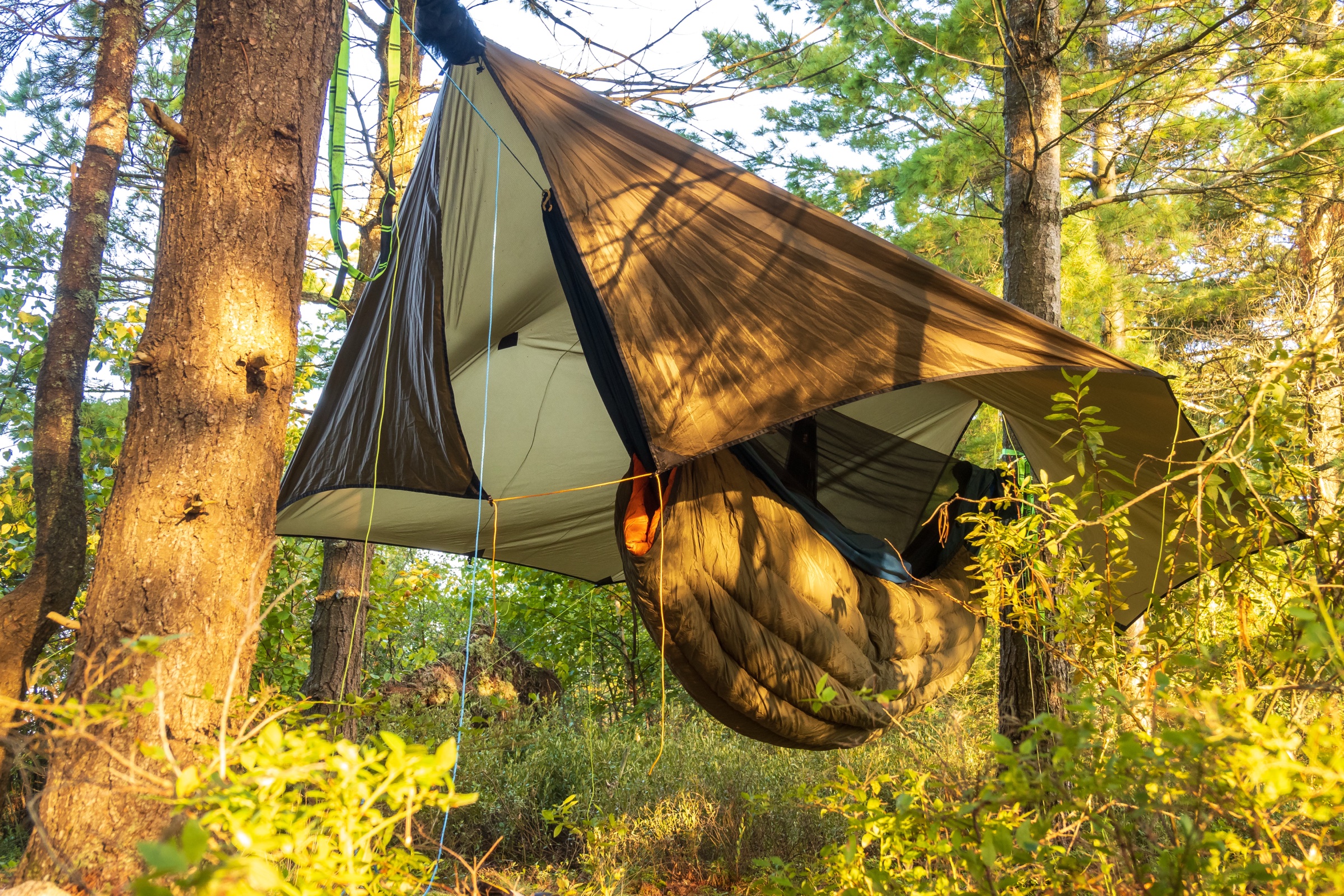
Hammock or tent: how to choose where you sleep
A tent, a sleeping pad, and bag is what most people use to sleep outdoors, and for good reason: it works on almost any ground, in almost any weather, for one person or four. A camping hammock replaces the tent and pad with a bed slung between two trees… and the people who switch tend to say they have never slept better outside. Both are complete, proven ways to spend a night; however, they differ in where they work, how they keep you warm, and who they suit.
This guide compares the two systems piece by piece: the terrain each one suits, comfort, warmth, rain and wind, insects, weight and cost, and how each handles a partner, child, or dog. It then covers how to hang a hammock properly, the anchors that cause injury, the rules parks set for trees, and how to try a hammock for a night using gear you already own. The sleep system itself is covered in depth in how to stay warm through a cold night, and choosing the spot is detailed in setting up a safe backcountry campsite.
Two answers to the same night
Any shelter has to do four jobs: keep rain off, cut the wind, keep insects out, and stop the cold underneath you from draining your heat. A tent does the first three with one piece of fabric and leaves the fourth to the pad. A hammock splits the jobs up: a tarp for rain and wind, a net for insects, and insulation beneath you for the cold.
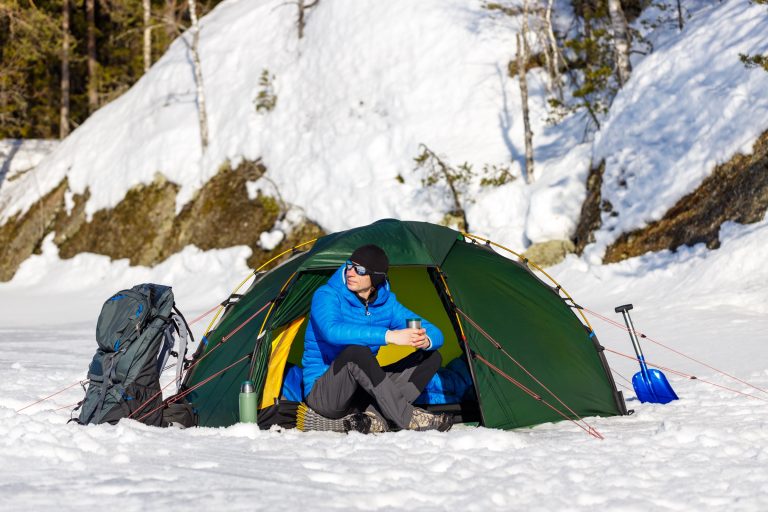
- The ground system needs a patch of ground that is flat, drained and clear, and gives you an enclosed room in return. It works the same way in a forest, on a beach, in the desert and above the trees.
- The hammock system needs two sound trees the right distance apart and it largely doesn’t matter what is underneath (aside from getting in and out). Slope, rock, roots and wet ground underneath are now no longer impediments to getting a good night’s sleep. Where there are no trees or similar anchor points however, it is essentially useless.
That is the heart of the choice. A tent requires good ground and a hammock needs good trees; so your destination may determine which is more suitable.
What each system is made of
The comparison only makes sense system against system. A bare hammock both weighs and costs very little, but it is not a shelter. Compare what you would carry for a night of rain at the same temperature.
- Ground system: tent with fly, poles and stakes; often a groundsheet; a sleeping pad; and a sleeping bag or quilt.
- Hammock system: hammock; suspension (two wide webbing straps and the hardware that connects them to the hammock); a tarp with its own guylines and stakes; a bug net, which is often sewn onto the hammock; insulation underneath — either a pad or an underquilt; and a sleeping bag or quilt on top.
Three terms come up constantly with hammocks. A gathered-end hammock is the familiar shape: a rectangle of fabric bunched together at each end. A bridge hammock uses spreader bars to hold the fabric open like a narrow cot, which lies flatter and suits some side sleepers, at more weight. An underquilt is a quilt that hangs outside the hammock, snug against the underside, so your weight does not crush it.
The top half of the sleep system is the same either way. The sleeping bag you already own works in a hammock, usually unzipped and draped over you like a quilt, because wriggling into a zipped mummy bag while suspended is awkward.
Where each one works
Start with the land, because it can settle the question before comfort becomes a consideration.
Hammocks are at their best in forest with poor ground. Steep hillsides, rock slabs, root-laced or boggy forest floor and brushy shorelines are where tent campers spend the last hour of daylight hunting for a flat spot. A hammock hangs over all of it. In thick eastern and northern forest, the list of usable sites gets much longer once the ground characteristics are taken out of the decision, which also makes it easier to stop where you planned to stop. Wet ground and running water in a downpour simply pass underneath you.
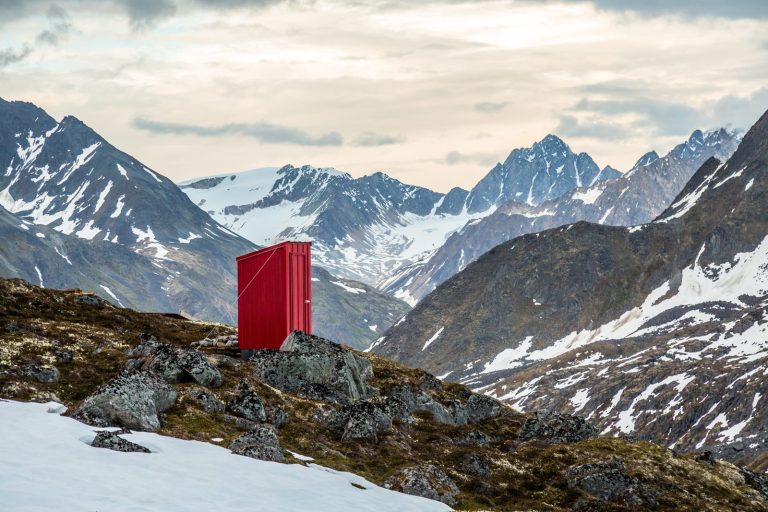
Tents work where trees are absent, small, or off limits. Above the treeline, on tundra, prairie, desert and open beach there is nothing to hang from. Stands of slender young trees, and old burns where the standing timber is dead, are no better. Many established campgrounds are also built around the tent: a levelled pad, and sometimes a rule against attaching anything to the trees (see park rules below).
A hammock camper can still get through a night with no trees by going to ground: the tarp is pitched low on trekking poles, a use we cover in our trekking pole guide, and the hammock is laid out as a groundsheet and bug shelter. It works only if the insulation you carry is a pad, since an underquilt does nothing once it is squashed against the ground. If a route crosses long treeless stretches, that is a reason to carry a pad or to take the tent.
Comfort and how you sleep
Comfort is the reason most people try a hammock, and it is also the most personal part of the comparison.
In a hammock, nothing presses on your hips and shoulders, and there are no roots or stones to find at two in the morning. Many people who wake stiff on a pad sleep through the night in a hammock. The trick is the diagonal lay: you lie across the hammock at an angle of 20 or 30 degrees to its centre line, head to one side and feet to the other, and the fabric flattens out under you. Lying straight down the middle curves you like a banana and strains the knees and lower back. The diagonal needs room, which is why a hammock meant for sleeping is long, about 10 to 11 feet (3 to 3.4 m), where the short hammocks sold for an afternoon in the yard leave an adult curled up.
Back sleepers adapt fastest. Side sleepers can usually find a comfortable position on the diagonal, with the knees slightly bent, or in a bridge hammock. Sleeping on your stomach does not work well in a gathered-end hammock. Some people also dislike the fabric rising around their shoulders, or find that their heels press uncomfortably where the fabric tightens under the calves; a small pillow under the knees usually fixes the second problem.
On the ground, comfort comes from the pad and the site. A thick inflatable pad on level ground suits every sleeping position, lets you sprawl and turn freely, and feels like a bed to most people from the first night. The weak points are an uneven or sloping site, a pad too thin for a side sleeper’s hip, and the slow leak that puts you on the ground by morning.
Neither claim is universal. Some lifelong tent campers switch after one night and others give a hammock a fair week and go back. The only reliable test is a night or two of your own, which is why the section on trying one first matters.
Warmth: the cold comes from below
This is the part of hammock camping that catches the most people out. On the ground, a pad stops your heat draining into the earth. In a hammock there is no earth under you, and it is tempting to think the problem has gone away. It has simply changed form: moving air now passes under your back all night. Without insulation underneath, most people feel the chill on their back and hips once the night drops below about 70°F (21°C).
There are two ways to insulate the underside:
- A sleeping pad inside the hammock. Use the pad you own. Closed-cell foam is the simplest; an inflatable works better let down a little soft so it bends to the curve. Pads slide around on the slick fabric and leave your shoulders exposed where the hammock wraps up past the pad’s edges. Hammocks made with two layers of fabric hold a pad between the layers, which solves the sliding.
- An underquilt. Because it hangs snug beneath the hammock, it keeps its loft, wraps the shoulders, and never shifts under you. It is the more comfortable answer and the warmer one for its weight. The costs are money, pack space, and the fact that it is useless on the ground. It has to hang snug: a gap between quilt and hammock lets cold air in and removes its benefits.
Underquilts are sold with temperature ratings like sleeping bags, and the same caution applies: choose one rated colder than the nights you expect. Wind matters more than it does in a tent, because it strips heat from the whole underside, so on a cold or breezy night pitch the tarp low and close on the windward side.
A tent has the easier job in the cold. It blocks wind completely and holds a pocket of air a little warmer than outside, and ground insulation is simple to add: pads stack and their R-values (the standard measure of a pad’s resistance to heat flow) add together. Hammock camping in winter is rare but done, by people with full-length winter underquilts and tarps that close at the ends, but it is a specialty. For planned nights on snow, see our winter camping guide.
A warm bag will not fix a cold back
If you are cold in a hammock, the heat is almost always leaving from underneath. Adding a warmer sleeping bag changes little, given you are generally using it as a quilt. Put a pad or an underquilt under you first, then judge the bag.
Rain, wind, and storms
Rain. A good tarp pitched properly keeps a hammock as dry as a tent, and it has two advantages: you are off wet ground entirely, and the space under the tarp is a covered porch where you can sit, sort gear and get in and out of rain clothes standing up. The tarp should extend at least 6 to 12 inches (15 to 30 cm) past each end of the hammock, and more is better in wind-driven rain. One detail is particular to hammocks: water runs down the suspension straps toward you. A short length of cord tied to each strap just outside the hammock, called a drip line, gives the water somewhere to fall off before it reaches the fabric.
A tent is simpler: pitch it, close the door, and it is the same shelter every time. Its weak points in rain are the site and the air inside. Water pools on flat ground, which is why site drainage matters so much, and a closed tent on a cool damp night collects condensation on the inside of the fly. A hammock under a tarp has so much airflow that condensation is rarely a problem.
Wind. This is the tent’s ground. A well-staked tent with its low, narrow end pointed into the wind sheds a gale, and inside it the air is still. A tarp in strong wind is noisy, has to be pitched low and tight, and still lets moving air reach you. On an exposed lakeshore or ridge in a cold wind, a tent is warmer and quieter.
Thunderstorms. Neither shelter protects you from lightning. A tent gives no protection, and a hammock ties you to two trees. The terrain rules in lightning safety apply to both: get off high ground and away from the tallest trees, and choose a stand of trees of similar height over a few large ones. Strong wind also brings down limbs, so the overhead check described under anchors matters most on a stormy night.
Insects
A tent’s mesh inner is a sealed room, and in heavy mosquito or blackfly country that room is where you eat, read and wait out the evening. A hammock with a zipped bug net protects you just as well while you are in it, and you are also off the ground, away from crawling insects. There is one gap to close: mosquitoes can bite through a single layer of thin hammock fabric wherever your body presses against it. An underquilt or a pad stops them, as does a double-layer hammock. In warm weather with no insulation underneath, treat the hammock fabric with permethrin, the same clothing treatment we describe in our guide to ticks and biting insects.
The difference presents itself outside sleeping hours. A tent gives people a bug-free place to sit up together. A hammock gives one person a place to lie down.
Weight, bulk, and cost
Hammocks have a reputation for being lighter, and system against system that is not reliably true.
Using manufacturer weights: a complete entry-level backpacking hammock with an attached bug net, rain fly and tree straps weighs about 3 pounds (1.3 kg). An underquilt adds roughly 1 to 2 pounds (450 to 900 g) depending on its fill and temperature rating, for a total of 4 to 5 pounds (1.8 to 2.3 kg) before the top quilt or bag. On the ground side, the two-person tents we review weigh 4.9 pounds (2.2 kg) for the Kelty Discovery Trail 2 and 6.2 pounds (2.8 kg) for the MSR Elixir 2, and a three-season pad such as the NeoAir XLite adds 13 ounces (370 g).
- One person carrying a two-person tent has roughly 6 to 7 pounds (2.6 to 3.2 kg) of shelter and pad. The hammock is lighter.
- Two people sharing that tent carry about 3.5 pounds (1.6 kg) each including their pads. Two hammock systems weigh more.
- Purpose-built solo and ultralight gear narrows the gap from both directions, and at that end of the market the two systems are close to even.
Bulk follows the same pattern. A hammock and tarp pack small, with no poles. A down underquilt takes about the space of a second small sleeping bag, where an inflatable pad rolls to the size of a water bottle.
On cost, a basic hammock is one of the least expensive ways to get off the ground, and that low entry price is real if you reuse the bag and pad you own. A complete hammock system with a quality tarp, an underquilt and a top quilt costs about as much as a good tent and pad, and often more. The tent side has the wider range of proven budget options.
Partners, children, dogs, and living space
A tent is a room, and a hammock is a bed. A good deal of the practical difference follows from that.
- Couples. A two-person tent lets you share warmth, talk, and split the carried weight. Hammocks sleep one person each. Hammocks sold as doubles are wider, which makes them pleasant for one, and two adults in one for a whole night end up rolled together in the middle. Two hammocks under two tarps also need four suitable trees close together.
- Children. Young children generally sleep better beside a parent, and a tent keeps the whole family inside one zip. Older children often love a hammock of their own, hung low and close by.
- Dogs. A dog sleeps easily on the floor of a tent. With a hammock the dog sleeps on the ground beneath you, on its own pad, under the tarp, which suits some dogs and not others. Claws and thin hammock fabric do not mix.
- Privacy and changing. A tent has walls. Under a tarp you change in the open or pitch the sides low. In a busy campground this matters to many people.
- Gear. In a tent the pack comes inside or into the vestibule. With a hammock it hangs from a strap or sits under the tarp on a groundsheet. Boots stay dry under the hammock, tipped on their sides.
- A day of rain. Sitting upright under a tarp with a view beats lying in a small tent. In cold wind or thick insects, the tent is the better place to spend those hours.
How to hang a hammock well
Almost every bad first night in a hammock comes from a poor hang. It is easy to get right once you know what to aim for, and worth practising in a yard or a local park before a trip.
- Pick the trees. Two live, solid trees about 12 to 15 feet (3.5 to 4.5 m) apart, which is five or six normal paces. Each should be at least 6 inches (15 cm) through at the height of the strap, and thicker is better. Check both trees and everything overhead before you unpack (see anchors).
- Wrap the straps. Use flat webbing straps at least 1 inch (2.5 cm) wide, wrapped once around each trunk at about head height. Higher for trees that are far apart, lower for trees that are close.
- Aim for a 30-degree hang. The suspension should leave each tree angled down at roughly 30 degrees from horizontal, so the empty hammock hangs in a deep curve, like a smile. Point your index finger straight ahead with the thumb straight up: the line from the tip of the thumb to the tip of the finger is close to the right angle. A hammock pulled tight looks neater, squeezes your shoulders, and loads the anchors much harder.
- Set the height. When you sit in it, the hammock should be at about chair height, roughly 18 inches (45 cm) off the ground, so you can sit down and stand up without climbing. Hang it over ground you would not mind landing on, clear of rocks and stumps.
- Raise the foot end a little. With the foot end slightly higher than the head end, you stop sliding toward the middle during the night.
- Lie on the diagonal, as described under comfort.
- Pitch the tarp over a line run between the same two trees, just above the hammock, and add the drip lines.
Many sleeping hammocks have a structural ridgeline: a fixed cord joining the two ends of the hammock, usually about 83 percent of the hammock’s length. It holds the same sag every time, whatever the distance between the trees, and gives you somewhere to hang a light and a small gear pocket. If you find a hang you like and your hammock does not have one, it is a simple addition.
Anchors: what holds you up
A hammock is safe on sound trees and wide straps. The injuries and deaths on record come overwhelmingly from the anchors and from what is overhead.
The forces are larger than they look. At a 30-degree hang, each strap pulls on its tree with a force about equal to your body weight. Flatten the hang to 15 degrees and the pull on each anchor nearly doubles, and dropping into the hammock adds a shock load on top. Much of that pull is sideways, which is the direction posts, pillars and dead trees are least able to resist.
Hang only from live, solid trees
Never hang a hammock from a dead tree, a leaning or rotten tree, a brick or stone pillar, a fence post, a porch column or a vehicle roof rack. People have been killed when a brick pillar or a dead tree pulled over onto the hammock they were lying in. Before you hang, look up: dead limbs and broken branches caught in the canopy above either tree, or above the hammock, are a reason to move.
- Test each tree. Push on the trunk and watch the crown. A tree that sways at the base, sheds bark, shows fungus or has no leaves or needles in the growing season is out. The full overhead scan is in the hazards section of our campsite guide.
- Stay low. Leave No Trace recommends keeping the hammock less than 5 feet (1.5 m) off the ground. Chair height is better. Stacking hammocks one above another multiplies both the fall and the load on the trees.
- Inspect the gear. Check straps for cuts and fraying, stitching at the loops, and the hammock fabric for snags and small tears before each trip. Use the carabiners or hardware supplied for the purpose, and stay within the maker’s weight limit.
- Take it down when you leave camp. An empty hammock left hanging can tangle wildlife.
Food rules do not change with the shelter. A hammock is no more bear-resistant than a tent, and food, toiletries and anything scented stay out of both. The methods are in protecting your food and camp from animals.
Trees, park rules, and Leave No Trace
Hammocks are easy on the ground: no levelling, no trenching, and no flattened vegetation under a tent floor. The impact moves to the trees, and it is avoidable. Thin cord and rope cut into bark and crush the living layer just beneath it, which is how a tree is damaged or killed. Leave No Trace’s hammock guidelines are short:
- Use webbing straps 1 inch (2.5 cm) wide or wider, wrapped once around the trunk, and never nail or screw anything into a tree.
- Choose live trees at least 6 inches (15 cm) in diameter, with firm bark, and hang from the thickest part of the trunk.
- Hang in an established campsite where one exists, over ground with little or no plant cover, and at least 200 feet (60 m) from water.
- Check the area’s rules before you go.
That last point matters, because the rules vary a great deal from one park to the next. Minnesota’s state parks allow hammocks but require straps at least 1 inch (2.5 cm) wide, trees at least 12 inches (30 cm) in diameter where the strap sits, and no more than one hammock per tree. Ozark National Scenic Riverways bans tying a hammock to trees in its developed campgrounds whatever strap is used, and allows only free-standing hammocks. Ontario Parks asks campers to use wide straps, never nails, and to take everything down when they leave. Some campgrounds supply hammock posts, and some backcountry sites require you to camp on a built pad or platform. The park’s own website or office is the place to check, and it is worth doing before you leave the tent at home. The wider set of principles is in Leave No Trace: the seven principles.
Choosing by trip
A hammock is the stronger choice when:
- you are travelling solo, or each person in the group wants their own bed;
- the route stays in mature forest, especially on steep, rocky, rooty or wet ground;
- the nights are mild, or you own the insulation for the nights you expect;
- you sleep on your back or side and wake sore on a pad;
- the rules where you are going allow it.
A tent, pad and bag is the stronger choice when:
- any night of the trip is above the treeline, or on desert, prairie, beach or burned ground;
- two people are sharing, or you are camping with young children or a dog that sleeps beside you;
- you expect cold, strong wind, or heavy insects through the evening;
- you sleep on your stomach, or you want walls and a door;
- you are staying in a campground built around tent pads, or one that restricts hammocks.
Plenty of experienced campers own both and choose by trip. A canoe trip through rocky lake country and a week above the trees are different problems, and nothing says one shelter has to solve both.
Try a hammock before you buy the system
One night, with gear you already own
Borrow or buy a basic hammock long enough to sleep in, with wide straps. Put your own sleeping pad inside it and use your own sleeping bag as a quilt. Pick a warm, dry, still night in the yard, a local campground that allows hammocks, or a site beside your tent. You will know by morning whether the diagonal lay suits you, and you will have spent very little to find out.
If it suits you, add the pieces in the order they earn their place: a tarp large enough to cover the hammock, then a bug net if the hammock lacks one, then an underquilt once you want to stretch into cooler nights. Keep the pad. It is the piece that lets a hammock camper sleep on the ground when the trees run out.
If it does not suit you, little is lost. The same night out will have shown what your ground setup lacks, and for most people who sleep badly in a tent, the answer is a thicker, warmer pad.
Common mistakes
- Hanging the hammock tight and flat. It squeezes the shoulders, makes the hammock tippy, and puts close to double the load on straps and trees. Let it sag until the suspension leaves each tree at about 30 degrees.
- Lying straight down the middle. You sleep bent like a banana and wake with sore knees and a sore back. Shift your head to one side and your feet to the other until the fabric flattens under you.
- No insulation underneath. A cold back on a mild night is the usual reason people give up on hammocks after one try. Put a pad inside the hammock or an underquilt beneath it on any night below about 70°F (21°C).
- Buying a short hammock to sleep in. There is no room for the diagonal lay, so you never get flat. Choose a hammock about 10 to 11 feet (3 to 3.4 m) long for sleeping.
- Using rope or thin cord around the tree. It cuts into the bark, and it is the reason some parks restrict hammocks. Use webbing straps at least 1 inch (2.5 cm) wide.
- Not looking up. A dead limb above the hammock, or a dead tree as an anchor, is the most serious hazard in hammock camping. Check both trees and the canopy before you hang, and move if anything overhead is dead or broken.
- A tarp that is too small or too high. Wind-driven rain reaches the ends of the hammock and soaks the insulation. Use a tarp that extends past both ends, and in bad weather pitch it low, with the edges close to the hammock.
- Taking a hammock where there is nothing to hang from. You find out at dusk, above the trees or at a site that does not allow it. Check the terrain and the rules for every night of the route, and carry a pad so you can sleep on the ground if you have to.
- Choosing a tent site for the view and not the ground. A slope slides you into the tent wall all night and a hollow fills with water in rain. Pick level, slightly raised, well-drained ground first; our campsite guide covers how to read it.
- Buying the warmer bag before the warmer pad. On the ground, as in a hammock, the cold comes from below. Choose the pad by its R-value for the coldest ground you expect, then choose the bag.
What to carry
For the ground:
- A tent. The easy-pitching Kelty Discovery Trail 2 for a first tent, the durable MSR Elixir 2 for regular multi-day use, and the four-season MSR Access 2 for winter.
- A sleeping pad chosen by R-value. The Klymit Static V for warm nights, the Therm-a-Rest NeoAir XLite for three seasons, the NeoAir XTherm for cold ground, and the closed-cell foam Z Lite Sol, which cannot puncture.
- A sleeping bag rated colder than the nights you expect: the synthetic TETON Sports mummy bag, the down Kelty Cosmic 20, or the roomier NEMO Disco.
For a hammock:
- A hammock long enough to sleep in, about 10 to 11 feet (3 to 3.4 m), with a bug net attached or added. The Wise Owl Outfitters hammock is an inexpensive way to try one, the onewind 11 ft is a full-length sleeping hammock with a bug net and ridgeline, and the Hennessy Expedition Zip is a complete shelter with its own rain fly.
- Two webbing tree straps at least 1 inch (2.5 cm) wide, with the connecting hardware.
- A tarp that extends past both ends of the hammock, with guylines and stakes. The AquaQuest Safari is our all-round pick, with the heavier Defender for vehicle camps and the lighter Guide for backpacking.
- Insulation for underneath. A pad to start with: the foam Z Lite Sol is the simplest to use in a hammock and doubles as your bed on the ground. An underquilt when you are ready for cooler nights.
- A sleeping bag or top quilt. Any of the bags above, used unzipped.
- Two short drip lines, and a small groundsheet for your pack and boots.
Key takeaways
A tent, pad and bag works on almost any ground in almost any weather, shelters two or more people in one enclosed space, and is the simpler system to learn. A hammock needs two sound, live trees and in exchange is impervious to slope, rock, roots and wet ground, and many people sleep better in one than they ever have on a pad. Compare complete systems: a hammock needs a tarp, a bug net and insulation underneath, and once those are counted it is not reliably lighter or less expensive than a tent. The cold in a hammock comes from below, so a pad or underquilt is needed on any night under about 70°F (21°C). Hang with a deep sag at about 30 degrees, at chair height, on webbing straps at least 1 inch (2.5 cm) wide, and lie on the diagonal. Hang only from live, solid trees, never from posts, pillars or dead timber, and look up before you set up. Check the park’s rules, because some restrict or ban hammocks. Choose by the trip: forest and poor ground favour the hammock; treeless country, shared shelter, cold wind and heavy insects favour the tent. Before buying a whole system, spend one warm night in a basic hammock with the pad and bag you already own.
Tree-protection and siting guidance follows Leave No Trace’s “How to Hammock Camp Responsibly” guidelines (2025). Park rules cited are from the Minnesota Department of Natural Resources, the US National Park Service (Ozark National Scenic Riverways) and Ontario Parks, and can change; check the current rules for the area you are visiting. Anchor loads are calculated from the hang angle. Product weights are manufacturer specifications.
Wilderness Experts is reader-supported. As an Amazon Associate we earn from qualifying purchases; when you buy through links on our site we may earn a commission at no extra cost to you. It never changes what we recommend.