
How to keep kids entertained while camping — without screens
Take the screens away and something wonderful happens at camp: kids get bored for about ten minutes, and then they get inventive. A stick becomes a fishing rod, a log becomes a balance beam, and a patch of dirt becomes an afternoon. The trick is not to schedule every minute. It is to set the stage, offer a few good ideas, and let the outdoors do the rest. This guide collects the best screen-free ways to keep kids of every age happily busy while camping, from scavenger hunts and campfire games to whittling, stargazing, and rainy-day fallbacks.
The underlying idea is simple: the outdoors is the entertainment, and your job is mostly to remove the friction and add a spark. A little boredom is a feature, not a bug. It is the doorway to imaginative play. So pack a small kit of open-ended gear, teach a couple of games, hand out real jobs, and keep everyone fed, warm, and safe, and most kids will fill the hours themselves. This pairs naturally with setting up a safe campsite and, for the youngest campers, dressing them right for the conditions so comfort never cuts the fun short.
Why screen-free is worth it
Camping is one of the few places a family can genuinely unplug, and kids get more out of it than they let on. Unstructured time outdoors builds creativity, problem-solving, physical confidence, and attention span, and it is where the memories actually form, the salamander under the log, the fort in the trees, the first s’more. The goal is not to ban fun but to swap the passive kind for the active kind. Set the expectation before you leave home (“this is a screen-free trip”) so it is the plan, not a punishment, and lead by example by putting your own phone away too.
Let them be bored
Resist the urge to fill every gap. The magic sentence is “I’m bored”. It is the sound of a kid about to invent something. Give it a few minutes before you step in, and when you do, offer a spark (“I wonder what’s under that log?”) rather than a full activity.
Set them up to succeed
A little groundwork makes the whole trip smoother. Walk the boundaries with the kids on arrival. How far they can roam, which way is camp, the water’s edge, and any hazards, and set a simple check-in rhythm. Give each child a whistle and teach the rule: three blasts means “I need help, come find me,” and if they ever feel lost they should stop, stay put, and blow the whistle rather than wander (the same STOP idea in our guide to what to do when you’re lost). Show them the plants to look at but not touch, and keep snacks, water, and warm layers within easy reach so hunger and cold never end the fun early. With the guardrails set, you can relax and let them explore.
Scavenger hunts & nature games
Nothing turns a campsite into an adventure faster than a hunt. They cost nothing, scale to any age, and can run again and again:
- Scavenger hunt. Make a list (a pinecone, something rough, a feather, a Y-shaped stick, three kinds of leaf) and send them off with a bag. Younger kids get pictures; older kids get riddles or a “find something that…” twist.
- Nature bingo. A grid of things to spot, woodpecker, ant hill, animal track, red berry, spider web, first to a line wins.
- Alphabet hunt. Find something in nature for each letter, A to Z.
- Color walk. Give each kid a paint chip or a color and have them find matches, surprisingly hard and great for little ones.
- Texture & sound hunt. Collect five different textures, or sit still for two minutes and list every sound you hear.
Turn finds into a nature collection on a log “museum,” but teach Leave No Trace early: look, photograph in your memory, and put living things back where you found them.
Classic outdoor games
The old games work because they need almost nothing but space and energy:
- Hide and seek and sardines (reverse hide-and-seek. One hides, everyone squeezes in as they find them), within the agreed boundaries.
- Capture the flag or flashlight tag once there are enough kids and a bit of terrain.
- Nature obstacle course , logs to jump, a stump to balance on, a tree to run around, a rock to touch.
- Rock stacking / cairn contests, stick-fort building, and pinecone target toss into a bucket or hoop.
- Kubb, ladder toss, cornhole, or a soft ball if you have room in the car, low-effort, high-reward camp classics.
- “Camp Olympics” , invent events (log balance, pinecone shot-put, sack race) and give out leaf medals.
Campfire time: stories, songs, s’mores
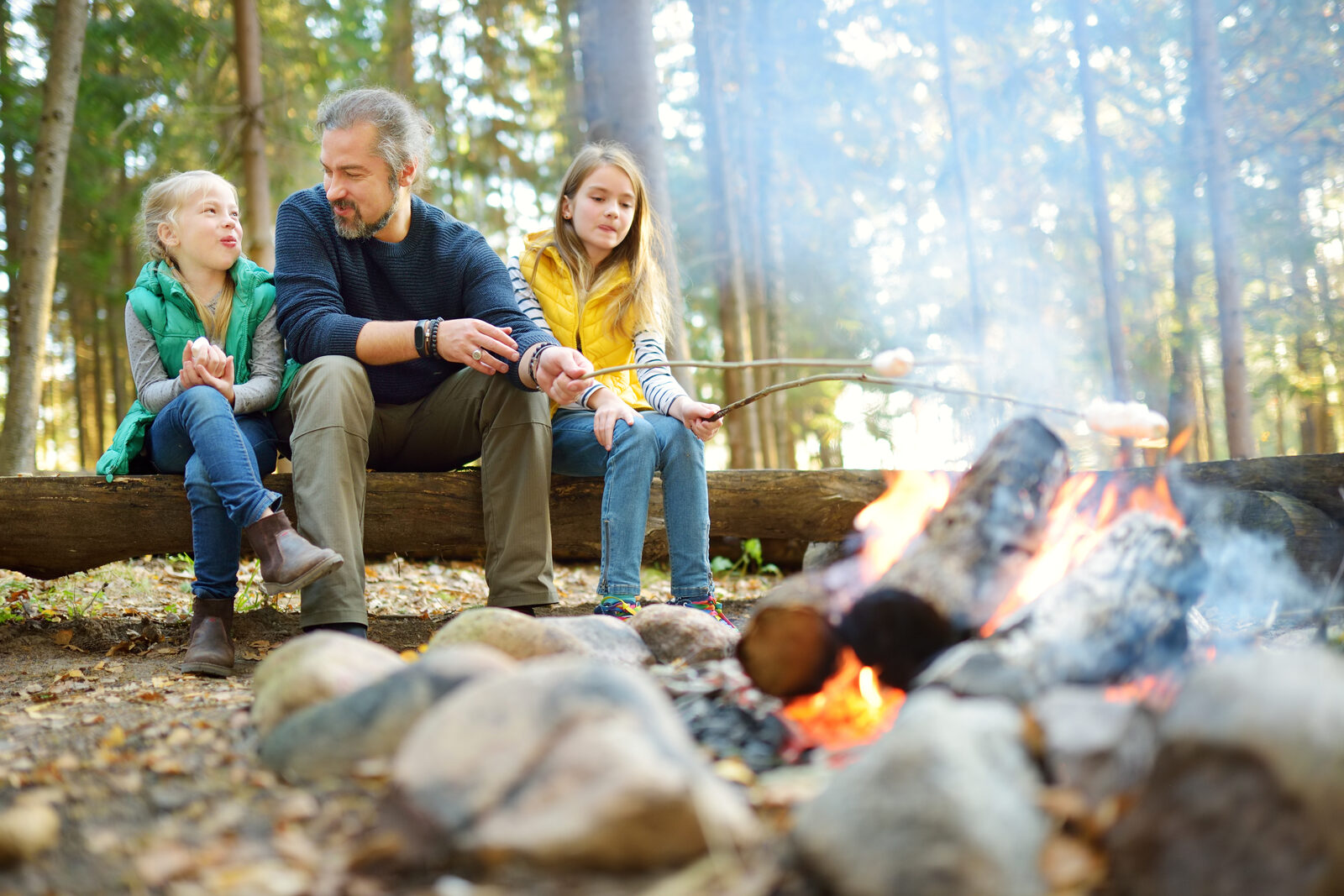
The fire is the heart of camp and a whole evening’s entertainment on its own. Keep a strict arm’s-length rule for little ones and never leave kids unattended near flame, then lean in: tell stories (round-robin “and then…” tales, gentle ghost stories for older kids), sing camp songs, and play word games like Twenty Questions and I Spy. Cooking is entertainment too. Let kids roast s’mores, toast bread on a stick, or make banana boats and foil-packet dinners they assembled themselves. Learning to build and tend the fire safely is a genuine thrill for older kids; our guide to starting a fire in any conditions is a good primer to teach from, always under close supervision.
Fun with a safety net
The best camp activities involve fire, water, knives, and roaming, which is exactly why they’re memorable, and why supervision matters. Match the activity to the child, set the rules first, keep a first-aid kit handy, and know that a scraped knee treated calmly becomes a good story, not a disaster.
Building & making: forts, whittling, crafts
Kids are natural builders and makers, and camp is full of raw material:
- Stick forts and lean-tos. Give them a patch of woods and watch a whole afternoon disappear. Tie-off practice with cheap cordage adds a skill, learning a few knots is a quiet superpower.
- Whittling. For older, ready kids, carving a marshmallow stick or a simple point is a rite of passage. Teach the rules first. Carve away from your body, keep a “blood circle” of space around you, cut on your lap over your knees, and always supervise. A simple, safe folding knife like the Opinel No.8 is a classic first blade; our guide to wilderness knives covers safe handling and care.
- Nature crafts. Leaf rubbings, painted rocks, twig rafts, pinecone animals, friendship bracelets, and “fairy houses” from bark and moss.
- Journals & nature art. A cheap notebook becomes a trip log, a sketchpad, or a pressed-leaf album.
Water, dirt, and mud play
If there is a safe, shallow creek or lakeshore, you have a free water park. Skipping stones, damming a trickle with rocks, floating stick “boats,” catching (and releasing) minnows and tadpoles, and plain old splashing will occupy kids for hours. Dirt and mud are just as good: digging, mud “kitchens,” and construction sites with toy trucks. The one rule is water safety, little ones near water need eyes on them at all times, life jackets for anything deeper than wading, and a clear edge they do not cross without an adult. Bring a full change of clothes and expect everyone to get filthy; that is the sign of a good day.
Bugs, critters, and wildlife watching
Small creatures are endlessly fascinating to kids. Flip logs and rocks (and gently replace them) to find beetles, worms, and salamanders; watch an ant highway; catch fireflies at dusk in a jar and let them go; and use a cheap magnifying glass or bug box for a closer look. A small pair of binoculars turns bird- and animal-watching into a mission, and a track-and-scat spotting game teaches real woodcraft. Teach respect and safety alongside the wonder: observe from a distance, never chase or corner an animal, and know which critters to leave well alone, our guides to wildlife encounters and snakes, spiders, and stinging insects cover the rules. And keep food and scented items packed away so your fun does not draw animals into camp.
After dark: stars, flashlights, night walks
The hours after sunset are pure magic without a screen in sight. Lie back for stargazing , spot the Big Dipper, trace it to the North Star, hunt for satellites and shooting stars, and make up your own constellations (the same night sky we use for finding direction without a compass). Hand out headlamps or glow sticks for flashlight tag, shadow puppets on the tent wall, and glow-stick ring toss. A short, calm night walk to listen for owls and watch for eyeshine is thrilling for kids, a good headlamp each keeps it safe, and a “quiet as a fox” challenge keeps it calm. Wind down with a story in the tent as everyone’s eyes get heavy.
Quiet-time activities
Every camp day needs a low gear, for the heat of midday, for winding down, and for the adults’ sanity. Keep a small stash of screen-free quiet fun: a deck of cards (Go Fish, Uno, solitaire), travel board games and dice games, books, mad-libs and dot-to-dots, string games like cat’s cradle, and drawing supplies. Reading in a hammock or playing cards in the shade is not a failure of outdoor spirit. It is the rest that lets the next adventure happen.
Give them real camp jobs
Kids love being useful, and “jobs” are secretly some of the best entertainment there is. Put them in charge of gathering tinder and kindling, hauling (filtered) water, pumping the water filter, sweeping out the tent, sorting gear, helping cook, and running the “camp store.” Frame it as responsibility, not chores, a job with a title (“Fire Marshal,” “Water Chief,” “Chief Bug Scout”) is a badge of honor. They learn real skills, they feel part of the team, and they are busy and proud instead of bored.
Ideas by age
Match the activity to the camper:
- Toddlers (1–3): water and dirt play, buckets and cups, short scavenger “find a rock” hunts, splashing, and lots of naps and snacks. Constant supervision; keep the world small and safe.
- Young kids (4–7): scavenger hunts, hide and seek, bug catching, fort building, crafts, s’mores, and simple jobs like gathering sticks. Big imagination, short attention, rotate activities.
- Big kids (8–12): knots and whittling, fire-tending under supervision, real hikes, capture the flag, journaling, cooking their own foil dinners, and bigger responsibilities.
- Tweens & teens: give them ownership. Plan a hike, run navigation with a map and compass, teach the younger ones, or lead the fire. Autonomy and a real role beat any game.
Rainy days and downtime
Weather happens, and a wet day does not have to mean screens. A big tarp shelter over the picnic table turns rain into cozy fun, cards, board games, crafts, and cocoa underneath it. Puddle-jumping and mud play in rain gear is a blast if everyone is dressed for it (see what to wear in the bush). Keep a “rainy-day box” of new-to-them cheap activities in reserve, tell stories, build a blanket fort in the tent, and remember that a lazy, drizzly afternoon reading and dozing is one of camping’s underrated pleasures.
A screen-free activity kit
You do not need much. A small bin of open-ended gear covers almost everything above:
- A deck of cards and one or two travel games
- A cheap magnifying glass or bug box, and small binoculars
- A ball of cordage/string (knots, forts, crafts) and a roll of duct tape
- A notebook and pencils/crayons per kid
- A whistle and a headlamp for each child, plus a few glow sticks
- A bucket and scoop, and a bag for treasures
- Marshmallows and s’mores supplies (never underestimate them)
- For ready older kids: a safe folding knife for supervised whittling
- Full changes of clothes and rain gear so weather and mess never end the day
Key takeaways
Keeping kids entertained without screens at camp is less about clever activities and more about getting out of the way: set the boundaries, pack a little open-ended gear, offer a spark when they stall, hand them real jobs, and let the outdoors do the heavy lifting. Scavenger hunts, forts, fire, water, bugs, and stars have entertained kids for generations and will again. Build a safe camp, keep everyone fed, warm, and dry, embrace a little boredom and a lot of dirt, and the memories will make themselves.
Wilderness Experts is reader-supported. As an Amazon Associate we earn from qualifying purchases; when you buy through links on our site we may earn a commission at no extra cost to you. It never changes what we recommend.