
WATERFLY 20L hiking daypack review: the budget pack with a backbone
A packable daypack is a fine first bag until the day you put a full water bottle, a jacket and lunch in it and feel it fold around your spine. The fix is structure, and structure usually comes at a premium price. The WATERFLY 20L puts a stiff frame sheet into an inexpensive daypack, which keeps a day’s load in shape and off your back. What it leaves out is a hipbelt that carries weight, and that one omission determines in what situations it should be used.
Quick take
A well-made budget daypack with the one thing a packable lacks: a frame sheet, so it holds its shape and keeps lumpy gear off your back. It easily holds a day’s water, layers and lunch, carries a hydration reservoir or a laptop, and fits as airline carry-on. The waist strap is plain webbing that steadies the pack but carries no weight, so everything rides on your shoulders. Use it on short and mid-length day hikes and it is excellent value.
Waterfly saw our review of their 35L packable daypack and was kind enough to send us this pack, free of charge, to evaluate alongside it.
What it does
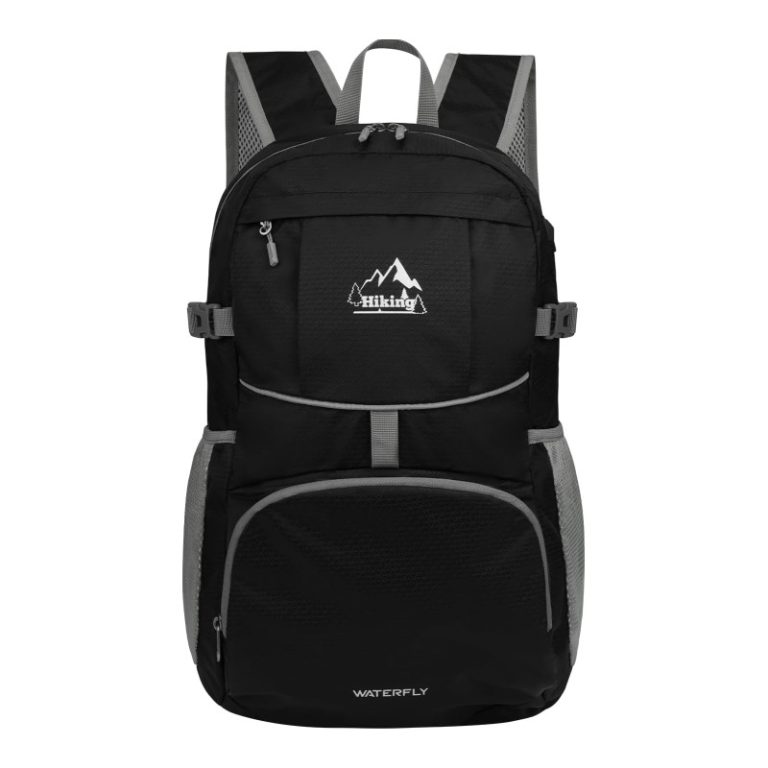
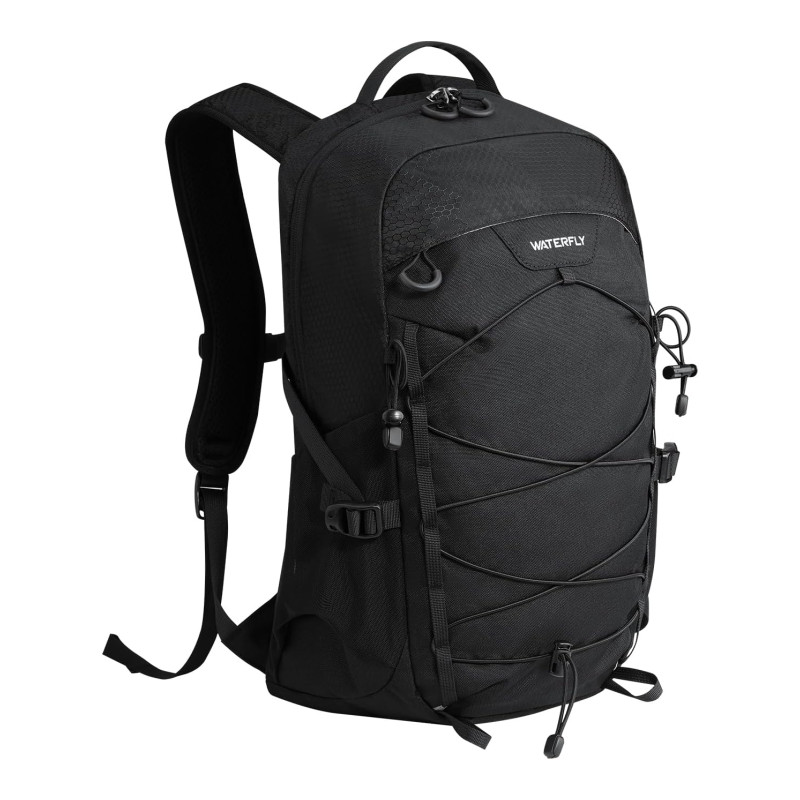
The WATERFLY 20L is a conventional hiking daypack: a wide zippered main compartment, a front zip pocket for small things, an internal zip pocket, two deep side pockets for water bottles, a bungee cord across the front for a wet jacket, and loops to carry trekking poles. The sternum strap carries a built-in whistle — very handy. At about 1.4 pounds (620 g) it is roughly twice the weight of the packable 35L, and the difference is almost entirely structure.
That structure is a polypropylene frame sheet, a stiff plastic board sewn into the back panel. In a big pack, a frame sheet gathers the load and hands it down to a padded hipbelt. Here there is no load-bearing belt to hand it to, so the sheet does a different and still worthwhile job: it keeps the pack flat against your back, stops uncomfortable packed items from pressing into your spine, and stops a half-full pack from slumping into a sack. A ventilated mesh back panel sits over it to let some air move. The waist strap is plain webbing. It keeps the pack from swinging when you step down off a rock or hop a root, but it is not padded and does not carry weight, so what you pack rides on the shoulder straps. Webbing below the padded shoulder straps adjusts their length, so you can snug the pack up high against your back, where a pack with no hipbelt carries best.
Inside the main compartment is a padded sleeve that takes either a 2L hydration reservoir, hung from a buckle clip at the top of the sleeve, with a hose port marked H2O at the top of the back panel, just below the grab handle, or a laptop as large as a 15.6-inch model. The outer fabric is 600-denier polyester with 200-denier nylon, water-resistant rather than waterproof, and the pack measures 18.9 by 10.8 by 6.5 inches (48 by 27 by 16.5 cm), which fits standard airline carry-on limits.
What verified buyers say
Across verified-purchase reviews, the same points come up:
- The right size for a day on the trail. Owners describe it holding snacks, water bottles and a change of clothes, and one reports it carrying everything needed for day hikes of 3 to 8 miles (5 to 13 km).
- Light and well made for the money. Sturdy, lightweight, versatile and well designed are the words that recur, from buyers who used it on the trail rather than just around town.
- Heavy loads land on the shoulders. One buyer found it hurt their shoulders and back and advises packing light, which is exactly what a pack without a load-bearing hipbelt will do when it is overfilled.
Worth knowing
With no load-bearing hipbelt, this pack is only as comfortable as the weight you put in it. Keep it to what a day needs: water, a warm layer, a rain shell, lunch and the small kit of the Ten Essentials. The padded sleeve takes a reservoir or a laptop, so on a hiking day the laptop stays home. It is water-resistant, not waterproof: in steady rain, water gets in through the zippers and seams, so line it with a bag or carry a pack cover.
Who it is for
In carrying support, this is the step between our two daypack picks. The WATERFLY 35L packable is the right bag for travel, a summit sack, or a first pack for easy days, but it has no frame, so a real load sags and digs in. The WATERFLY 20L is smaller, but it fixes that: the pack keeps its shape, sits steadier, and has a padded sleeve for a hydration reservoir. It suits half-day and day hikes in mild conditions, the kind of day where the pack holds water, layers and lunch and not much else, and it doubles as a tidy carry-on or a laptop bag for the commute.
When your days get longer, hotter or more committed, the weight goes up with the water and the extra layer, and that is when a hipbelt that carries weight earns its price. Our guide to fitting and packing a backpack explains why the hipbelt does the work, and the Osprey Talon 22 is the daypack we recommend for that job: similar capacity, a supportive hipbelt, and a harness that adjusts to your back.
Specs at a glance
Type: framed daypack (fixed polypropylene frame sheet) · Capacity: 20 L · Weight: about 1.4 lb (620 g) · Size: 18.9 × 10.8 × 6.5 in (48 × 27 × 16.5 cm) · Fabric: 600D polyester and 200D nylon, water-resistant · Hydration: padded sleeve with a hanging clip for a 2L reservoir, or a 15.6-inch laptop; hose port · Waist strap: webbing, not load-bearing · Best for: half-day and day hikes, travel, commuting
Wilderness Experts is reader-supported. As an Amazon Associate we earn from qualifying purchases; when you buy through links on our site we may earn a commission at no extra cost to you. It never changes what we recommend.
The Verdict
The WATERFLY 20L is what a budget daypack should be: sensibly sized, well made, and built around a frame sheet that makes a day’s load sit properly instead of sagging against your back. Its limit is honest and easy to live with once you know it. The waist strap steadies the pack but does not carry it, so the weight stays on your shoulders, and the answer is to pack for the day rather than for every possibility. Load it with water, layers, lunch and the essentials, and it is a comfortable, capable pack for the hikes most people actually do. If you already feel the straps by midday, that is the sign to step up to the Osprey Talon 22.