
Hiking after 50: how to keep hiking well for decades
Plenty of the strongest hikers on any trail are past fifty. They have decades of judgment, they know their own bodies, and many of them have more time for the mountains now than they did while raising kids or building careers. What changes with age is not whether you can hike, but what it takes to keep hiking well: recovery runs slower, balance needs deliberate work, the body handles heat and cold less forgivingly, and a growing medicine cabinet starts to matter on the trail. None of that is a reason to stop. All of it is a reason to hike a little differently.
This guide is for hikers in their fifties, sixties, seventies and beyond, whether you have been walking all your life or are coming back after a long gap. It covers what really changes and what does not, when a conversation with your doctor is worth having, how common medications behave on the trail, training that carries over to real terrain, balance and falls, knees and joint replacements, pace and recovery, heat, cold and water, carrying less, sleeping well outside, insurance and rescue, and choosing trips that fit. Where we already have a deep guide on a topic, we point you to it rather than repeat it.
What changes after fifty, and what does not
Aging is not one change. It is several slow ones, arriving at different rates in different people, and most of them respond to training far more than people expect.
- Aerobic capacity drops, but how fast depends heavily on you. Studies of master athletes who kept training hard found their aerobic capacity declined at roughly half the rate seen in sedentary people of the same age. A good part of what gets called aging is really doing less.
- Muscle mass and strength decline, gradually through middle age and faster from about sixty. Leg strength is what gets you up a steep step and, more importantly, controls you on the way down.
- Balance gets worse without practice. The inner ear, the sensors in your feet and ankles, your eyesight and your reaction time all contribute, and all of them slip. This is the change most likely to hurt you on a trail.
- Recovery takes longer. The soreness from a big descent that used to be gone in a day may now take two or three, and back-to-back hard days accumulate damage faster.
- Temperature regulation weakens. Older bodies start sweating later and sweat less, so they store more heat, and thirst becomes a less reliable signal. In the cold, the body is slower to clamp down blood flow to the skin and to shiver.
- Bones thin, especially in women after menopause, which raises the stakes of any fall.
Some things do not decline, or improve. Endurance at a steady, moderate pace holds up well. Judgment, patience and knowing when to turn around tend to get better. And one surprise from altitude research: older age does not raise the risk of acute mountain sickness. A study of travellers aged 59 to 83 at a Colorado resort found a slightly lower rate than is usually reported in younger visitors, and later reviews have found no increase with age. The same study included many people with coronary artery disease, high blood pressure or lung disease, and none had a problem during five days at 8,200 feet (2,500 m). Higher and harder trips are a different question for anyone with heart or lung disease, and our guide to altitude sickness covers ascent rates for everyone.
Your heart, and when to see a doctor first
Hiking is good for your heart. It is also, for a small number of people, the moment an existing heart problem shows itself. Research on sudden cardiac death among mountain hikers in the Austrian Alps, led by Martin Burtscher over several decades, found the risk rises sharply in men past their mid-thirties and is concentrated in people with a previous heart attack (about eleven times the risk), diabetes (about seven times) or high cholesterol (about three times). Roughly half the deaths happened on the first day of hiking, usually in the late morning, and the researchers point to unaccustomed hard effort and long stretches since the last food and drink as the main triggers. Regular mountain activity was strongly protective: people who spent more than two weeks a year hiking or skiing in the mountains had about a quarter of the risk.
That points to who should talk to a doctor before a big step up, rather than everyone before every walk. Book the appointment if any of these apply:
- You have had a heart attack, stent, bypass, heart failure, an irregular heartbeat, or a stroke.
- You have diabetes, kidney disease, or high blood pressure that is not under control.
- You get chest discomfort, unusual breathlessness, dizziness, or a racing or skipping heartbeat with effort, even if it passes when you stop.
- You have been inactive for a long time and are planning something much harder than your current activity: a steep climb, a trip at altitude, or a multi-day route.
Go with specifics. “I want to hike 10 miles (16 km) with 3,000 feet (900 m) of climbing at 8,000 feet (2,400 m)” gets a far more useful answer than “is hiking okay?” A doctor may suggest an exercise stress test, adjust medication timing, or give you a target effort level. The Canadian 24-Hour Movement Guidelines for adults 65 and over and the physical activity readiness questionnaires used by fitness professionals are a reasonable place to check yourself first.
Heart attack on the trail: act on the first signs
Chest pressure, squeezing or pain, especially spreading to the arm, neck, jaw or back, with breathlessness, nausea, a cold sweat or lightheadedness. Women are more likely to have breathlessness, upper back or jaw pain, pain in the upper abdomen, or extreme fatigue without obvious chest pain. Stop, sit the person down, and call for help immediately by phone or satellite messenger. If they are not allergic to ASA (Aspirin) and have not been told to avoid it, have them chew and swallow one regular-strength 325 mg tablet or two 81 mg low-dose tablets, the size often called baby aspirin. Keep them still, and do not have them walk out. Carry a few chewable 81 mg baby aspirin in your first-aid kit.
Medications on the trail
By sixty, most people take at least one daily medication, and several common ones change how your body responds to exercise, heat and water. None of these is a reason to stay home. They are reasons to ask your pharmacist or doctor one question: “How does this behave when I am exercising hard for hours, in heat or cold, possibly short of water?”
- Beta blockers (metoprolol, atenolol, bisoprolol and others) hold your heart rate down, so a watch’s heart-rate zones stop meaning much. Pace by effort instead, using the talk test: you should be able to speak in full sentences while climbing. Beta blockers also reduce sweating and skin blood flow, so you heat up faster.
- Diuretics (water pills such as hydrochlorothiazide and furosemide) increase fluid and salt loss. In the heat, that means dehydration comes sooner.
- Thiazide diuretics and SSRI antidepressants (sertraline, citalopram and others) each raise the risk of low blood sodium in older adults, and the risk is higher when they are taken together. On a long, hot day, that is the same condition as exercise-associated hyponatremia, which looks like heat exhaustion but is made worse by drinking more plain water. Our heat illness guide explains how to tell them apart.
- Blood thinners (warfarin, apixaban, rivaroxaban, and daily aspirin) make a fall more dangerous. Any head strike while on a blood thinner means getting out and getting checked, even if the person feels fine, because bleeding inside the skull can take hours to show. Cuts also bleed longer, so carry extra gauze and know how to apply firm direct pressure.
- Insulin and other diabetes medications can drive blood sugar too low when you walk for hours, sometimes late in the day or overnight. Test more often than at home, carry fast sugar where you can reach it without taking off your pack, and tell your partners what low blood sugar looks like in you. Insulin must be kept from freezing and from heat: carry it close to your body in winter and insulated in summer.
- Antihistamines, some bladder medications, and some sleep aids reduce sweating and can make you drowsy or unsteady.
- Blood pressure medications in general can make you lightheaded when you stand up fast after a rest stop. Stand up slowly and wait a moment before you shoulder your pack.
Practical habits help with all of them. Carry a written list of your medications, doses and conditions in your first-aid kit, where a partner or rescuer can find it. Split your supply between two places on multi-day trips, and bring a few days extra. If a trip crosses time zones, ask your pharmacist how to shift your dosing times. And if you carry nitroglycerin spray or an epinephrine auto-injector, make sure your partners know where it is and how to use it.
Go easy on ibuprofen and naproxen. Hikers take them for sore knees without a second thought, but these drugs reduce blood flow to the kidneys, and so do dehydration and hard exercise. In a randomized trial during ultramarathons, runners given ibuprofen developed acute kidney injury more often than those given a placebo. Kidneys lose reserve with age, and many blood pressure drugs add to the load. Treat pain with acetaminophen where your doctor agrees, use anti-inflammatories only when you are well hydrated, and never take them to push through pain on a hard day.
Training that carries over to the trail
The single best thing you can do for your hiking after fifty is train between hikes. Walking alone keeps your aerobic base, but it does not build the leg strength and balance that trails demand. Both the Canadian guidelines and the World Health Organization recommend that older adults get at least 150 minutes of moderate activity a week, do muscle strengthening at least twice a week, and include activities that challenge balance. That is also, almost exactly, a hiking training plan.
Strength
Twice a week, work the muscles that carry you up and control you down. Start with body weight, add a loaded backpack or dumbbells as it gets easy, and progress slowly.
- Step-ups onto a stair or sturdy box, 6 to 12 inches (15 to 30 cm) high to start. Drive up through the front heel.
- Slow step-downs. Stand on a step and lower the other heel to the floor over a slow count of three, then step back up. This trains the braking work of descending, which is the kind of work that causes deep soreness and knee pain on the way down.
- Sit-to-stand from a chair without using your hands, then squats as that gets easy.
- Calf raises, on both feet, then one, for ankle strength on uneven ground.
- Hip and core work: side-lying leg raises, bridges, and a plank held for as long as your form is good.
Balance
A few minutes most days, ideally near a counter you can grab. Stand on one foot while you brush your teeth. When that is easy, turn your head side to side, then close your eyes. Walk heel to toe along a line. Stand on a folded towel or a cushion to mimic soft, shifting ground. Tai chi has good evidence for reducing falls in older adults, if a class suits you better than drills.
Aerobic base and trail-specific work
Walk briskly most days, and once a week walk hills or stairs, down as well as up. Then practise the real thing: carry the pack you will use, gradually build toward the distance and climbing of your target hike, and include descents. Stair and hill work in the weeks before a trip is the best defence against the quad soreness that turns day two into a slog.
Start from where you are
If you are coming back after years away, begin with flat walks you can finish feeling fresh, then add one thing at a time: distance, then climbing, then pack weight. Give each step two to three weeks. Tendons and bones adapt more slowly than your heart and lungs, so feeling strong is not the same as being ready for more.
Balance, eyesight, and falls
Falls are the leading cause of injury for adults over 65, and the US Centers for Disease Control and Prevention reports that more than one in four older adults falls each year. On a trail, the ground is uneven, you are often tired, and help is far away, so preventing falls deserves more attention than any other part of this guide.
Check your glasses
Bifocals and progressive lenses put the reading portion at the bottom, which is exactly where you look to watch your footing. An Australian study of people aged 63 to 90 found that wearers of multifocal glasses had worse depth perception and edge contrast when looking through the lower part of the lens, and were more than twice as likely to fall, especially on stairs and outside the home. A later randomized trial gave multifocal wearers a pair of single-vision distance glasses: for those who regularly spent time outdoors, falls dropped substantially.
If you wear bifocals or progressives, ask your optometrist about a pair of single-vision distance glasses for hiking, including prescription sunglasses. Carry cheap reading glasses in the lid of your pack for maps, phones and splinters.
Use two trekking poles
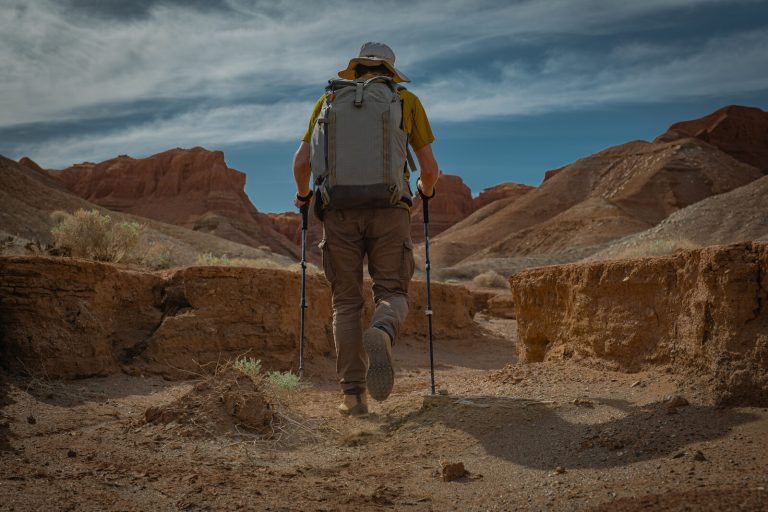
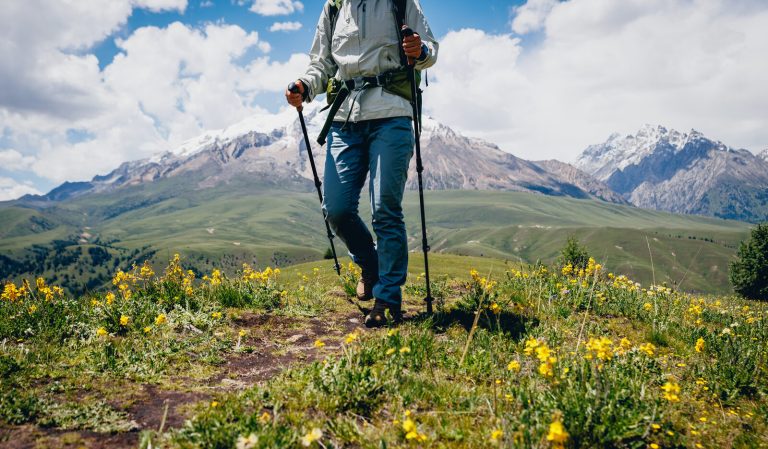
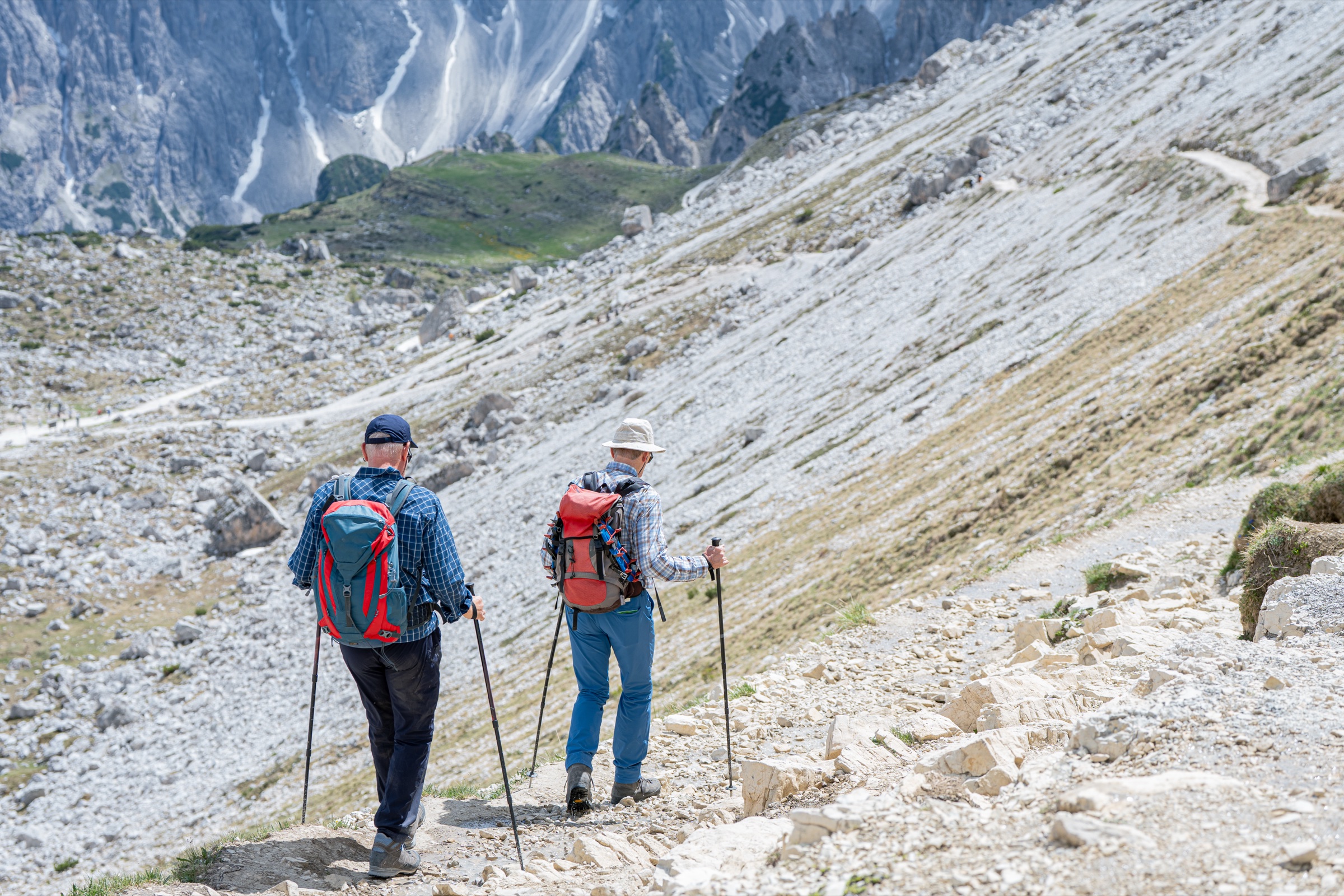
Two poles give you four points of contact on bad ground, catch a stumble before it becomes a fall, and take load off your knees. In a study of downhill walking, poles reduced forces on the knee by roughly 12 to 25 percent. Our trekking pole guide covers sizing and technique. Poles are standard kit for a large share of experienced hikers of every age, and on descents, river crossings and wet rock they are as close to a free safety upgrade as hiking has.
Walk to stay upright
- Shorten your stride on descents and keep your knees slightly bent, so each foot lands under you rather than out in front.
- Stop to look. Admire the view standing still, then look back at your feet before you move.
- Treat wet rock, roots, and wooden bridges as ice. Step on them flat-footed, or step around them.
- Watch the late afternoon. Falls cluster when you are tired and the light is going. That is the hour to slow down, not to hurry to the car.
- Put grip and fit first in footwear. A sole that holds on wet rock and a heel that does not lift matter more than the category. Our guide to choosing hiking footwear covers the trade-offs.
- Take down steep rock on your seat if that is what it takes. Nobody gives points for style.
For the technique of moving over loose rock and steep ground, see crossing difficult terrain.
Knees, hips, and joint replacements
Sore knees are the most common complaint among older hikers, and descents are almost always the reason. Walking downhill makes your thigh muscles work while they lengthen, as brakes, which loads the knee far more than climbing does. The fixes are mostly already in this guide: step-down training, two poles, shorter steps, and choosing routes where the descent is gentler than the climb. On a loop, it is often worth walking it in the direction that puts the steep section uphill.
Arthritis is not a reason to stop. For most people with osteoarthritis, regular walking reduces pain and stiffness over time, and strong thigh muscles protect the joint. The difference is in how you manage load: cushioned footwear, a lighter pack, flatter terrain on bad days, and a willingness to shorten a hike when a joint flares rather than walking hard on a swollen knee.
After a hip or knee replacement, many people return to hiking, often more comfortably than before. The timeline and limits belong to your surgeon and physiotherapist, so ask specific questions: how soon you can walk on uneven ground, whether steep descents or heavy packs are a concern, and what warning signs mean stop. Build back gradually, use poles, and expect the other knee or hip to complain for a while as it takes on its share.
Pace, distance, and recovery
Your pace should be set by breathing, not by the people around you. The talk test works at any age and on any medication: if you cannot say a full sentence, slow down. On climbs, the rest step, a brief pause with your weight on the straightened back leg before each step, lets you keep moving steadily without stopping to gasp.
Time estimates need adjusting. Naismith’s rule describes a fit, unloaded walker in good conditions, and most hikers already add time to it. Rather than guess, time yourself on a few known trails and build your own figure for how long a mile and 1,000 feet (300 m) of climbing takes you, then use that for planning. Set a turnaround time before you leave, and leave generous daylight at the end.
Plan around recovery as well as around effort:
- Make the first day of any trip an easy one, especially after travel or a drive to higher ground. The heart research above found the first day to be the riskiest, and it is also when soreness starts.
- Eat and drink steadily through the day. Long gaps without food or fluid were one of the triggers in that research, and they are also how hikers of any age run out of energy.
- Alternate hard and easy days on a multi-day trip, and schedule a rest day every three or four days on a long one.
- Allow two or three days between big hikes at home if your legs are still sore. Soreness that lasts is your body telling you the last one was a step up.
- Sleep counts as training. Short nights before a trip show up as slower legs and worse balance on the trail.
Heat, cold, and water
Heat
Because older bodies sweat later and less, they store more heat during the same work, and blood pressure and heart medications can add to that. Start early to finish climbs before the afternoon, take shade breaks before you feel you need them, wet your hat or a neckerchief at streams, and know the warning signs in yourself: headache, nausea, dizziness, unusual fatigue, or any confusion. Our guides to hiking in the heat and heat illness cover prevention and treatment.
Water
Thirst dulls with age, which tempts people to drink by the clock. That creates the opposite risk, especially for anyone on diuretics or SSRIs: drinking plain water well beyond what you lose can dilute the sodium in your blood. The site’s position is the same at every age. Sip steadily through the day, use thirst plus urine colour as your guide (pale straw is the goal, dark means drink more, and clear and frequent means you are overdoing it), eat salty snacks along with your water on long or hot days, and never force yourself to finish a set amount.
Many older hikers drink less on purpose to avoid needing a toilet on the trail. That trade-off is real, and it is a poor one on a hot or long day. Plan bathroom stops instead, and learn to go comfortably outdoors; our guide to human waste in the backcountry covers how.
Cold
With age, the body is slower to narrow the blood vessels in the skin and to start shivering, so heat is lost faster before the warning signs arrive. Put a layer on as soon as you stop rather than when you feel chilled, keep a warm hat and gloves in the pack year round in the mountains, and eat regularly, because shivering runs on food. Wet, windy weather around 45°F (7°C) is more dangerous than dry cold, and our hypothermia guide explains why. For how to layer, see what to wear in the bush.
Bones, menopause, and the long game
Walking with a pack is a weight-bearing exercise, which helps keep bones strong, and hiking is one of the better long-term investments you can make in them. Bone density still declines with age, faster in women in the years around menopause, and men lose it too, later. If you have been told you have osteopenia or osteoporosis, a fall that would bruise someone else could break a wrist or hip. That is a reason to take the balance, footwear and pole advice above seriously, not a reason to stay on pavement.
Menopause brings its own trail realities. Hot flashes are easier to manage in layers you can open without stopping, such as a zip-neck base layer and a vest. Sleep can be broken, which affects energy the next day, so plan easier mileage after a rough night. Many women also find they need a bathroom more often; carrying a small toilet kit and knowing how to use it without fuss makes that a non-issue. Talk to your doctor about bone density testing and about calcium, vitamin D and strength training, which together do more for fracture risk than walking alone.
Carrying less
A pack that felt fine at forty feels heavier at sixty-five, and every extra pound (0.5 kg) goes onto the knees on every descent. Carrying less is the most direct way to hike farther with less pain.
Start with the base weight, which is everything except food, water and fuel. The biggest savings are almost always in the shelter, the sleeping bag and pad, and the pack itself, so replacing those gradually as they wear out does more than trimming small items. For day hikes, a well-fitted daypack with a real hipbelt carries the load on your hips instead of your shoulders; our pack fit guide shows how to set one up.
Do not cut weight from safety. The Ten Essentials, your medications, a way to call for help, and enough warm clothing for an unplanned night all stay in the pack. Cut duplicate items, oversized containers and “just in case” gear that does not match the trip instead. In a group, share the shelter, stove and first-aid kit rather than carrying one each.
Sleeping well outside
A bad night on the ground costs older hikers more the next day, and the fixes are mostly equipment.
- Get a thicker, warmer pad. Hips and shoulders feel a thin pad more with age, and the body loses more heat to cold ground. An inflatable pad with a higher R-value, the rating for how well a pad blocks cold from the ground, fixes both. Our guide to staying warm through a cold night explains how to choose.
- Plan for getting up at night. Keep a headlamp in the same pocket every night and your shoes just outside the door. Pitch the tent on level ground with a clear path, because camp falls happen in the dark on the way to pee. A pee bottle, with a female urination device if you need one, saves the trip altogether in cold or bear country.
- Make getting up off the ground easier. A tent tall enough to kneel in, a campsite with a log or rock to push up from, or a light camp chair all help stiff knees and hips.
- Choose your nights. Huts, lodges, yurts and campgrounds with a car nearby are real options, not a lesser version of the trip. Walking all day from a comfortable base can give you more trail time than carrying a full pack.
Solo hiking, check-ins, and calling for help
Many people hike alone more as they age, because partners have moved, slowed down or stopped. Solo hiking is a legitimate choice, and it raises the value of a few habits:
- Leave a written trip plan with someone reliable: your route, when you expect to be out, your medical conditions and medications, and the time they should call for help if they have not heard from you. Our Leave Word tool does this for you: it emails your plan to your contact, puts an alert in their calendar for when you are due back, and has a box for medical issues and medications that is sent but never saved. Our trip planning guide covers what a good plan contains.
- Carry a way to call for help without cell service. A satellite messenger lets you send check-ins and have a two-way conversation with rescuers about your medical situation. A personal locator beacon sends an emergency signal only, with no subscription. For a hiker with a heart condition or diabetes, being able to describe the problem is worth a lot.
- Wear or carry medical information: a medical ID bracelet, or an emergency information card in your pack and the medical ID feature on your phone, which rescuers can read without unlocking it.
- Choose busier trails for solo days when you are trying something harder, so someone is likely to pass if you twist an ankle.
If you do get hurt or lost, the priorities are the same at any age. Our guides to what to do when lost and signalling for rescue cover staying put, staying warm and being found.
Insurance, rescue, and crossing the border
Readers on both sides of the border cross it to hike, and both national health systems cover surprisingly little once you do.
- Canadians hiking in the US: provincial and territorial health plans pay little or none of the cost of care outside Canada, at their home-province rates, and the Government of Canada advises buying travel health insurance before you leave. A hospital stay in the US after a fall can be financially devastating without it.
- Americans hiking in Canada: original Medicare generally does not cover care outside the United States. Some Medicare supplement plans and some Medicare Advantage plans include limited emergency coverage abroad. Check yours, and buy travel medical insurance if it does not cover you.
- Read the pre-existing condition clause. Many travel policies for older travellers exclude conditions that have not been stable for a set period before departure, and a medication change can count as unstable. Declare everything honestly, because a claim can be refused over an undeclared condition.
- Check what “rescue” means. Search and rescue in national parks is generally not billed to the person rescued, but ground or air ambulance transport afterwards often is. Some policies cover evacuation and some do not; confirm before you rely on it.
Put a copy of your policy number and the insurer’s emergency phone line with your medication list, so a partner can reach them if you cannot.
Choosing trips that fit
The distance printed on a trail sign tells you less than the climbing does. When you compare routes, look at total elevation gain, how steep the steepest section is, whether the descent is steep, how rough the footing is, and how far you are from a road at the hardest point. A 6-mile (10 km) route with 2,500 feet (760 m) of climbing on loose rock is a much harder day than a 10-mile (16 km) route on a gentle, well-built trail.
Useful ways to keep doing big trips as you age:
- Hut-to-hut and lodge-based trips let you carry a daypack across real mountain terrain.
- Out-and-back routes let you turn around at any point with the same trail home, instead of committing to a loop.
- Shoulder seasons are cooler and quieter, but shorter days and colder nights leave less margin, so plan with both in mind.
- Guided trips handle logistics and carry group gear, and a good guide adjusts the pace to the group.
- Base camping near the trailhead, with day hikes of different lengths, lets you match each day to how you feel that morning.
What a specific park asks of you, from the elevation and the season to the terrain and access, depends on your route, your group and the month you go.
Build your trip in the Trip Planner
Common mistakes
- Planning from the hikes you did twenty years ago. Memories of an easy ridge walk turn into a hard day now, with a late finish in the dark. Time yourself on a few local trails this season and plan from those numbers.
- Making the first day of a trip the big one. Half the sudden cardiac deaths in the mountain hiking research happened on the first day, and your legs have had no time to adapt. Schedule a short, easy walk on day one and save the summit for day two or three.
- Pacing by heart rate on a beta blocker. The medication holds your heart rate down, so the watch says you are fine while you are working too hard. Use the talk test: if you cannot say a full sentence, slow down.
- Hiking in bifocals or progressives. Looking at your feet through the reading portion blurs the edge of every rock and root, and falls follow. Ask your optometrist for single-vision distance glasses for the trail, and keep reading glasses in your pack.
- Walking descents with long strides and straight legs. That puts the full impact through your knees and makes a slip more likely. Shorten your steps, keep your knees soft, and plant both poles ahead of you.
- Taking ibuprofen to get through a long, hot day. Anti-inflammatories plus dehydration strain the kidneys. Drink properly, use acetaminophen where your doctor allows it, and shorten the day instead of masking the pain.
- Drinking to a fixed amount because thirst is unreliable. Forcing down plain water can dilute your blood sodium, especially on diuretics or SSRIs. Sip steadily, watch your urine colour, and eat salty food with your water.
- Keeping medications and medical details private from partners. If you collapse, they cannot tell rescuers what is wrong or find your spray or glucose. Put a written list in your first-aid kit and brief your partners at the trailhead.
- Carrying the same heavy kit you always have. Every extra pound (0.5 kg) goes through your knees on every descent. Weigh your pack, replace the heaviest big items as they wear out, and share group gear.
- Brushing off chest discomfort or unusual breathlessness as being out of shape. Those can be the only warning of a heart problem. Stop, rest, and if it does not settle quickly or comes back, call for help and get checked before hiking again.
- Stopping strength and balance training between trips. Leg strength and balance fade fast, and they are what keep you upright on rough ground. Keep two short strength sessions and a few minutes of balance work in every week, all year.
What to carry
The Ten Essentials apply at every age. These are the additions and upgrades that matter most after fifty:
- Two trekking poles: the Black Diamond Trail for sturdy, adjustable everyday poles, or the Cascade Mountain Tech for a lighter budget pair.
- Your medications and a written list, with a few days extra, split between two places on overnight trips.
- A first-aid kit you have added to, such as the My Medic MYFAK Large, with chewable 81 mg baby aspirin, extra gauze, fast sugar, and any rescue medications you are prescribed.
- A way to call for help: a satellite messenger or personal locator beacon.
- Single-vision distance glasses or prescription sunglasses, plus cheap readers for maps and phones.
- A bright headlamp with a good flood beam, such as the Black Diamond Spot 400-R, because older eyes need more light to read uneven ground.
- Cushioned, supportive socks and footwear: Smartwool Hike Light Cushion Crew (men’s / women’s), and footwear chosen with our footwear guide.
- A warm layer you can put on at every stop: the Mountain Hardwear Ghost Whisperer (men’s / women’s) packs small enough to always come along.
- For overnights, a thick insulated pad such as the Therm-a-Rest NeoAir XTherm, and a pee bottle.
- Salty snacks and electrolyte mix for hot or long days.
- Insurance details and an emergency contact card in a small dry bag with your medication list.
Key takeaways
Hiking after fifty is less about what you can no longer do and more about what you now need to do on purpose. Train strength and balance twice a week, all year, because they fade fastest and matter most on rough ground. See a doctor before a big step up if you have heart disease, diabetes or symptoms with effort, and act on chest discomfort or unusual breathlessness immediately. Learn how your medications behave with exercise, heat and water, pace by the talk test rather than heart rate on a beta blocker, and go easy on anti-inflammatories. Swap bifocals for single-vision glasses on the trail and use two poles, especially downhill. Make the first day of every trip easy, eat and drink steadily, and allow more time to recover between hard days. Start early in the heat, layer up at every stop in the cold, and drink to thirst and urine colour rather than a quota. Carry less, sleep on a thicker pad, and plan for getting up in the dark. Leave a trip plan with Leave Word, carry a way to call for help, and make sure your partners know your medical details. Check your travel insurance before you cross the border. Then pick trips by their climbing and footing rather than their distance, and keep walking.
Sudden cardiac death findings are from Burtscher and colleagues’ studies of mountain hikers in Austria, summarized in Niebauer and Burtscher, “Sudden Cardiac Death Risk in Downhill Skiers and Mountain Hikers and Specific Prevention Strategies,” International Journal of Environmental Research and Public Health, 2021. Heart attack signs and ASA dosing follow the Heart and Stroke Foundation of Canada and the American Heart Association. Fall statistics are from the US Centers for Disease Control and Prevention. Multifocal glasses findings are from Lord, Dayhew and Howland, Journal of the American Geriatrics Society, 2002, and the VISIBLE randomized trial, Haran and colleagues, BMJ, 2010. Knee force reductions with poles are from Schwameder and colleagues, Journal of Sports Sciences, 1999. The ibuprofen trial is Lipman and colleagues, Emergency Medicine Journal, 2017. Altitude findings are from Roach and colleagues, “How well do older persons tolerate moderate altitude?”, Western Journal of Medicine, 1995, and later reviews. Activity recommendations are from the Canadian 24-Hour Movement Guidelines and the World Health Organization. Insurance guidance is from the Government of Canada and Medicare.gov, current as of September 2026. This guide is general information, not medical advice: talk to your own doctor or pharmacist about your health and medications.
Wilderness Experts is reader-supported. As an Amazon Associate we earn from qualifying purchases; when you buy through links on our site we may earn a commission at no extra cost to you. It never changes what we recommend.