
Kahtoola EXOspikes Review: traction for trail that is only sometimes frozen
There is a kind of winter day that chews up a chain-and-spike device: frozen trail that keeps turning to bare rock, gravel and pavement, with ice only in the shaded corners. The Kahtoola EXOspikes are built for that day. They are the lower-profile, abrasion-resistant cousin of the MICROspikes, and they solve the mixed-surface half of the traction problem set out in our guide to winter hiking and snow travel.
Quick take
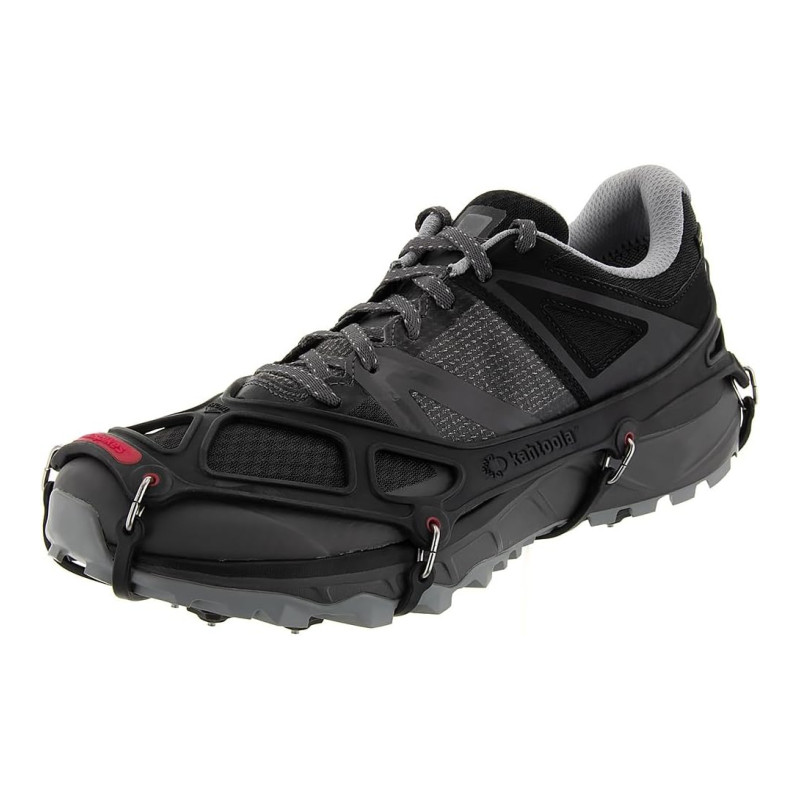
Traction for trail that is only sometimes frozen. Twelve spikes per foot working at three depths: tungsten carbide tips for ice, aluminum steps for uneven ground, and moulded lugs for loose stuff, all set in an abrasion-resistant matrix that survives the bare rock and pavement which shreds chains. Low profile enough to run in, and the same cold-flexible harness as the MICROspikes. The trade is bite: in soft snow lying over ice the short points do not reach through, and that is a real limit rather than a quibble. Runs small, so size up.
What it does
The EXOspikes are the answer to a question the MICROspikes do not ask. A chain-and-spike device is built to bite deep on snow and ice, and it pays for that on rock and road, where the chains ring, wear and get in the way. Kahtoola’s approach here is a TPU Traction Matrix, a moulded plate rather than a chain, carrying twelve points per foot that work at three different depths: tungsten carbide tips that take the ice, aluminum steps that grip uneven surfaces, and TPU lugs that dig into loose ground. The result is a device you can leave on across a mixed trail instead of stopping to strip it off every time the snow runs out. It is markedly lower profile than a spike device, which is why trail runners took to it, and the moulded shape sheds snow rather than balling up underneath. The harness is the same thermoplastic elastomer Kahtoola uses on the MICROspikes, with reinforced eyelets at the stress points and enough stretch to stay workable down to -22°F (-30°C). Kahtoola backs them with a four-year warranty.
What verified buyers say
Verified-purchase owners are weighted toward trail runners and walkers dealing with freeze-thaw cycles rather than deep-snow hikers, and the pattern is clear:
- They earn their keep on freeze-thaw ground. Runners in regions that cycle between thaw and refreeze describe them as the thing that makes winter running possible on trails that are ice one week and bare the next.
- Low enough profile to forget. Owners report a natural stride rather than the deliberate walk a taller device encourages, which is the whole argument for this design.
- Durability against abrasion. The recurring comparison is to cheaper devices that come apart quickly, with buyers pointing at the moulded matrix as the reason these survive the rock and road sections.
- Accessible across ages and abilities. Several older buyers single out being able to get them on and off unaided once correctly sized, on ground where they would otherwise stay home.
Worth knowing
Know the limit before you buy, because it is a genuine one: in fresh or soft snow lying over ice, the short points do not always reach through to the hard layer, and owners who bought these expecting deep-snow security have gone down. These are for hard packed surfaces and mixed terrain. If your winter is real snow depth, or hard glare ice on a mountain trail, the deeper bite of the MICROspikes is the right device and the reason we rate that one higher. Sizing runs small and the chart is optimistic, so if you are between sizes or wearing a wide or insulated boot, take the larger option. Expect a fight getting them on the first few times regardless: the harness is deliberately tight, which is what stops them rolling off, and it loosens with use. As with any traction device, check the elastomer at the start of each season and retire the pair when it begins to perish.
Who it is for
The Enthusiast rung of the traction ladder, and the pick for a specific kind of winter rather than a specific level of skill. Choose these if you are out often on trail that alternates between frozen and bare, if you run in winter, or if your ground is packed and hard rather than deep. A first traction device for gentle packed paths and town ice is better served by the cheaper Yaktrax Diamond Grip, and the all-round winter hiking answer is still the MICROspikes, which is why that pair sits in our Everyone tier and this one does not. Traction of any kind only solves the hard-and-slippery problem: when the snow is soft and deep you need flotation, which means snowshoes, and on a mixed day you carry both.
Specs at a glance
- Typemoulded matrix traction device
- Points12 per foot at three depths
- Materialstungsten carbide tips, aluminum steps, TPU lugs
- HarnessTPE elastomer, flexible to -22°F (-30°C)
- Warranty4 years
- Listed weight7.3 oz (208 g) · pair, size M
- Best formixed frozen and bare trail, winter running
Wilderness Experts is reader-supported. As an Amazon Associate we earn from qualifying purchases; when you buy through links on our site we may earn a commission at no extra cost to you. It never changes what we recommend.
The Verdict
The EXOspikes are the right device for a trail that cannot make up its mind. They hold on the ice, they survive the rock and pavement that destroys chains, and they sit low enough that you stop thinking about your feet. Buy them for freeze-thaw country and for winter running, size up, and be honest with yourself about depth: the moment soft snow is covering the ice, you want the deeper bite of the MICROspikes instead. Our guide to travelling safely on snow and ice covers how to read the surface and decide which one the day is asking for.