
MSR Lightning Ascent Review: the snowshoe for steep, firm snow
Most winter hiking happens on flat and rolling ground, and a standard modern snowshoe covers it. The MSR Lightning Ascent is for the days that are not that: firm crust on a side slope, a sustained climb, a traverse above a runout where sliding is not an option. It is the shoe our guide to winter hiking and snow travel means when it says take the modern ones with teeth.
Quick take
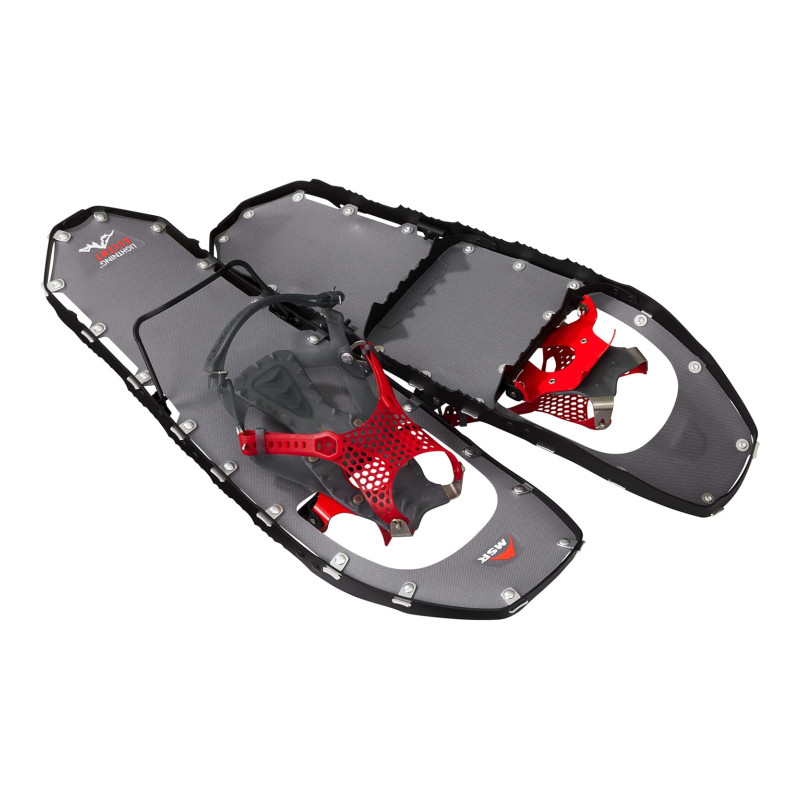
The snowshoe to own when the terrain has consequences. Serrated steel frames run the full perimeter rather than sitting in two clusters underfoot, so the whole edge bites on a traverse instead of only the bit under your boot, and steel crampons add the straight-line grip. The Televator heel lift takes the strain out of a long climb and flips with a pole tip. It is light for what it does, at 4 lb 5 oz (1.96 kg) for the 25 inch (64 cm) pair. Overkill on flat trail, and those perimeter teeth will shred fabric they touch. Buy it for steep and firm, not for a Sunday loop.
What it does
The Lightning Ascent answers a different question from an ordinary snowshoe. A standard deck carries steel under the ball of the foot and the heel, which is enough going straight up a moderate slope and much less reassuring across one. This shoe instead builds the frame itself out of serrated steel, so traction runs 360 degrees around the perimeter and the uphill edge has something to hold with when you are side-hilling on crust. MSR calls these Traction Frames, and the difference is most obvious in exactly the situation the guide flags as the hardest ground in winter, the traverse, where your uphill ankle rolls and the downhill edge finds nothing. Steel DTX crampons underfoot handle the straight-line bite. The Paragon binding uses a single contouring strap that wraps the boot instead of a set of separate straps pressing on hard points, which is what makes it workable in gloves and comfortable over a long day. The Ergo Televator heel lift bar flips up under the heel on sustained climbs and takes the load off your calf, and it is designed to be flicked with a pole tip so you are not bending down in deep snow. The 25 inch pair measures 8 x 25 inches (20 x 64 cm), weighs 4 pounds 5 ounces (1.96 kg) and is rated to carry a load up to 220 pounds (100 kg), with 22 inch (56 cm) and 30 inch (76 cm) sizes either side of it.
What verified buyers say
Verified-purchase owners skew heavily toward people doing hard days, winter peak-baggers, trail breakers and backcountry travellers, and they are unusually consistent. MEC’s own buyers rate them 4.7 across 162 reviews. The themes:
- The traction is the reason people buy them twice. Owners who have rented or owned several brands describe these as the pair that holds where others slid, particularly on icy slopes and firm traverses.
- The heel lift changes long climbs. Repeated praise for being able to raise and lower the Televator with a trekking pole without stopping or bending down.
- Light for the capability. Buyers doing sustained mountain days note the weight is low enough that they stop noticing the shoes, which is not the usual experience with an aggressive snowshoe.
- Owners name the ceiling honestly. A recurring line is that if these will not get you up something, you need actual crampons rather than a better snowshoe. That is the right boundary, and it matches ours.
Worth knowing
The perimeter teeth cut fabric. This is the most useful complaint in the review pool: the serrated frame that makes the shoe grip will also saw through the lower legs of snow pants when one shoe brushes the other, and buyers have wrecked trousers learning it. Widen your stride, and treat sturdy gaiters as part of the purchase rather than an accessory. Some owners find the Paragon binding fiddlier to release than the pull-tab systems on MSR’s other lines, which is worth practising at home in gloves before it matters. Sizing is by total loaded weight, not height, so add your winter pack before reading the chart, and note that the 25 inch (64 cm) shoe tops out around a 220 pound (100 kg) load. Listings and labelling are inconsistent about unisex versus men’s fit, so check the binding size range against your boot rather than trusting the category. And be clear about where this shoe stops: it is built for steep firm snow, not for glaciers or technical ice, and a route that genuinely needs crampons and an axe is a mountaineering route with its own training.
Who it is for
The Expert tier, and deliberately so. This is a shoe whose defining strengths are grip and performance on consequential ground, and a first-timer on rolling forest trail would be paying for capability they will never load. If your winter is flat and wooded, the MSR Evo Trail is the better buy and we would tell you to spend the difference elsewhere. Choose the Lightning Ascent when your days involve sustained climbing, firm side slopes, or terrain where a slip runs somewhere you do not want to go. Carry traction as well, because a day that justifies these shoes will usually include ground that wants spikes instead, and fit snow baskets to your poles. One boundary worth repeating from the guide: steep, firm and consequential terrain also raises the avalanche question, and no snowshoe answers that one.
Specs at a glance
- Sizes22, 25 and 30 in (56, 64 and 76 cm)
- Listed weight4.3 lb (2 kg) · pair, 25 in (64 cm)
- Traction360-degree serrated steel frames plus steel DTX crampons
- Heel liftErgo Televator, pole-flickable
- BindingParagon one-piece contouring strap
- Loadup to about 220 lb (100 kg) on the 25 in
- Best forsteep, firm and icy snow
This link goes to MEC. We have no affiliate relationship with them and earn nothing if you buy through it. We link it because this is a specialty snowshoe that is never stocked in quantity anywhere, and MEC carries it first-party in all three sizes, which is the most reliable way for a Canadian reader to actually get one. In the United States, REI and MSR both stock it.
The Verdict
The Lightning Ascent is the snowshoe that earns its keep on the days a normal snowshoe starts sliding. Steel around the whole frame rather than only underfoot is not a marketing distinction, it is the thing that holds you on a firm traverse, and the Televator turns a punishing climb into a merely hard one. It is more shoe than most winter hiking needs, and that is the point: buy it for the terrain, not for the brand. Wear gaiters with it, size from your loaded weight, and know that the moment the route needs an axe you have left snowshoe country. For everything gentler, the Evo Trail is the sensible pair, and our guide to travelling safely on snow and ice covers how to tell the two days apart before you leave the house.