
Kahtoola MICROspikes Review: the winter traction benchmark
Traction is the first winter purchase that changes what you can safely do, and the Kahtoola MICROspikes are the device most winter hikers end up owning. They are the answer to the hard, slippery half of the problem set out in our guide to winter hiking and snow travel: not flotation for deep snow, but grip on packed trail, frozen dirt and the glare ice that causes more injuries near the trailhead than deep snow ever does.
Quick take
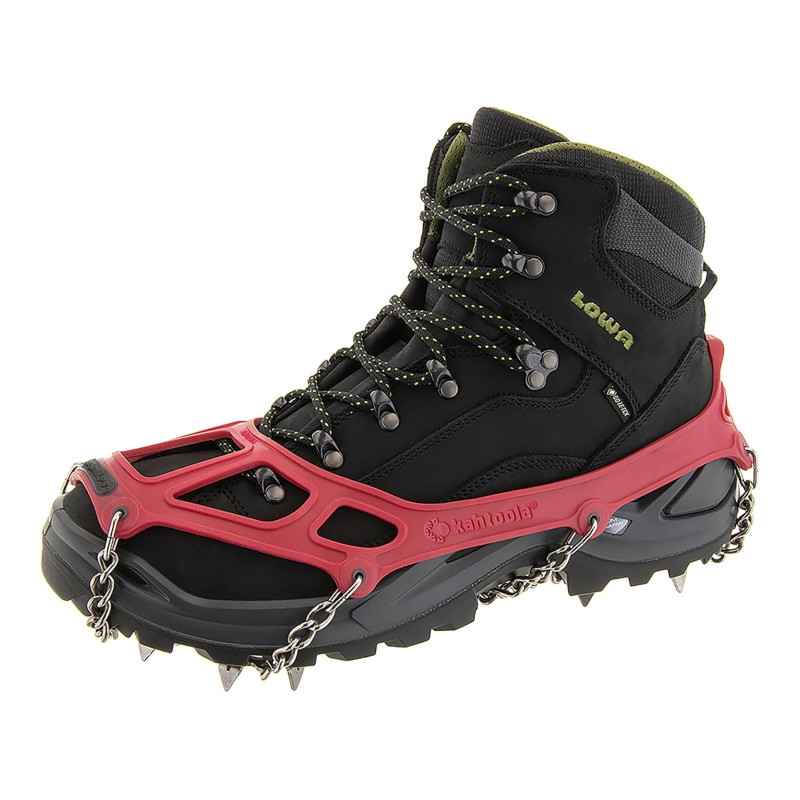
The benchmark traction device, and the one piece of winter kit we would tell anyone to buy first. Twelve stainless steel spikes per foot on welded chains, held on by a stretchy elastomer harness that still goes on with cold hands. They bite hard packed snow, frozen dirt and ice, they stow small enough that there is no excuse for leaving them in the car, and they come off in under a minute when the trail turns to bare rock. They are not crampons and they will not hold you on steep hard ice, and they do not float you in powder. Get the size right from the chart and they will last many seasons.
What it does
MICROspikes solve traction, not flotation. A moulded elastomer harness stretches over the boot and holds a set of welded stainless steel chains under the sole, carrying twelve heat-treated spikes per foot: eight under the forefoot and four under the heel. Weight lands on the spikes rather than the boot tread, so instead of skating across a frozen surface you get a positive bite in the same way a studded tyre works. The harness is a thermoplastic elastomer chosen to stay stretchy in the cold, rated by Kahtoola to remain flexible down to -22°F (-30°C), which matters because a rubber band that goes stiff is one you cannot get over a boot toe at 7am. Reinforced eyelets take the stress at the points where cheaper devices tear. The whole pair packs down to roughly 5 x 3 x 2 inches (13 x 8 x 5 cm), which is the reason they live in the pack all winter rather than getting left behind.
What verified buyers say
Verified-purchase owners, among them winter hikers, trail runners, ice fishers and people who simply have to get down an icy driveway, return to the same handful of points:
- They convert people from coil devices. The most common review arc is a long-time user of coil-and-spring traction who tries spikes once on real ice and does not go back. Buyers describe the difference as walking normally instead of shuffling.
- They work on more than ice. Owners report using them on frozen dirt, wet rock and steep hard-packed trail, not just snow, and several say they now reach for them any time footing is marginal.
- On and off in seconds. Repeated praise for how quickly they go over a boot and come back off, which is what makes people actually use them on a mixed day rather than pushing on without.
- They last. Multi-season owners report the spikes and chains outliving several winters of regular use, with the elastomer harness rather than the steel being the part that eventually gives out.
Worth knowing
Size from the chart against the boot you will actually wear, not your shoe size. The single most common complaint is a pair that will not stretch over a bulkier winter boot, and a device that is too small is one you will fight with in the cold or give up on. Too large is its own failure: a loose harness lets the chains rotate under the sole. The elastomer is the wear part, so check the harness and the eyelets at the start of each season and replace the pair when it starts to perish, because a band that fails mid-traverse leaves you on ice with nothing. The spike layout leaves gaps between contact points, which is worth remembering on off-camber ice where you want the whole foot loaded. And be clear about the limit: these are traction devices, not mountaineering crampons. On sustained steep ice you need rigid crampons, an ice axe and the training to use both, which is a different activity from winter hiking.
Who it is for
Anyone who walks on frozen ground. A first-time winter hiker gets the biggest single safety return available for the money, and an experienced one carries the same pair on hard trips, which is exactly why this sits in our Everyone tier rather than on the ladder. They pair naturally with trekking poles for the two extra points of contact that matter most on a traverse, and with gaiters once snow is deeper than your ankle. If your day is soft and deep rather than hard and slippery, traction is the wrong tool and you want snowshoes instead, and on a mixed day you carry both. If your walking is mostly packed sidewalks, plowed paths and the school run rather than mountain trail, the lighter Yaktrax Diamond Grip covers that ground for less.
Specs at a glance
- Typechain-and-spike traction device
- Spikes12 per foot, heat-treated stainless
- Layout8 forefoot, 4 heel
- HarnessTPE elastomer, flexible to -22°F (-30°C)
- Chainswelded stainless steel
- Pack sizeabout 5 x 3 x 2 in (13 x 8 x 5 cm)
- Listed weight11.9 oz (338 g) · pair, size M
- Best forpacked snow, frozen trail and ice
Wilderness Experts is reader-supported. As an Amazon Associate we earn from qualifying purchases; when you buy through links on our site we may earn a commission at no extra cost to you. It never changes what we recommend.
The Verdict
If you buy one thing before your first winter hike, buy these. MICROspikes turn the most common winter hazard, a frozen trail you did not expect, back into ordinary walking, and they do it with a device light enough that it stays in the pack all season. Know the boundary and you will not get into trouble with them: hard and slippery is theirs, steep and consequential belongs to crampons and a course. For the deep and soft half of winter see our review of the MSR Evo Trail snowshoes, and for how to decide between the two on the day, read our guide to travelling safely on snow and ice.