
Yaktrax Diamond Grip Review: everyday grip for packed snow and ice
Most winter falls do not happen deep in the backcountry. They happen on a packed path, a driveway or the last frozen hundred yards to the trailhead, which is the ground the Yaktrax Diamond Grip is built for. It is the cheap, light, easy answer to everyday ice, and the sensible first traction device for someone whose winter is mostly sidewalks and gentle trail rather than mountain terrain.
Quick take
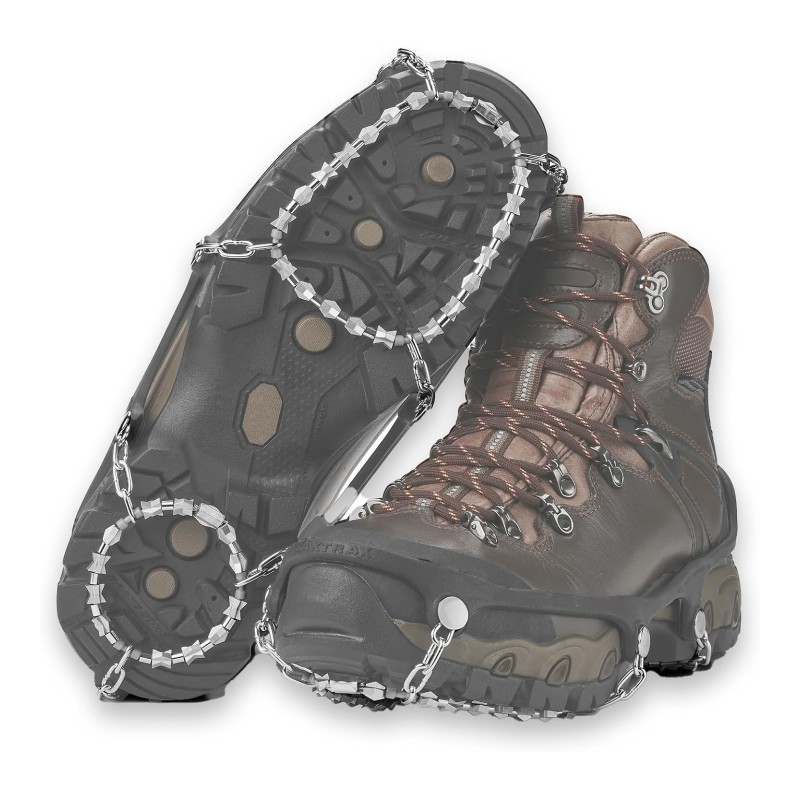
Everyday traction for packed snow and sidewalk ice, at a fraction of the weight and cost of a spike device. Case-hardened steel beads strung on steel cables give grip all the way around the foot rather than only under the tread, the rubber upper band stays flexible well below freezing, and they go on over almost any footwear in seconds. The tradeoff is depth of bite and lifespan: the beads cannot match spikes on hard glare ice or steep trail, and the cables are the part that eventually rusts or breaks. As a low-commitment device for town, packed paths and easy winter walking, they are hard to argue with.
What it does
The Diamond Grip sits between plain boots and a spike device. Instead of chains and points, it carries case-hardened steel alloy beads strung on aircraft-grade steel cables, riveted to a natural rubber upper band that stretches over the shoe. Because the beads run right around the footprint rather than sitting in two clusters, contact is spread across the whole sole, which is what makes them feel stable on flat frozen ground and on the sideways-tilted ice you get on a compacted path. There is no orientation to get right and nothing to buckle: you pull the band over toe and heel and walk. The rubber is a cold-resistant natural compound rather than a hard plastic, so it does not crack or split in sub-zero temperatures, and it is forgiving enough to fit a work boot, a walking shoe or a winter boot from the same size band.
What verified buyers say
Verified-purchase owners, heavily weighted toward dog walkers, commuters, older buyers worried about a fall, and people clearing snow, are consistent about where these fit:
- They restore normal walking on packed ice. The recurring theme is confidence rather than performance: owners describe walking upright on ground they had been shuffling across, on sidewalks that are a mix of frozen slush and bare patches.
- Easy enough that they get used. Buyers keep a pair at the door and a pair in the car, and the low friction of pulling them on is repeatedly cited as the reason they actually wear them.
- A clear step up from the coil version. Owners moving from the original coil Yaktrax report the diamond beads bite noticeably better on frozen ridges and refrozen slush.
- Buyers name the limit themselves. A common and useful review line is that these are not the choice for serious hiking or big grip on hard ice, and that a spiked device is the right tool there.
Worth knowing
Durability is the honest weak point. The most frequent critical report is the steel cable rusting and then parting, sometimes within a season or two of heavy use, and owners who wear them daily describe replacing a pair every winter or so. Treat them as a consumable rather than a lifetime purchase, rinse and dry them after use on salted ground, and check the cables before the first frost. Sizing runs tight for some buyers, so if you are near the top of a size band and wear a bulky boot, take the larger option. They are also not a mountain device: on steep or off-camber hard ice the beads skate where spikes would hold, and putting them on for a real winter trail is asking them to do a job they were not built for.
Who it is for
This is the Casual tier done properly: someone buying their first traction device, for packed paths, town ice, a frozen driveway or an easy winter walk. It lowers the barrier enough that people carry traction at all, which is worth far more than the difference between devices. For anyone heading onto real winter trail, or dealing with the glare ice described in our guide to winter hiking and snow travel, step up to the Kahtoola MICROspikes, which bite where these slide. If your ground is soft and deep rather than hard and slick, traction is the wrong problem entirely and you want snowshoes.
Specs at a glance
- Typebead-and-cable traction device
- Gripcase-hardened steel alloy diamond beads
- Cablesaircraft-grade steel, riveted to the band
- Bandcold-resistant natural rubber
- Coveragefull footprint
- Listed weight11.2 oz (318 g) · pair, size M
- Best forpacked snow, sidewalk and driveway ice
Wilderness Experts is reader-supported. As an Amazon Associate we earn from qualifying purchases; when you buy through links on our site we may earn a commission at no extra cost to you. It never changes what we recommend.
The Verdict
The Diamond Grip is the right amount of traction for the ground most people actually slip on. It is light, it is easy, and it removes the excuse for walking on ice with nothing. Buy it for town, packed paths and easy winter walking, expect to replace it after a few hard seasons, and do not ask it to hold you on a mountain trail. When your winter moves onto real trail, the Kahtoola MICROspikes are the upgrade, and our guide to travelling safely on snow and ice explains how to tell on the day which of the two the surface is asking for.