
Camp shovels and entrenching tools: how to choose and use one
Somewhere between the knife and the axe sits the most quietly useful tool a camper carries: something to dig with. A trowel or entrenching tool turns a dozen backcountry chores from miserable to trivial, a proper cathole instead of a scraped-out mess, a safe fire pit instead of a scorched forest floor, a drainage trench that keeps your tent dry, a leveled sleeping platform in the snow. This guide explains the whole family of digging tools, what each part does, every job they handle in the field, and how to use and care for one without hurting yourself or the land.
There is no single “best” digging tool, only the right one for how far you walk and how hard you dig. An ultralight trowel that vanishes in a pocket and a folding steel entrenching tool that trenches through roots and frozen ground are both correct answers to different questions. Learn the handful of ideas below and you will be able to pick up any shovel and know, at a glance, what it is good for.
The jargon, decoded
Shovel talk has its own shorthand. Skim this field glossary now, then refer back as you read.
- Trowel , a small hand digger, usually for one job: digging a cathole to bury human waste. Ultralight and pocketable.
- Entrenching tool (“E-tool”) , a compact folding shovel of military origin, built to dig fighting positions (“entrenchments”). The heavy-duty end of the family; folds small, digs hard.
- Tri-fold , the common E-tool design that folds in two places (blade against handle, then in half again) into a pouch-sized package.
- Cathole , the small hole (15–20 cm / 6–8 in deep) you dig to bury solid human waste, per Leave No Trace.
- Mattock / pick , a pointed or adze-like blade for breaking hard, rocky, or root-bound ground; many E-tools add a fold-out pick.
- Serrations , saw teeth on one edge of a shovel blade, for cutting roots and small branches.
- Haft , the handle or shaft of the tool.
- Locking collar , the threaded ring or lever on a folding E-tool that clamps the blade at a fixed angle so it does not fold under load.
- Shovel vs. hoe position , most E-tools lock the blade straight (a shovel) or at 90° (a hoe/adze) for chopping and scraping toward you.
- Dakota fire hole , a below-ground fire built in two connected holes; efficient and low-signature, and only practical if you can dig (see our fire-building guide).
Three tools, three jobs
Digging tools form a ladder from featherweight to heavy-duty. Match the rung to your trip.
- The backpacking trowel , a few ounces of aluminum or plastic whose one job is a fast, clean cathole. This is what most three-season hikers actually need, and the honest answer for anyone counting grams. Our budget pick is the NACETURE aluminum trowel; the cult-favorite is the tiny TheTentLab Deuce of Spades, which weighs less than a granola bar and digs far better than its size suggests.
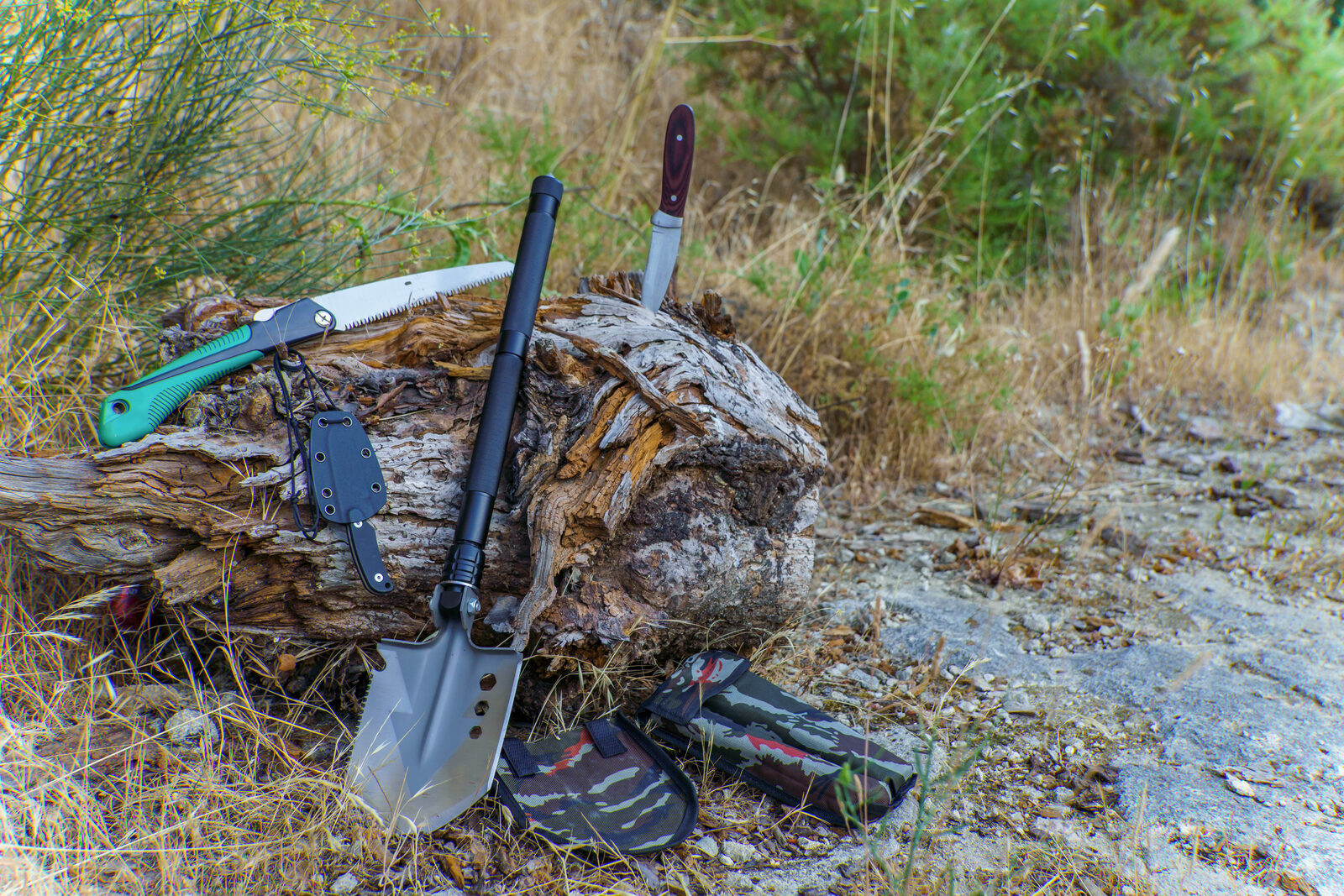
- The folding entrenching tool , a full-strength folding steel shovel that trenches, chops roots with a serrated edge, breaks hard ground with a fold-out pick, and doubles as a hoe, hammer, and pry bar. It is heavier (roughly 1–1.5 kg / 2–3 lb), so it belongs on car-camping, basecamp, winter, and vehicle/emergency kits rather than a fast-and-light thru-hike. Our pick is the SOG Entrenching Tool.
- The full-size shovel , a long-handled spade or a dedicated avalanche shovel. Overkill for the trail, but the right tool at a fixed basecamp, and (in the case of an avalanche shovel) a non-negotiable piece of winter safety gear that a folding E-tool does not replace, more on that below.
Rule of thumb
If your only real digging job is burying waste, carry a trowel and save the weight. Step up to a folding entrenching tool when you expect to build fire pits, trench for drainage, work frozen or rocky ground, or dig in snow, the jobs where a trowel simply cannot cope.
Anatomy of an entrenching tool
A folding E-tool has more moving parts than it looks. Here is the map:
- Blade , the digging head. A pointed or squared spade shape for moving dirt and cutting a clean edge.
- Cutting edge , the front lip of the blade. On better tools it is beveled sharp so it slices into soil and roots rather than just pushing.
- Serrated edge , saw teeth along one side of the blade for cutting through roots and small branches.
- Pick / mattock , a fold-out pointed spike (or wide adze) on the back of the head for breaking hard-packed, rocky, or frozen ground.
- Hinge and locking collar . The joint that lets the blade fold, plus the ring or lever that locks it rigid at the shovel or hoe angle. This is the part that determines how much abuse the tool survives.
- Haft (shaft) , the handle. Some extend telescopically for more reach and leverage.
- Grip / pommel . The end you hold; often a D- or T-grip on longer shovels, a plain capped handle on compact E-tools.
- Carry pouch . The belt- or pack-mounted case a folded E-tool rides in.
Materials: aluminum, steel, and plastic
What the tool is made of decides its weight, strength, and price. A real trade-off, not a matter of “better.”
- Plastic / polymer (trowels) , the lightest option, and fine for digging catholes in normal forest and meadow soil. The catch: cheap polymer trowels flex and snap the moment they hit a root or hardpan. A quality molded trowel like the Deuce is far tougher than a bargain-bin one.
- Aluminum (trowels and some E-tools) , light and rust-proof, with far more bite than plastic for prying against roots and stony ground. The sweet spot for a do-more backpacking trowel.
- Carbon or stainless steel (entrenching tools) , heavy but nearly indestructible: the only material that reliably trenches through roots, pries rocks, and takes the shock of a pick without bending. Carbon steel can rust, so it wants wiping dry and a light oil; stainless trades a little strength for low maintenance. A coating (paint or black oxide) helps carbon steel resist corrosion.
What a digging tool does in the field
A shovel earns its weight because it touches almost every part of campcraft:
- Human waste (the number-one reason to carry one). A trowel digs a proper cathole so you can bury solid waste the Leave No Trace way (see our full guide to dealing with human waste and building a latrine), central to backcountry hygiene and sanitation and to the “dispose of waste properly” principle in our Leave No Trace guide.
- Fire safety. Dig a fire pit down to mineral soil, cut a firebreak ring, build an efficient Dakota fire hole, and, most important, dig into and fully bury and drown a fire dead cold before you leave. You cannot properly put a fire out that you could not dig.
- A dry, level camp. Clear and level a tent site, and (only where digging is allowed and durable) cut a shallow drainage trench to divert runoff away from your shelter in a storm. A classic move covered in setting up a campsite and building an emergency shelter.
- Snow and winter work. Level a platform, cut snow blocks, dig a snow trench or quinzhee, and free a buried tent. In deep cold an E-tool with a pick breaks through frozen crust that a trowel bounces off.
- Breaking hard ground. The fold-out pick and serrated edge chop through roots, pry embedded stones, and cut into hardpan, clay, and rocky desert soil where a hand trowel is useless.
- Odd jobs. Hammer tent stakes with the flat of the blade, chop small brush with the edge, scrape a cooking surface, move hot coals and ash, and, in a genuine emergency, use it as a pry bar or a last-ditch defensive tool. It is one of the more versatile items in a vehicle survival kit.
A folding E-tool is not an avalanche shovel
For travel in avalanche terrain you need a dedicated, lightweight aluminum avalanche shovel with a large blade, sized for moving huge volumes of dense debris fast in a companion rescue. A compact folding entrenching tool is too small and slow for that job. Carry the real thing (with a beacon and probe, and the training to use them) when snow slopes are in play.
Digging technique that saves your back
Digging is where people wreck a cheap tool or a good back. A little technique goes a long way:
- Read the ground first. Pick a spot with softer, diggable soil, the downhill side of a log, a patch of duff, a gap between roots. For a cathole, that also means well off the trail and (see below) far from water.
- Score the outline. Cut the perimeter of your hole first with the blade edge or serrations, slicing any roots, then lift the plug of soil out whole so you can replace it later.
- Use the pick for hard ground. Lock the blade at the hoe (90°) angle, or deploy the fold-out pick, and loosen hard or rocky soil by chopping before you try to scoop it. Do not try to power a straight blade through hardpan. That is how handles and wrists get hurt.
- Kneel; let your legs and the tool do the work. Keep your back straight and drive with short, controlled strokes rather than big heaving swings. On a full-size shovel, step the blade in with your foot and lift with your legs, not your lower back.
- Keep the excavated soil on something. Pile it on a flat rock or your dug plug so you can backfill cleanly and leave no scar, especially for a cathole, which you fill and disguise completely.
Using it safely
A sharpened steel blade on a swinging handle deserves respect, and a dig gone wrong far from help is a real problem.
- Mind the arc. Before you swing a pick or chop with the edge, clear people, and your own shins and feet, out of the blade’s path.
- Lock it before you load it. On a folding E-tool, make sure the collar is fully locked at the shovel or hoe angle before you put weight on it; a blade that folds mid-stroke can trap fingers or gash a hand.
- Watch for buried hazards. Roots hide rocks; rocks hide wasps’ nests and, near old sites, buried glass and metal. Chop tentatively until you know what is down there.
- Protect your hands and back. Blisters come fast on a bare-handed dig. Gloves help. Warm up, kneel, and pace yourself; frozen or rocky ground is a genuine workout.
- Hygiene is part of safety. The tool that digs your cathole handles waste-zone soil. Keep it out of the kitchen, and wash your hands afterward, a core message of our backcountry hygiene guide.
Cathole spec, memorized
Dig it 15–20 cm (6–8 in) deep and at least 60 m (200 ft, about 70 big steps) from any water, trail, or camp. Do your business, fill the hole with the original soil, and disguise it. In fragile alpine, desert, or heavily used areas, and always with a group’s trash, the rule flips to pack it out. See Leave No Trace.
Care and maintenance
A digging tool lives in dirt and moisture, so a minute of care after each trip is what keeps it working. Knock off the caked soil, then wipe the blade dry , non-negotiable for a carbon-steel E-tool, which should get a light film of oil before storage. Do not put a wet steel tool away in its pouch, where trapped moisture breeds rust.
Keep the cutting edge keen with a few passes of a file or field stone; a sharp edge slices roots instead of bouncing, which is both easier and safer. On a folding tool, brush grit out of the hinge and locking collar and add a drop of oil so it opens smoothly and locks positively. A gummed-up collar that will not lock is a tool you cannot trust under load. Check the collar for wear over time; it is the part that fails first.
Choosing your digging tool
Match the tool to how you actually travel. Our three reviewed diggers map cleanly onto the common needs:
- Lightest / first trowel: the NACETURE aluminum trowel , cheap, rust-proof, and tough enough for real soil. The right starting point for most backpackers.
- Ultralight favorite: the TheTentLab Deuce of Spades , well under an ounce, yet it digs a proper cathole fast. The gram-counter’s answer.
- Do-everything heavy-duty: the SOG Entrenching Tool , a folding steel E-tool with a serrated edge and pick that trenches, chops roots, breaks frozen ground, and lives happily in a truck or basecamp kit.
Most three-season hikers need nothing more than a trowel. Add a folding entrenching tool when you camp in winter, build fires and drainage at a fixed camp, or want one rugged digger in the vehicle for emergencies. And if you travel in avalanche country, a dedicated avalanche shovel is a separate, required piece of kit. Not something an E-tool covers.
Key takeaways
Something to dig with is one of the most useful and most overlooked tools in the pack. Decide honestly what you will dig: if it is only catholes, a few ounces of trowel is all you need, and carrying more is dead weight. If you build fires, trench for drainage, work frozen or rocky ground, or dig in snow, step up to a folding entrenching tool with a pick and serrated edge. Learn to loosen hard ground before you scoop, keep your back straight and the blade locked, bury your fires and your waste properly, and wipe the steel dry when you are done. Not sure where to start? Read our field reviews of the NACETURE trowel, the Deuce of Spades, and the SOG Entrenching Tool.
Drawn from established bushcraft and field practice, including the field-craft and sanitation sections of the U.S. Army Survival Field Manual (FM 3-05.70 / FM 21-76) and Leave No Trace guidance, combined with modern outdoor-tool design.
Wilderness Experts is reader-supported. As an Amazon Associate we earn from qualifying purchases; when you buy through links on our site we may earn a commission at no extra cost to you. It never changes what we recommend.