
Mosquitoes, black flies and other biting bugs: how to keep them off on the trail and in camp
Algonquin Park has recorded 42 species of black fly. Only four of them bite people, and those four are enough to shape every canoe trip on the Canadian Shield in late May and June. Biting insects rarely put anyone in danger, but they decide more trips than bears do: when to go, where to camp, whether a child enjoys their first night out, and whether a tired paddler makes a careless decision at the end of a day spent swatting. Most of the misery can be prevented with the right repellent, the right clothes, a head net and a little thought about timing and campsites.
This guide covers which insect is biting and when, how repellents compare and how to use them safely on adults and children, what to wear, head nets and bug jackets, choosing a campsite, deer flies and horse flies, what to do about bites, the diseases mosquitoes can carry, and the products that do not work. Ticks have their own guide in ticks and Lyme disease. Bees, wasps, spiders and the risk of a severe allergic reaction are covered in snakes, spiders and stinging insects.
The short version
Wear light-coloured, loose, long clothing with tight cuffs. Put a registered repellent such as DEET or picaridin on exposed skin, and carry a head net. Camp in the open where a breeze reaches you, and be inside the tent or a screen shelter at dusk in mosquito season.
Which bug, and when
Each of the common biting insects has its own season, time of day and habitat, and knowing which one you are dealing with tells you what will help.
Black flies
Black flies breed in running water, from large rivers to small streams, so they are worst near rapids, outflows and creeks. In Algonquin Park, most species fly as adults from about mid-May until late June, depending on the weather that year, and they bite mainly during the day. They are most abundant on hot, humid spring days. The same spring season holds across the canoe country of the Shield, in parks such as Killarney and Quetico.
Black flies are small and dark, and they behave differently from mosquitoes. A female often lands and crawls some distance before biting, which takes her into hairlines, behind ears, and under collars, cuffs and the edge of a cap. They bite most often around the head and neck. They are attracted to dark colours.
Mosquitoes
Mosquitoes lay their eggs in still or slow water: ponds, bogs, beaver meadows, puddles and even small pools in hollow logs. In most of Canada they are common from May to September. In Algonquin they are most abundant from mid to late May into July, in the cool, shady parts of the forest, and in the evening and the first couple of hours of darkness. Health Canada’s description fits most places: they can bite at any time, but they are most active between dusk and dawn. Some species bite during the day too.
Deer flies and horse flies
These are large, fast flies that bite in daylight through the summer, often after the black flies have gone. They hunt by sight and are drawn to movement, dark shapes, warmth and the carbon dioxide in your breath, so they circle a moving hiker or paddler. Their bites are painful. They are covered in more detail below, because the usual defences work less well against them.
Biting midges, or no-see-ums
These are tiny flies, under 1/16 inch (1.5 mm) long, that can bite by day or by night. They are common near marshes and shorelines, and they are at their worst in calm air. Their size is the problem: they pass through ordinary insect screen.
Repellents: what works and how to use them
The active ingredients
The US Centers for Disease Control and Prevention (CDC) recommends repellents registered with the Environmental Protection Agency (EPA) that contain one of these active ingredients:
- DEET. The longest-studied repellent, effective against mosquitoes, black flies and ticks. Higher concentrations last longer; they do not repel more strongly.
- Picaridin, called icaridin in Canada. Comparable protection, with little smell, and it does not damage plastics and synthetic fabrics the way DEET can.
- IR3535.
- Oil of lemon eucalyptus (OLE) or para-menthane-diol (PMD). A plant-derived ingredient. The registered products are refined and tested; a bottle of lemon eucalyptus essential oil is not.
- 2-undecanone.
In the United States, look for an EPA registration number on the label; in Canada, a Health Canada Pest Control Product (PCP) number. Both mean the product has been tested for safety and for what the label claims.
How long they last
The EPA’s data show DEET repelling mosquitoes for between two and twelve hours, depending on the strength. In a well-known comparison published in the New England Journal of Medicine in 2002, volunteers put their arms into cages of mosquitoes: a 23.8 percent DEET product protected them for about five hours on average, the IR3535 product tested lasted under half an hour, and the botanical sprays tested lasted under 20 minutes. Picaridin was not part of that study, and it is on the CDC’s list.
The practical rule is to choose a strength for how long you will be out, not a stronger one for worse bugs. A product of 20 percent or more lasts several hours; a weaker one needs reapplying sooner. Sweat, rain, swimming and wiping your face all shorten protection, so reapply when bites start.
Using it well
- Apply it to exposed skin only, thinly and evenly. Black flies find any patch you miss, so include the hairline, ears and neck. Do not put it under clothing.
- For the face, spray it on your hands and rub it on. Keep it away from the eyes and mouth, and off cuts and irritated skin.
- With sunscreen, put the sunscreen on first and the repellent second. Combined sunscreen and repellent products are no longer sold in Canada, and the two need reapplying on different schedules anyway.
- Wash it off at the end of the day, especially for children, and wash treated clothing before wearing it again.
- Keep DEET away from gear that can be damaged by it, such as some watch crystals, sunglasses lenses and synthetic fabrics. Picaridin is the better choice for anyone who handles a lot of plastic, such as fishing line, camera bodies and binoculars.
Repellent and children
Health Canada sets age limits for repellents, and they are a sound default on either side of the border.
- DEET. Up to 30 percent for adults and children over 12. Up to 10 percent for children aged 2 to 12, applied no more than three times a day. Up to 10 percent for children from 6 months to 2 years, applied no more than once a day. None for infants under 6 months. For children under 12, do not use DEET every day for more than a month.
- Icaridin (picaridin). Not for infants under 6 months.
- Oil of lemon eucalyptus or PMD. Not for children under 3. The CDC gives the same limit.
- Soybean oil products have no age limit, and products made from a blend of essential oils are not for children under 2.
For a baby under 6 months, use a mosquito net over the stroller, carrier or sleeping area instead of repellent. For any child, put repellent on your own hands and apply it, keep it off their hands (which go into eyes and mouths), and let them carry no repellent of their own until they are old enough to use it properly.
What to wear
Clothing is the most reliable protection, because a bug cannot bite through what it cannot reach.
- Light colours. Algonquin’s advice is white, tan or khaki. Black flies and deer flies are drawn to dark colours, and dark navy and black clothing attracts more of them.
- Loose, tightly woven fabric. Mosquitoes bite through thin fabric that is stretched tight against the skin. A loose shirt with a close weave keeps the skin out of reach.
- Close every gap. Cuffs and collars that button or close tightly, trousers with elastic cuffs or tucked into socks, and the shirt tucked into the trousers. Black flies crawl, so an open cuff is an invitation.
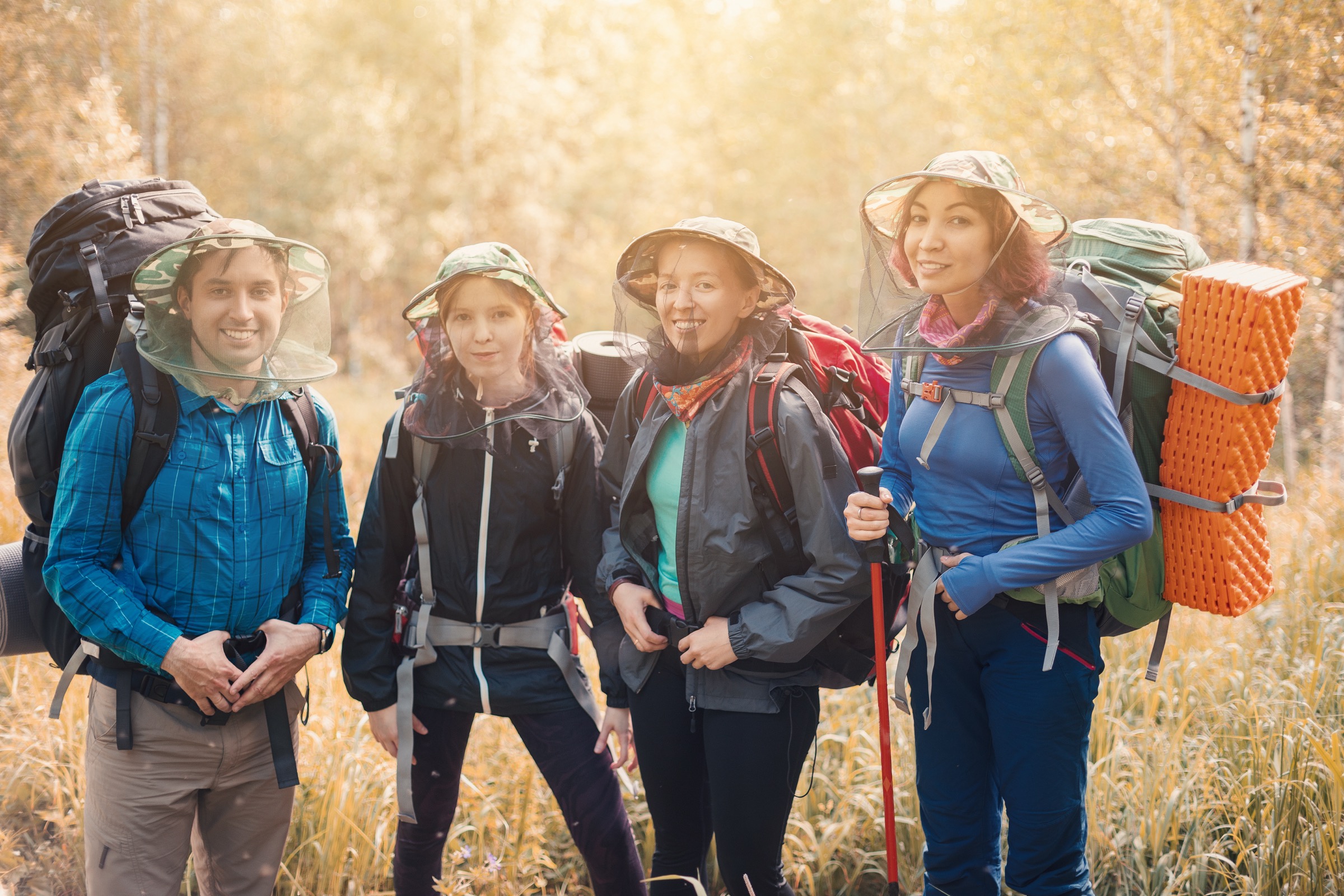
- A hat with a brim, which also gives a head net something to rest on.
Permethrin-treated clothing adds protection against mosquitoes as well as ticks. In the United States, you can buy factory-treated clothing or treat your own with a 0.5 percent spray. In Canada, only factory-treated clothing carrying a PCP number is approved, for people over 16, and it is sold for protection against mosquitoes. The details are in our guide to ticks, and the rest of the clothing system is in what to wear in the bush.
Head nets, bug jackets and screens
A head net weighs almost nothing and protects the part of you that repellent covers least well: the eyes, ears, hairline and the back of the neck. In black fly season on the Shield, many paddlers wear one for most of the day. Choose one with fine mesh, wear it over a brimmed hat so the mesh stands off your face, and tuck the bottom into a collar or jacket. A bug jacket, a mesh jacket with an attached hood and net, extends the same protection to the arms and body, and it is the most comfortable way to keep a child protected without much repellent.
Mesh size matters. Mosquitoes and black flies are stopped by ordinary insect netting, but biting midges pass through standard window screen. Tents, shelters and nets sold as “no-see-um” mesh use a much finer weave, and that is the kind to buy if you camp near marshes or on the coast.
Mosquitoes find their way into a tent through any gap. Keep the door zipped, get in and out quickly, and spend a minute with a headlamp clearing the inside before you sleep. A hammock needs its own net: the Hennessy Expedition Zip has one sewn in, and hammock or tent covers the trade-offs in bug country.
Choosing a campsite
Where you camp decides how many mosquitoes you meet at dusk.
- Look for a breeze. Mosquitoes are weak fliers. A site open to the wind, such as a point, a rocky shore or a bare ridge, usually has far fewer than a sheltered hollow in the trees.
- Stay back from still water. Bogs, beaver ponds and wet meadows breed mosquitoes. A site above a lake with open water in front of it is usually better than one beside a marshy bay.
- Expect black flies near moving water by day. Rapids and outflows breed them, so a lunch spot at the bottom of a portage can be the worst place on the route in late May.
- Set up a screen shelter for meals in peak season. Algonquin recommends one, and on a long trip it is the difference between eating in peace and eating inside your tent.
- Use a smoky fire only where fires are allowed, and only as a supplement. Smoke keeps some insects off the people sitting in it, and it does nothing for anyone a few feet away.
The basics of a good site are in choosing and setting up a safe backcountry campsite.
Deer flies and horse flies
Deer flies and horse flies follow movement and dark shapes, and they usually go for the head and shoulders. Repellent helps less with them than with mosquitoes: it can stop them landing, but they keep circling, because your movement and breath still draw them in.
- Wear a hat, in a light colour, and keep your neck covered.
- Use a sticky patch on the back of the hat. An entomologist at Michigan State University describes smearing a sticky insect-trap product on the back of a hat to catch the flies that circle your head as you walk.
- Cover your arms and legs. Their bites are painful and come through thin fabric, so long, loose sleeves and trousers in a light colour help more than repellent alone.
Treating bites
Most bites need nothing but restraint. Wash the area, apply a cold pack or a cold, wet cloth for 15 minutes or so, and use an anti-itch cream or an oral antihistamine if the itch keeps you awake. Do not scratch: a scratched bite on a trip can become infected, and a bite that becomes red, hot, swollen and painful after a day or two needs the care described in wound care in the backcountry.
Black fly bites are different from mosquito bites. A black fly cuts the skin and feeds on the blood that pools, so the bites often bleed a little and can swell a lot, sometimes into a lump the size of a golf ball, especially behind the ears and along the hairline. A person who takes many bites at once can develop what is called black fly fever: headache, fever, nausea and swollen glands. It passes, but it is a sign to cover up completely and get out of the swarm.
A severe allergic reaction to an insect bite is rare, and it is usually caused by bees and wasps rather than biting flies. The signs, and what to do, are in snakes, spiders and stinging insects.
West Nile virus and other diseases
Mosquitoes in North America can carry West Nile virus. According to the CDC, about 80 percent of infected people have no symptoms at all, and about 20 percent develop a fever with a headache, body aches, joint pain, vomiting, diarrhea or a rash. Fewer than 1 percent develop a severe illness affecting the brain and nervous system, and older people are at the greatest risk of it. Symptoms usually start 2 to 6 days after the bite. Canada’s West Nile season runs from mid-April to November. See a doctor about a high fever, a severe headache, a stiff neck, confusion or weakness after a summer of mosquito bites.
Black flies and biting midges in Canada and the United States are a nuisance rather than a disease risk to people. Deer flies can occasionally spread tularemia, a bacterial infection also carried by ticks, so see a doctor about a fever with a sore that will not heal at the site of a bite. The diseases carried by ticks are a different matter, and they are covered in ticks and Lyme disease.
What does not work
- Repellent wristbands, neckbands and ankle bands. In the 2002 study, the wristbands gave no protection at all, and Health Canada lists them among products that do not protect well. They protect, at most, the skin under the band.
- Electronic and ultrasonic repellers. Health Canada lists them as products that do not protect against biting insects, and they are not registered as repellents in the United States.
- Short-lived botanical sprays. Many plant-oil products work for minutes, not hours. If you use one, choose a registered product and reapply it often.
Clip-on devices that give off a repellent called metofluthrin are different: Health Canada says they repel mosquitoes, and some repel black flies too. They work best when you are sitting still in calm air, and they are a supplement to clothing and repellent on skin, not a replacement. Children should not be allowed to change the refill discs.
Common mistakes
- Wearing dark clothing in black fly season. Black flies and deer flies home in on dark colours, so a navy shirt collects them. Wear white, tan or khaki.
- Leaving the cuffs and collar open. Black flies crawl in and bite where repellent never went. Button the cuffs and collar, and tuck the trousers into your socks.
- Missing the hairline and ears. These are where black flies bite most, and a bleeding row of bites along the hairline is the usual result. Rub repellent along the hairline and behind the ears, or wear a head net.
- Buying the strongest DEET for bad bugs. A stronger product lasts longer; it does not repel better, and children should not use it. Choose the strength for the length of your day, and reapply.
- Camping in a sheltered hollow by a marsh. It is calm, and it is where the mosquitoes are. Choose a breezy point or a site above open water.
- Arriving at camp at dusk in June. Mosquitoes peak just as you are pitching the tent and cooking. Plan to reach camp in the afternoon, and have the screen shelter or tent up before evening.
- Bringing a head net with ordinary mesh to the coast. No-see-ums pass straight through it. Buy no-see-um mesh for tents and nets used near marshes and shorelines.
What to carry
- Repellent with DEET or picaridin at a strength suited to the youngest person in the group, in a small bottle that fits a pocket.
- A head net with fine mesh, and a brimmed hat to wear under it.
- Light-coloured, loose, long clothing with closable cuffs, or permethrin-treated clothing where it is available to you.
- A bug jacket for children, and for anyone in peak black fly season.
- A tent with no-see-um mesh, and a screen shelter for meals on long trips in peak season.
- Anti-itch cream or an oral antihistamine in the first-aid kit, such as the Surviveware Small.
Key takeaways
Biting insects follow seasons and places. Black flies breed in running water and bite in daylight from about mid-May to late June on the Shield. Mosquitoes breed in still water and are worst from late May into July, at dusk and after dark. Deer flies and horse flies take over in midsummer, and biting midges come out on calm evenings near marshes and coasts.
Protect yourself in layers. Wear light-coloured, loose, long clothing with every cuff closed. Put a registered repellent such as DEET or picaridin on exposed skin, choosing the strength for how long you will be out, and follow the age limits for children. Carry a head net, and use no-see-um mesh near the coast. Camp where the breeze reaches you, away from still water, and be under mesh at dusk. Skip the wristbands and ultrasonic gadgets, and see a doctor about a high fever, a severe headache or confusion after a summer of mosquito bites.
Black fly and mosquito seasons, times of day and breeding sites, the number of biting black fly species, and the advice on clothing colour, cuffs, netting and screen shelters follow Algonquin Provincial Park’s guidance on biting insects; national mosquito season and activity follow Health Canada. The list of repellent active ingredients follows the US Centers for Disease Control and Prevention, repellent duration follows the US Environmental Protection Agency, and the comparison of repellents and wristbands is from Fradin and Day, “Comparative efficacy of insect repellents against mosquito bites,” New England Journal of Medicine, 2002. Repellent age limits, sunscreen use, metofluthrin devices and products that do not protect well follow Health Canada, and the permethrin rules in Canada follow the Public Health Agency of Canada. West Nile virus figures follow the CDC, and the Canadian season follows the Public Health Agency of Canada. Biting midge size and screen mesh follow University of Arizona Cooperative Extension; deer fly and horse fly behaviour follows University of Kentucky Entomology, and the sticky hat follows Michigan State University. This is general education and not a substitute for advice from a doctor.
Wilderness Experts is reader-supported. As an Amazon Associate we earn from qualifying purchases; when you buy through links on our site we may earn a commission at no extra cost to you. It never changes what we recommend.