
NRS Sea Kayak Paddle Float review: the outrigger that gets you back in
A kayaker alone in deep water faces one specific problem, and it is not floating. The life jacket handles that. The problem is that an empty kayak is unstable and rolls away the moment you put weight on it, so climbing back aboard from the water is genuinely hard, and it gets harder every minute your hands are in cold water. A paddle float is the simple answer: inflate it, slide it onto one blade, brace the shaft across the deck, and your paddle becomes a temporary outrigger that holds the boat still long enough for you to get back in.
Paddling solo? Our guide to canoe and kayak safety covers the self-rescue sequence in full, and why staying with the boat beats swimming for a shore that looks close.
Quick take
The self-rescue aid for anyone who paddles a sea or touring kayak alone. Two independent air chambers with separate valves, so a puncture in one still leaves you with a working float, and a webbing strap with a buckle that locks it onto the blade rather than trusting friction. Each chamber displaces 8 litres, which is plenty of support. The catch is not the product: it is that a paddle float re-entry is a skill, and one you have to practise in warm water before you need it in cold.
What it does
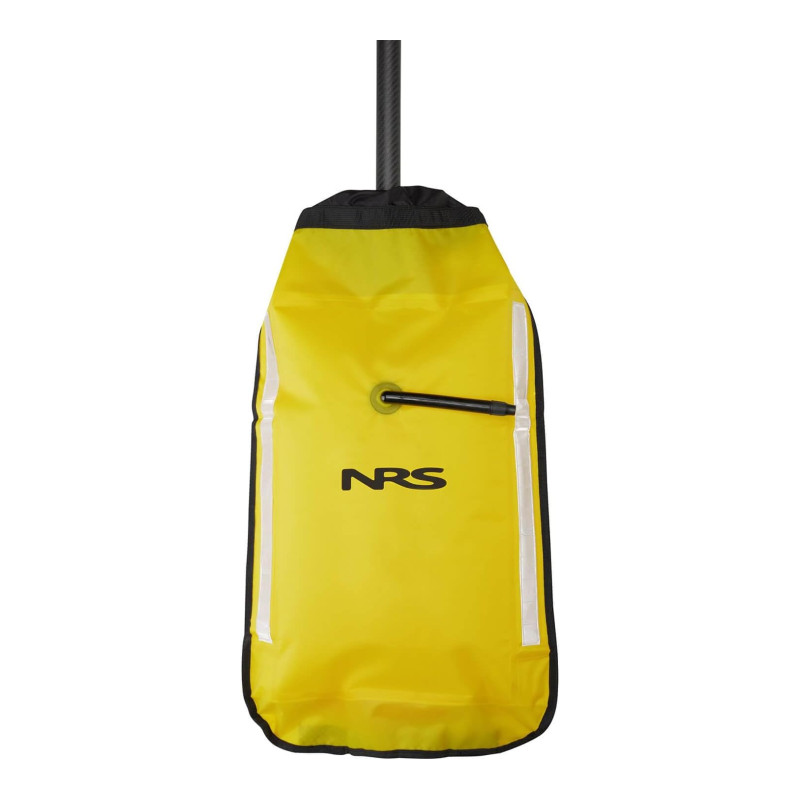
The float is an inflatable bladder in a tough fabric sleeve that slides over one paddle blade and is strapped in place. Inflated, it gives that end of the paddle enough buoyancy to support your weight, so with the shaft braced behind the cockpit you have a stable triangle: boat, paddle, float. You kick up, get your chest onto the back deck, swing one leg then the other into the cockpit, and roll upright, keeping weight toward the float the whole way. Then you pump the water out, which is a separate job and the reason a bilge pump belongs in the same conversation.
This one is built with two independent air chambers, each with its own twist valve, and that redundancy is the reason to choose it. A single-chamber float that punctures is a bag of water at the exact moment you need it, and this is equipment you carry precisely for the low-probability day. Each chamber displaces 8 litres. A webbing strap and buckle form a security loop that holds the float on the blade, which matters because the common failure with cheaper floats is the thing sliding off mid-manoeuvre. Reflective safety tape is included, which is a small, sensible touch on gear used in poor conditions.
Inflating takes deliberate breaths, and that is worth rehearsing: doing it with cold hands, in chop, while holding onto a boat, is a different exercise from doing it on the lawn.
What verified buyers say
One honest pattern stands out in the verified-purchase reviews, and it shapes how much weight to give them: most owners have never had to use this in a real capsize, and several say so directly. What they can speak to is build quality and dry-land testing.
- Construction inspires confidence. Owners repeatedly describe it as well made, with the exterior material and the dual chambers singled out, and several say the redundancy is exactly why they chose it over cheaper single-chamber floats.
- It changes how people feel about paddling alone. The recurring sentiment is carrying it and hoping never to use it, with owners describing open-water trips as more relaxed for having it aboard.
- Cold hands and the valves. The most useful criticism: the screw-lock inflation valves are fiddly in cold water, which is precisely when you would be using them. Practise with gloves on.
- Strap it tight. One owner reports the float sliding off the blade unless the straps are properly cinched, which is a technique point rather than a defect but worth knowing before the day it matters.
- Packing it away is awkward. Deflated, it does not fold as neatly as owners would like, and stowing it somewhere reachable takes a little thought.
Worth knowing
Owning a paddle float is not the same as being able to use one, and this is the piece of gear where that gap is widest. The re-entry is a real skill with a real failure rate, and it is much harder in wind and chop than in a calm bay. Practise it in warm water, wearing what you actually paddle in, until it is dull, and practise the whole sequence including pumping out, because a boat full of water is unstable even once you are in it. Cinch the strap properly or the float can slide off the blade. Expect the twist valves to be awkward with cold hands. Stow it where you can reach it from the water rather than in a sealed hatch, because gear you cannot get to after a capsize may as well be at home. And remember this is a solo tool: if you are paddling with others, a partner-assisted rescue is faster and more reliable than any float.
Who it is for
This is for sea kayakers and touring paddlers who go out alone, or who paddle in groups that might get separated, which is most groups once wind and pace do their work. It is close to essential for solo open-water trips in a boat with a cockpit, and it is the natural companion to a bilge pump. It is less relevant if you paddle a sit-on-top, where remounting is far easier by design, or an open canoe, where the recovery is a different technique entirely, and it does nothing for you on a paddleboard.
Carry it with the rest of the self-rescue kit: a bilge pump to empty the boat once you are back in it, a throw bag for helping someone else, and dry insulation in a roll-top dry bag so that getting back aboard means getting warm. None of it substitutes for the life jacket you are wearing, and all of it assumes you understand what cold water is doing to you while you work.
Specs at a glance
Type: inflatable paddle float for kayak self-rescue · Chambers: two independent, separate twist valves · Displacement: 8 L per chamber · Retention: webbing strap with buckle security loop · Reflective safety tape · Best for: solo sea and touring kayaking · Requires practised technique, not just ownership
This link goes to NRS, the manufacturer. We have no affiliate relationship with them and earn nothing if you buy through it. We link it because Amazon has no reliable Canadian listing for a decent paddle float, and this is the one we would carry. In Canada, MEC stocks paddle floats and throw bags.
The Verdict
The NRS Sea Kayak Paddle Float is the right version of a piece of gear that most solo kayakers should own and most have never practised with. Two chambers instead of one is the decision that matters, because redundancy is the entire argument for carrying safety equipment you hope never to open, and the strap-and-buckle retention fixes the failure that plagues cheaper floats. The valves are fiddly with cold hands and it does not pack away neatly, both of which are true and neither of which would stop us buying it. What should stop you is treating the purchase as the solution. Get it, then spend an afternoon in warm water learning to use it, because the difference between a paddle float in the hatch and a paddle float you have practised with is the difference between equipment and a rescue.