
Onyx MoveVent Dynamic review: the life jacket you will actually wear
Almost nobody who drowns from a canoe or kayak was wearing a life jacket. In Canadian canoe deaths the figure is close to 95 percent not wearing one, and the vests are usually right there in the boat. They were bought, worn once, and left off because they were hot, bulky, or rode up into the wearer’s ears every time they sat down. The Onyx MoveVent Dynamic is the entry-level paddling vest built to solve exactly that, and comfort in a life jacket is not a luxury feature. It is the whole mechanism by which the thing saves you.
New to paddling? Read our guide to canoe and kayak safety first: what actually drowns paddlers, how to dress for the water rather than the air, and what to do in the first seconds of a capsize.
Quick take
The first life jacket to buy, and the one most likely to stay on your body. Inherently buoyant foam rather than an inflatable, approved by both the U.S. Coast Guard and Transport Canada, with mesh ventilation front and back and a high-cut back that clears a kayak or canoe seat instead of shoving you forward. Sizing runs in wide dual bands and is the one thing to get right, so measure your chest and read the size chart rather than ordering your shirt size.
What it does
The MoveVent Dynamic is an inherently buoyant paddling vest: the flotation is closed-cell foam that is simply there, with nothing to inflate, arm, or remember. It is built to the harmonized Level 70 standard that the U.S. Coast Guard and Transport Canada now share, the modern equivalent of the old Type III, which works out to roughly 15.5 pounds (70 newtons) of flotation. That is enough to hold a conscious person’s head clear of the water in the sheltered water most paddling happens on.
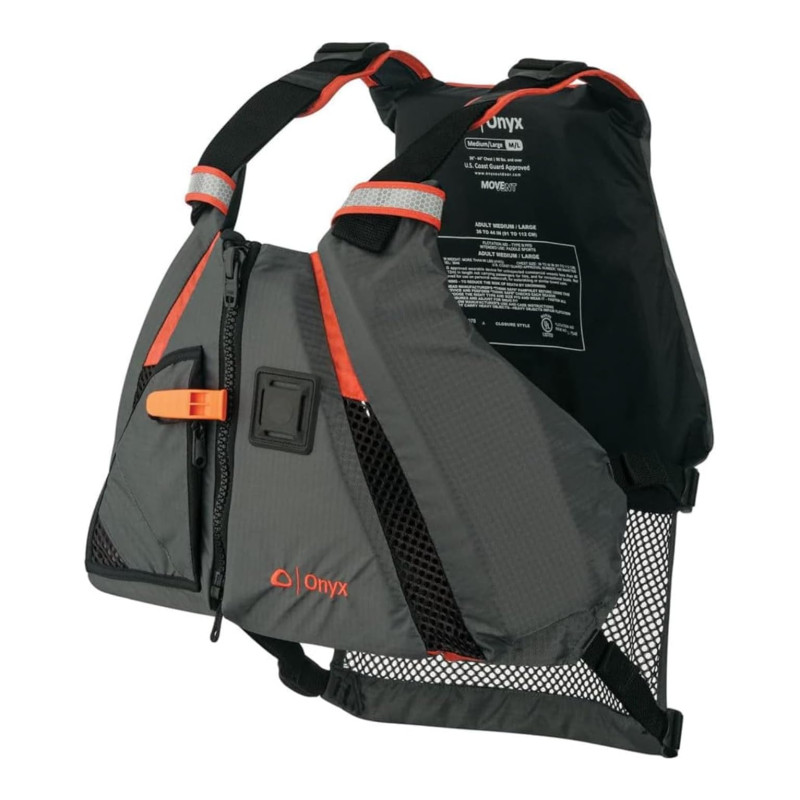
The design is aimed squarely at the seated paddler. The foam is sculpted into articulated segments rather than one slab, so the vest bends where your torso bends and does not fight the rotation of a paddle stroke. Mesh panels front and back move air across you, which matters more than it sounds: a vest that cooks you on a warm afternoon is a vest you take off. The lower back is mesh rather than foam, so it sits above a kayak backband or a canoe seat instead of wedging between you and the seat and pushing you forward. Shoulder straps adjust through neoprene-padded sliders and the side belts pull in from both sides, so the vest can be cinched down properly rather than merely closed.
The safety detailing is better than the price suggests. There is SOLAS-grade reflective material for visibility, an expandable zippered pocket with mesh drainage, a lash tab for a knife or a light, a drying loop, and a whistle already attached, which is the sound-signalling device both countries require you to carry. The shell is 200-denier nylon ripstop and nylon oxford, and the whole vest weighs about 1 pound 5 ounces (590 g).
What verified buyers say
Across verified-purchase reviews on both the American and Canadian listings, the same points come up:
- It disappears while you paddle. Owners consistently describe forgetting they have it on, and say it does not restrict arm movement or rub the shoulders over a full day. Several report near-daily use across a whole season with little visible wear.
- The high mesh back is the feature people name. Buyers who gave up on conventional vests that rode up into their armpits or pushed their ears forward single this out as the reason this one stays on, and note it clears a kayak backrest properly.
- It works for larger paddlers. Owners over 200 pounds (91 kg) report ample flotation and a fit that still closes down properly, and the ventilation earns particular praise from people who run hot.
- Sizing is the recurring complaint, in both directions. One buyer found the XL wildly oversized, another found the 2XL far too small, and the wide dual-size bands mean two people with the same nominal size can have very different experiences. Measure your chest against the chart.
- Assembly quality is occasionally uneven. A minority report twisted or crossed adjustment straps out of the bag, a crooked lash tab, or a torn panel, and one received a visibly damaged vest. Inspect it on arrival rather than on the water.
Worth knowing
This is a buoyancy aid, not an offshore life jacket, and the distinction matters. It is designed to keep a conscious person floating and able to help themselves; it is not self-righting and will not reliably turn an unconscious wearer face-up. That is the correct choice for canoeing, kayaking and paddleboarding on sheltered water, and it is the wrong choice for offshore or solo big-water trips, where a higher-performance jacket belongs. The front foam is thick enough that remounting a paddleboard from the water takes more effort, which a few paddleboarders find genuinely annoying. The zippered pocket holds a whistle and a snack, not a phone. And the dual-size bands are wide, so a vest that merely closes is not the same as a vest that fits: do up every buckle, tighten from the bottom up, and have someone pull hard on the shoulders. If it slides toward your ears on land, it will ride over your face in the water.
Who it is for
This is the vest for the recreational paddler: flatwater canoeing, touring, sit-on-top kayaks, paddleboards, and cottage-lake afternoons. It is the right first life jacket, the right spare to keep for guests, and the right answer for anyone whose current vest lives in the bottom of the boat because it is uncomfortable. It is not a whitewater vest, which needs a quick-release rescue belt and specific training to use, and it is not for offshore work. If you paddle hard enough to want more pockets, a tighter cut, and a fit dialled by six adjustment points rather than four, the vests further up our ladder are worth the money.
Wear it with the small things that make it a system rather than a garment: a whistle and signal mirror on the shoulder strap where a numb hand can reach them, a fixed-blade knife on the front rather than folded in a pocket, and a satellite messenger in a chest pocket rather than in the boat, because everything in the boat leaves with the boat. Then read what cold water actually does to you, because the vest buys you the time that knowledge spends.
Specs at a glance
Type: inherently buoyant foam vest · Approval: U.S. Coast Guard and Transport Canada, Level 70 · Flotation: about 15.5 lb (70 N) · Weight: about 1 lb 5 oz (590 g) · Sizes: XS/S chest 28–36 in (71–91 cm), M/L 36–44 in (91–112 cm), XL/2XL 44–56 in (112–142 cm) · Minimum wearer weight: 90 lb (41 kg) · Shell: 200-denier nylon ripstop and nylon oxford · Features: mesh front and back panels, high-cut mesh lower back, SOLAS reflective, zippered drainage pocket, lash tab, drying loop, attached whistle · Best for: recreational canoeing, kayaking, paddleboarding
Wilderness Experts is reader-supported. As an Amazon Associate we earn from qualifying purchases; when you buy through links on our site we may earn a commission at no extra cost to you. It never changes what we recommend.
The Verdict
The Onyx MoveVent Dynamic is the most useful life jacket we can point a new paddler at, for a reason that has nothing to do with specifications. Every vest on the market floats; this one is comfortable and cool enough that it stays on your body, and a worn vest is the single factor that separates the people who capsize from the people who drown. It is approved on both sides of the border, cut properly for a seated paddler, and detailed with the whistle, reflective tape and lash tab you would otherwise buy separately. Get the size right, inspect it when it arrives, and understand that it is a buoyancy aid for sheltered water rather than an offshore jacket. Then wear it every time, including on the warm, flat, close-to-shore afternoon when it feels unnecessary, because that is the exact afternoon the statistics are made of.