
NRS Compact Rescue Throw Bag review: the rope you can actually throw
The order is reach, throw, row, go, and the throw comes second for a reason: a rope thrown from a stable boat or a firm bank helps a swimmer without putting a second person in the water. Going in after someone is the last resort, and it is how would-be rescuers drown. Canadian rules require a buoyant heaving line in almost every paddlecraft, and the honest problem with throw bags is not that people buy bad ones. It is that a bulky bag gets left at home, and a rope in the garage has rescued nobody.
Paddling with others? Our guide to canoe and kayak safety covers what to do when someone else is in the water, and caught in whitewater covers moving water specifically.
Quick take
The throw bag that solves the real problem, which is carrying one at all. Small enough to sit under a deck bungee or in a canoe without being in the way, with 70 feet (21.3 m) of floating polypropylene line, which comfortably exceeds the 50 foot (15 m) Canadian minimum. Light enough that people who cannot throw a full-size bag can throw this one accurately. Buy it, then practise with it on dry land until repacking is boring.
What it does
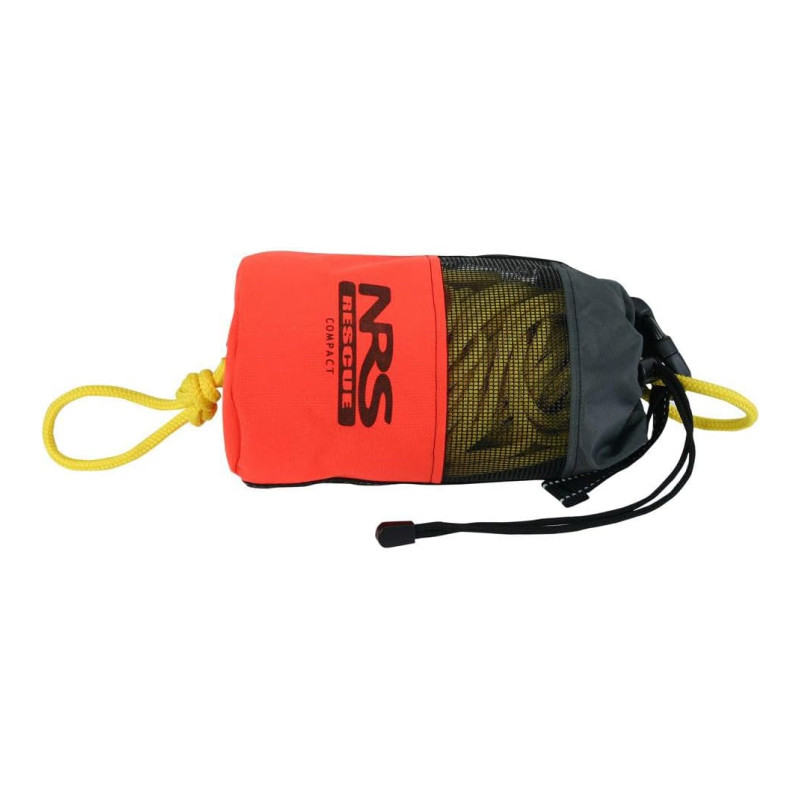
A throw bag is a length of floating rope stuffed, not coiled, into a bag with a weighted or buoyant mouth. You hold the loose end, throw the bag, and the rope pays out of it in flight. Stuffing rather than coiling is what stops it tangling, and it is why repacking a throw bag is a skill worth practising: a beautifully coiled bag will knot itself on the throw.
The Compact Rescue holds 70 feet (21.3 m) of polypropylene line, which floats and resists water absorption, so it stays on the surface where a swimmer can reach it and does not turn into a heavy sodden mess. The bag is nylon with a mesh panel, which drains and dries quickly, and the whole thing is deliberately smaller than a standard rescue bag. That size is the design decision the product is built around, and it cuts both ways: it is the reason the bag rides along on every trip, and it is the reason a first-time user may find it lighter than expected to throw.
On length: the Canadian minimum-equipment requirement for most paddlecraft is a buoyant heaving line of at least 50 feet (15 m). At 70 feet (21.3 m), this clears that comfortably, and the extra rope is genuinely useful, because distance over water is deceptive and a throw that lands short is a throw wasted.
What verified buyers say
Across verified-purchase reviews, the same points come up:
- The size is why it gets carried. Owners say it is compact enough to fit a kayak easily, and several make the point directly: because it is not in the way, it comes on every trip rather than the trips they remembered it.
- It has been used in anger. One owner describes recovering a pinned kayak with it, which is the second job a throw bag does and a real test of the line and the bag’s stitching.
- Rescue professionals use them for training. Buyers running technical water rescue practice call the size ideal and note that people who cannot throw a bulky standard bag can throw these accurately, which is the whole argument for a compact bag.
- Repacking is easy because the bag is not stuffed tight. Owners note the extra room inside makes restuffing the line quick, and a bag you can repack quickly is a bag you will practise with.
- Small niggles: at least one buckle failure, some dye running from the rope when new, and one owner who found it smaller than expected and sensibly recommends a trial run before relying on it.
Worth knowing
A throw bag is equipment that needs a skill attached, and buying one changes nothing on its own. Practise the throw on grass until you can land it near a target underhand, and practise restuffing until it is dull, because the first time you do this should not be while someone is being carried downstream. Never tie the line to yourself or to the boat: hold it, brace, and be ready to let go, since a rope under load in current can pull a rescuer in, which is the accident the rope was meant to prevent. Keep it somewhere you can reach it in one motion rather than buried in a hatch, and check the line for dye transfer onto light-coloured gear when it is new. Finally, this bag is not a substitute for swiftwater rescue training, which is the only way to learn moving-water rescue properly.
Who it is for
This is for anyone who paddles with other people, which is most people, and for anyone paddling in Canada who needs to meet the heaving-line requirement with something they will actually keep aboard. It suits canoes, kayaks, rafts and packrafts, and it suits shore-based use at a swimming hole or a cottage dock just as well. If you paddle serious whitewater, a full-size rescue bag with a larger-diameter line and a proper waist belt is the right tool, and it should come with the training. If you paddle alone on flat water, understand that a throw bag is for helping someone else: your own self-rescue depends on staying with the boat and getting back in, which is where a paddle float and a bilge pump earn their place.
Carry it alongside the rest of the in-boat kit: a dry layer in a roll-top dry bag, a waterproof first aid kit, and the things that stay on your body, starting with the life jacket you are wearing.
Specs at a glance
Type: compact rescue throw bag · Line: 70 ft (21.3 m) floating polypropylene · Exceeds the Canadian 50 ft (15 m) heaving-line minimum · Bag: nylon with mesh drainage panel · Deliberately compact for deck or thwart carry · Best for: recreational paddling groups, cottage and shore use · Not a substitute for swiftwater rescue training
This link goes to NRS, the manufacturer. We have no affiliate relationship with them and earn nothing if you buy through it. We link it because it is the throw bag we would carry, and because Amazon has no reliable Canadian listing for one. In Canada, MEC stocks throw bags including NRS.
The Verdict
The best throw bag is the one in the boat, and that is the argument for this one. NRS built the Compact Rescue small enough to stop being a decision, gave it 70 feet (21.3 m) of floating line that clears the Canadian requirement with room to spare, and made the bag roomy enough inside that repacking does not put you off practising. Rescue instructors use them for training because people can throw them accurately, which is the only performance figure that matters when someone is in the water and the clock is the one running in their body temperature. Buy it, practise with it on dry land until it is boring, keep it where one hand can reach it, and never tie it to yourself.