
How to hike safely in the heat
Heat changes the math of a hike. A trail that’s a pleasant day in spring becomes a serious undertaking at 100°F (38°C), where your body burns through water faster than you can carry it and your judgment fades before you notice. Deserts and hot exposed country reward preparation and punish improvisation, but with the right timing, pacing, and water discipline, you can travel through heat safely and even comfortably. This guide covers how to hike in the heat: when to move, how much to drink, what to wear, and how to spot trouble before it becomes an emergency.
The underlying principle is that your body cools itself by sweating, and sweating spends water and salt you have to replace, so hot-weather hiking is really an exercise in water and heat management. You win by generating less heat (traveling in the cool, resting in the shade), losing less water (covering up, slowing down), and replacing what you lose (drinking on a schedule with electrolytes). Get those right and heat is manageable; get them wrong and you become a heat casualty. This is the prevention side of our guide to recognizing and treating heat illness, and it builds on the fundamentals in hiking all day.
Time your travel around the heat
The most powerful tool you have is the clock. Do your hard travel in the cool of the early morning and the evening, and rest through the hottest hours, roughly late morning to mid-afternoon, in shade. In extreme heat, this can mean hiking at dawn and dusk and even by moonlight, and shading up entirely at midday. Ground temperatures run far hotter than the air (desert sand can be 30–40°F / 17–22°C hotter than the air above it), so getting off the hot ground and out of the sun during peak heat conserves both your water and your energy. Plan your day backward from the heat: where will you be at 1 p.m., and is there shade there?
Travel cool, rest hot
Shifting your miles to the cool hours is worth more than any gadget. A hiker who moves at dawn and dusk and rests in shade at midday uses dramatically less water than one who pushes through the afternoon, and arrives clear-headed instead of cooked.
Water: how much, and drink it
Heat and effort drive water needs far higher than most hikers expect. A person working hard in full sun at around 109°F (43°C) can need up to a gallon of water an hour, and five gallons (19 L) across a day. Even moderate hot-weather hiking commonly runs a liter an hour or more. Plan your water around the conditions and the distance to your next reliable source, and carry enough. Running out is what turns a hot hike into an emergency.
The critical rule: don’t ration your water, drink it. Rationing water to make it last is how people become heat casualties; you’re better off rationing your sweat (by resting and covering up) while drinking to stay hydrated. Thirst is a poor guide, lagging behind your actual need, by the time you’re thirsty you’re already dehydrated. So sip small amounts steadily rather than gulping a lot at once, and use thirst plus urine colour together as your guide. As a rough sense of scale, working in real heat can call for something like 1 pint (500 ml) an hour below 100°F (38°C) and up to about 1 quart (1 L) an hour above it, but treat those as the shape of the demand rather than a quota to hit. Steady sipping keeps you cooler and wastes less to sweat than drinking in big infrequent doses. Just as importantly, do not overdrink. Sustained plain water much above about 1.5 quarts (1.5 L) an hour can dilute your blood sodium into hyponatremia, which looks almost exactly like heat exhaustion and needs the opposite treatment. Our heat illness guide covers how to tell them apart, and the short version is that clear, copious urine with no thirst, in someone getting worse as they drink, means stop giving water.
Salt and electrolytes
Sweat carries out salt as well as water, and replacing only the water can leave you cramping or, in extreme cases, hyponatremic. On long, sweaty days, take in electrolytes, a drink mix, salt tabs, or salty snacks, alongside your water. A normal diet keeps up with ordinary losses, but hard effort in real heat outruns it, so plan to replace salt deliberately. Eating also costs water to digest, so if water is genuinely scarce, favor small salty snacks over a big meal and prioritize drinking.
Dress to stay cool
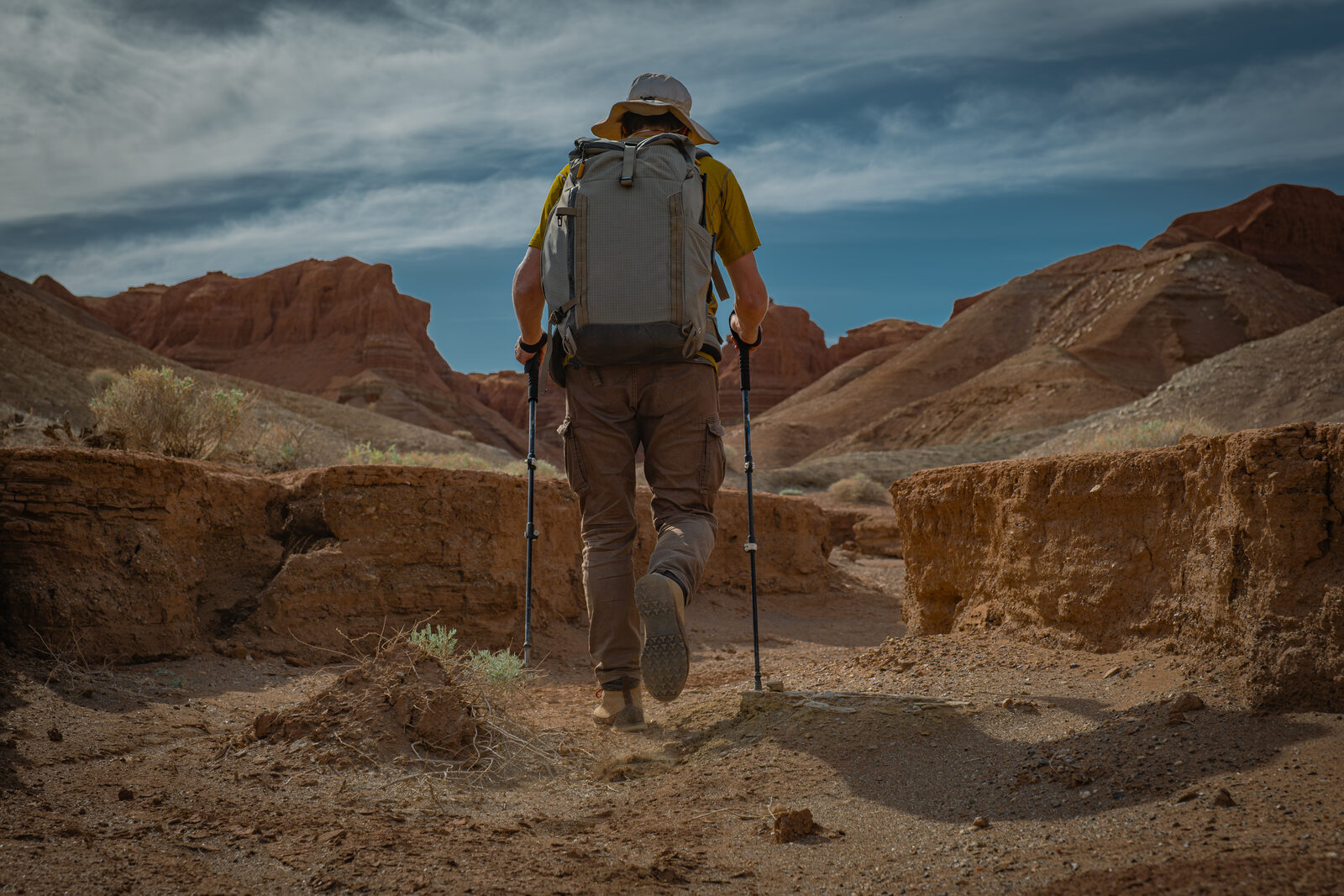
Counterintuitively, covering up keeps you cooler and safer than stripping down. Wear loose, light-colored, full-coverage clothing: long sleeves and long pants in a breathable fabric, a wide-brim hat, and a scarf or sun hoody to protect your neck. Covered skin is shaded from direct sun and reflected heat, and clothing holds a little sweat against your skin so you get its full cooling effect as it evaporates. Bare skin in desert sun heats faster and burns. Keep your shirt on and your sleeves down through the heat of the day. The instinct to take your shirt off and work in the sun is exactly wrong. Sunglasses and sunscreen round out the protection against glare and burn.
Pace, shade, and rest
Slow down. A gentle, sustainable pace generates less heat and less sweat than pushing hard, and there are no style points in the desert. Take regular breaks in shade, under a rock overhang, a lone tree, or a tarp you rig, and get your body off the hot ground onto a pad or pack when you rest; the shade can be 15–30°F (8.3–17°C) cooler than the open. Use the buddy system and watch each other: if someone lags, gets irritable, stops sweating, or wanders off, treat them as a possible heat casualty and stop. Distances deceive in open, hazy country, people routinely underestimate them by a factor of three, so don’t count on reaching that “close” ridge as fast as it looks. Our guide to hiking all day covers pacing and the Ten Essentials.
Finding and planning water
In hot, dry country, water is the trip-limiting resource, so plan around known sources and carry enough to bridge the gaps with margin. Research where reliable water is before you go, and top off fully at every good source rather than leaving water behind. The safest place to carry water is in your body and your bottles, not in the ground. Treat all found water; heat-country sources are often scarce, mineral-heavy, or contaminated. A reliable filter like the Sawyer Squeeze or a purifier plus backup tablets lets you use what you find. See our guide to purifying backcountry water. Avoid drinking from salt flats and mineral-laden pools; that water is undrinkable and can worsen dehydration.
Warning signs to watch for
Catch heat illness early, in yourself and your companions. Early warnings are a headache, fatigue, dizziness, irritability, and muscle cramps. The moment these appear, stop, get in shade, cool down, and drink with electrolytes. Escalating signs, heavy sweating with weakness and nausea, then confusion or a stop in sweating with hot skin, are heat exhaustion tipping toward heat stroke, an emergency. Check your urine as a gauge: pale means you’re drinking enough, dark means catch up now. Our companion guide to heat illness covers recognizing and treating each stage in detail; the key is to act at the first symptom, not after.
Confusion in the heat is an emergency
A hiker who becomes confused, stops sweating, or collapses in the heat may have heat stroke, a life-threatening emergency. Cool them immediately by any means, get them in shade off the ground, and evacuate. Don’t wait to see if they improve. See our heat-illness guide.
Other heat-country hazards
Hot regions bring their own extras. Deserts and hot canyons are prone to flash floods . Never camp or linger in a dry wash or narrow canyon when storms are anywhere upstream. Nights can turn surprisingly cold as the ground sheds heat fast, so carry a warm layer even for a hot day. Snakes, scorpions, and spiders shelter in shade, rock crevices, and your boots, shake out footwear and clothing, watch where you put hands and feet, and see our guide to avoiding bites and stings. And sandstorms or dust can blow up fast; cover your mouth and eyes, mark your direction, and wait it out low if you can’t see. Sunburn and eye strain from glare are constant, low-grade hazards. Cover up and shade your eyes.
Common mistakes
- Hiking through midday. The hottest hours cost the most water and risk. Travel cool, rest in shade.
- Rationing water. Sipping less to stretch your supply causes heat casualties. Drink it; ration effort and sweat instead.
- Forcing fluids to a fixed quota. Thirst lags a little, so sip steadily and check your urine, but drinking to a rigid schedule regardless of conditions is how hikers give themselves hyponatremia.
- Stripping down. Bare skin heats and burns faster. Cover up in loose, light, full-coverage clothing.
- Only drinking water. Replace salt too on long sweaty days, or you’ll cramp and fade.
- Underestimating distance and water needs. Open country fools the eye. Carry margin and plan your sources.
What to carry
- Ample water capacity , bottles or a bladder sized to the gaps between sources, plus margin.
- A water filter and tablets . To safely use any water you find.
- Electrolyte mix or salty snacks . To replace the salt sweat carries out.
- Sun protection , wide-brim hat, loose long-sleeve layers, sunglasses, and sunscreen.
- A warm layer , for the cold that follows hot days once the sun drops.
- A satellite messenger , for evacuation if heat or a hazard turns serious.
Recognize & treat heat illness
Key takeaways
Hiking in the heat comes down to managing water and heat: travel in the cool hours and rest in shade through the worst of it, cover up in loose light clothing, and drink steadily on a schedule with electrolytes rather than rationing. Plan your water around reliable sources with margin, slow your pace, watch your companions, and act on the first warning sign. Respect the extras, flash floods, cold nights, snakes, and deceptive distances. Do all that and hot country opens up to you safely; ignore it and the heat will make the decisions for you.
Adapted in part from the U.S. Army Survival Field Manual (FM 3-05.70 / FM 21-76), Chapter 13, “Desert Survival” (timing travel, water discipline, the thirst trap, clothing, and heat casualties) and Chapter 4 on daily water needs, with modern hot-weather hiking practice.
Wilderness Experts is reader-supported. As an Amazon Associate we earn from qualifying purchases; when you buy through links on our site we may earn a commission at no extra cost to you. It never changes what we recommend.