
Apple Watch Ultra 4 review: the smartwatch option for hikers
Many hikers already wear an Apple Watch, and the question they ask is whether it can replace a dedicated GPS watch on the trail. With the Ultra 4, released in September 2026, the answer is yes for day hikes and overnight trips, and closer than before for longer ones: it can call for help by satellite without a phone, and a new workout mode stretches GPS tracking to about two days.
How this review was written. The Ultra 4 had been on sale for three weeks when we wrote this. It draws on Apple’s specifications, on the first independent tests, and on independent testing of the Ultra 3 over the past year, which has the same case, screen and satellite features. There are too few verified-buyer reviews to summarise yet, and no outdoor test site has published a multi-day trial. We will revise this page as that evidence arrives.
Quick take
The smartwatch choice for hikers who use an iPhone. The Ultra 4 has accurate GPS, a bright screen, offline maps, a loud siren, and satellite SOS that works from the watch alone. Its battery lasts about two days of ordinary use, and Apple rates a new extended mode at up to 45 hours of GPS tracking. A dedicated hiking watch still runs several times longer and shows more terrain detail. Choose it for day hikes, weekends and everyday wear; for a week without charging, choose a dedicated watch.
What it does
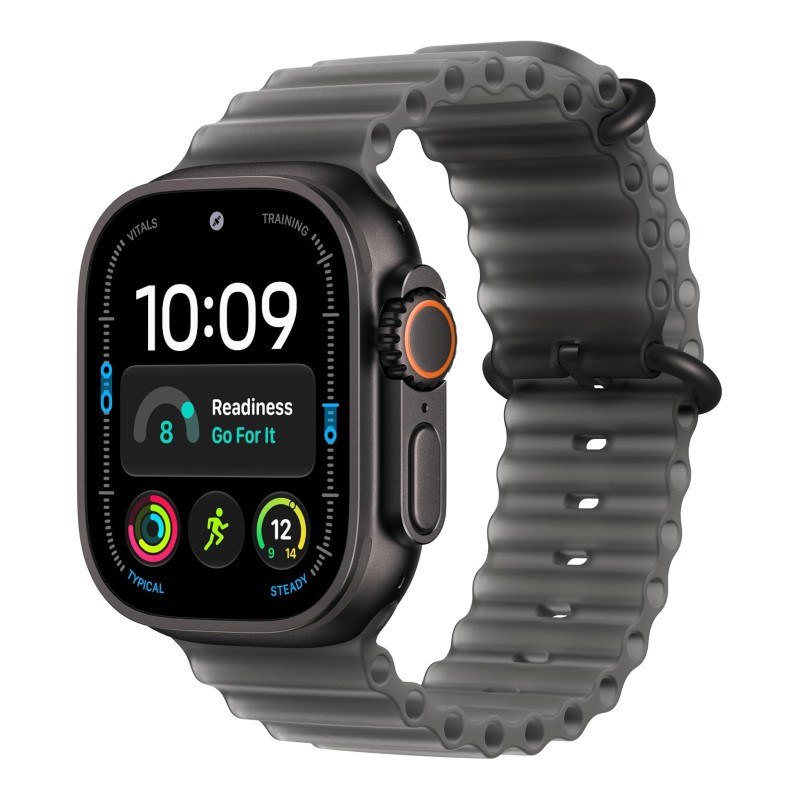
The Ultra 4 is Apple’s largest and toughest watch: a 49 mm titanium case with a flat sapphire crystal, tested to a military standard for durability, rated for swimming and for recreational diving to 130 feet (40 m), and sealed against dust. The screen reaches 3,000 nits, which makes it easy to read in midday sun, and it is a touchscreen backed by a rotating crown and a programmable Action button.
For navigation it has precise GPS, a compass, and offline maps that you download on the iPhone and sync to the watch. You can build a route on the phone and follow it on the wrist with turn-by-turn prompts, drop waypoints for a trailhead or a campsite, and use Backtrack, which records your path automatically when you leave coverage so you can retrace it. Holding the Action button sounds a siren that Apple says can be heard at 600 feet (180 m), and the screen doubles as a flashlight.
The watch can reach satellites directly. Emergency SOS by satellite works on every Ultra 4, with no phone and no cellular plan. Sending ordinary text messages and sharing your location by satellite need a cellular plan for the watch, and Apple includes the satellite service free for two years from activation.
It requires an iPhone 11 or later, running iOS 27. It does not work with Android phones.
Battery life, and what changed
Battery life was the reason hikers passed over earlier Ultra models. One independent test measured 16 hours of continuous GPS tracking on the Ultra 3, against 60 hours or more on dedicated watches.
Apple rates the Ultra 4 at up to 50 hours of ordinary use, 84 hours in Low Power Mode, and 18 hours of standard workout tracking. A new Max Extended Workout mode is rated at up to 45 hours of tracking a hike while still recording a GPS position every second. A 15-minute charge is rated to give about 18 hours of use.
Early tests support the gain in daily use: a reviewer who wore it for nearly a month, with the screen always on and an hour or two of workouts a day, charged it every two days. No one has yet published a test of the 45-hour mode on a multi-day hike, so treat that figure as the maker’s claim. For a weekend, plan on one top-up from a small power bank; for a week, the watch needs charging every day or two.
What early testing shows
- GPS is accurate and locks quickly. A tester checked the Ultra 4 against a measured route and found it accurate, and a longer test of the Ultra 3 measured a 2-mile (3.2 km) course exactly, including under trees and in a narrow canyon.
- The screen is bright and easy to read. Colour, and visible in full sun.
- Satellite SOS is built in. Few watches have it. Testing of the Ultra 3 confirmed that SOS reaches a satellite without a phone, and that frequent satellite messaging shortens battery life only a little.
- Maps show less terrain detail than the topographic maps on dedicated mapping watches, which matters off trail and in steep country.
- Data screens are less flexible. Hikers who want elevation, bearing and distance arranged their own way have fewer options than on a sports watch.
- It is large and heavy on a small wrist, and the design is unchanged from earlier Ultra models.
Worth knowing
Plan around the battery. Tracking, the always-on screen, cellular and satellite use all draw on it, and a watch with a flat battery cannot track or call for help. Carry a power bank and the charging cable on any trip longer than a day, and learn how to switch on Low Power Mode and the extended workout mode before you need them. Download offline maps for the area at home. A touchscreen is harder to use with wet fingers or thick gloves than buttons are, so set up the Action button for the function you use most. Satellite SOS needs a clear view of the sky and is not available in every country, and messaging by satellite needs a cellular plan. The watch works only with an iPhone. Carry a map and compass as you would with any electronic device.
Who it is for
The Ultra 4 is for iPhone owners who want one watch for daily life and for the trail: day hikers, weekend backpackers, paddlers and skiers who are back at a charger within two or three days, and anyone who values a satellite SOS button on the wrist. It is easy to use if you already know an iPhone.
If you spend a week or more away from power, or want detailed topographic maps on the watch, the Coros Apex 4 runs for about a week of full hiking days and costs less, and the Garmin Enduro 3 tracks for about 120 hours on a charge. If you want a tough watch with long battery life and can do without maps, see the Garmin Instinct 3 Solar. For two-way satellite messaging that does not depend on a phone plan, carry a Garmin inReach Messenger. Our guide to choosing a hiking watch explains how the three kinds of watch differ.
Specs at a glance
- Typesmartwatch with GPS and satellite SOS
- Case49 mm titanium, sapphire crystal
- Screencolour touchscreen, 3,000 nits
- Batteryup to 50 h use; 18 h GPS workout; up to 45 h extended mode (maker’s figures)
- Mapsoffline, synced from iPhone
- Navigationroutes, waypoints, Backtrack, compass
- SatelliteSOS on every watch; messaging with a cellular plan
- Water rating100 m; diving to 130 ft (40 m)
- Works withiPhone only
- Listed weightunavailable
- Best forday hikes, weekends and everyday wear
These links go to Apple’s own store. We have no affiliate relationship with Apple and earn nothing if you buy through them.
See it at Apple (Canada) See it at Apple (US)
The Verdict
The Apple Watch Ultra 4 is a capable smartwatch for hiking, and Apple rates its new extended mode to cover a weekend of tracking. Its GPS is accurate, its screen is excellent, and satellite SOS from the wrist is a real safety feature. It still needs charging far more often than a dedicated hiking watch, its maps show less terrain, and it works only with an iPhone. On the evidence so far, three weeks after release, it is a sound choice for day hikes and short trips. For longer trips, see the Coros Apex 4 or the Garmin Instinct 3 Solar.