
Garmin inReach Messenger review: satellite texting from your phone
Most people who carry a satellite communicator use it for two things: telling someone at home that all is well, and calling for help if it is not. The Garmin inReach Messenger is built for those two jobs. It turns the phone you already carry into a two-way satellite texting device, adds an SOS button that works without the phone, and can run for weeks on a charge.
Quick take
A simple way to text and call for help from places with no cell coverage. The inReach Messenger pairs with a phone app that sends each message by Wi-Fi, cell or satellite, whichever is available, and its battery lasts up to 28 days. It has an SOS button and a small screen for use without the phone, but no maps and no route navigation. A satellite subscription is required. Choose it when staying in touch matters more than navigating on the device.
What it does
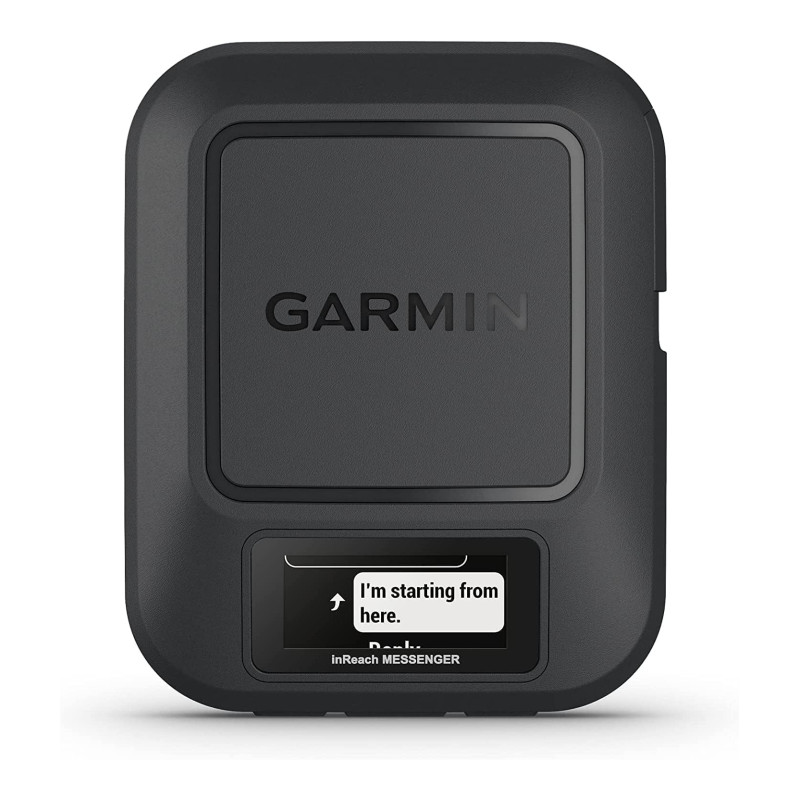
The inReach Messenger is a palm-sized two-way satellite communicator on the Iridium network, which covers the whole planet including the poles. You write and read messages in the Garmin Messenger app on your phone. The app sends each one by Wi-Fi or cell signal when you have it and switches to satellite when you do not, so a conversation that starts at the trailhead carries on in the backcountry without you changing anything. Friends and family who install the free app can reply the same way and join group chats.
The SOS button sits under a cover on the side of the unit. Pressing it sends your position to Garmin Response, a coordination centre staffed around the clock, which contacts the local rescue service and stays in two-way contact with you until help arrives. SOS works from the device alone, so a dead or broken phone does not leave you without it.
The unit has a small monochrome screen and four buttons. Without a phone you can trigger SOS, send preset check-in messages, read replies, see your coordinates and follow TracBack, an arrow that leads you back along the way you came. You can also share your position on a web map for people at home to follow, and request a weather forecast for where you are.
Garmin rates the battery at up to 28 days with a position sent every 10 minutes under open sky; expect about half that under tree cover. It charges by USB-C, weighs 4 ounces (114 g), is rated IPX7 for immersion to 3 feet (1 m) for 30 minutes, and can give a phone a short emergency charge from its own battery.
Messenger or Mini 2?
The Messenger and the inReach Mini 2 are similar in size and do different jobs. The Messenger is the better texting device: its battery lasts about twice as long, it tends to send messages faster under trees, and the app handles the switch between cell and satellite for you. It has no clip or carabiner loop, so it rides in the top pocket of a pack, where it still connects.
The inReach Mini 2 is the better backup navigator. It is slightly smaller and lighter, clips to a shoulder strap, stores waypoints and routes, pairs with the Garmin Explore mapping app, and shows a breadcrumb trail on its own screen. If you already carry a handheld GPS or navigate by phone and map, the Messenger is the simpler choice. If the communicator is also your backup for finding the way, choose the Mini 2.
What verified buyers say
Across verified-purchase reviews, the same points come up:
- Messages get through. Owners report sending and receiving from mountains, lakes, a tent in canoe country and a forest cabin with half the sky blocked by trees.
- Peace of mind at both ends. The most common reason for buying it: a partner or parent at home who wants a check-in, and a hiker, paddler or solo traveller who wants a way to call for help.
- The battery lasts. Eight days of use for less than half a charge, and four or five days left switched on with most of the charge remaining, are typical reports.
- Preset check-ins and the tracking link get the most use. A one-press “all good” message, and a web link that lets people at home follow the route.
- SOS has worked when needed. One group lost in the mountains at nightfall pressed the button and had a quick reply.
- Practise before the trip, at both ends. Setup, plan choice and the tracking page take time to learn. Messages sent to an ordinary phone number arrive from an unfamiliar number, which some recipients took for spam, and the app needs a fairly recent phone.
- Nowhere to clip it. There is no loop for a carabiner, and owners who wanted it on a shoulder strap facing the sky found that awkward.
- A minority had faults. Dropped connections to the app after a software update, a unit that would not activate, and weak position fixes each appear in a few reports.
Worth knowing
A satellite subscription is required, and over a few years it can cost more than the device. Read the plans before buying and choose by how many messages you send, not by the lowest monthly figure. Ask the people you will message to install the Garmin Messenger app before the trip, and send test messages in both directions with your phone in airplane mode, because messages between apps tend to be more reliable than texts to a phone number. The Messenger does not show maps or navigate routes, and it does not connect to the Garmin Explore app. Typing on the device itself is slow, so you depend on a charged phone: carry a small power bank on longer trips. Like other satellite devices it needs a view of the sky, and a message can take several minutes to send in a deep valley. Many recent phones can now send an emergency text by satellite, but coverage and features vary by phone and country, and a phone battery lasts days, not weeks.
Who it is for
The inReach Messenger is for hikers, paddlers, hunters and anyone travelling beyond cell coverage whose first need is to stay in contact, and for families who want a simple way to know that someone is safe. It is easy to hand to a person who has never used a satellite device, because nearly everything happens in a phone app that works like other messaging apps.
If you want navigation on the device, see the inReach Mini 2. If you want a rescue beacon with no subscription and no messaging, the ACR ResQLink does that one job for years on its battery. The SPOT X has its own keyboard and needs no phone, on a network with narrower coverage. Whatever you carry, tell someone your route and when you will be back, as our guide to hiking alone explains.
Specs at a glance
- Typetwo-way satellite communicator with SOS
- NetworkIridium, global (subscription required)
- MessagingGarmin Messenger app, group chats, preset check-ins
- On the deviceSOS, check-ins, TracBack, weather
- Batteryup to 28 days at 10-minute tracking
- ChargingUSB-C, can top up a phone
- Water ratingIPX7
- Listed weight4 oz (114 g)
- Best forstaying in touch and calling for help
Wilderness Experts is reader-supported. As an Amazon Associate we earn from qualifying purchases; when you buy through links on our site we may earn a commission at no extra cost to you. It never changes what we recommend.
The Verdict
The Garmin inReach Messenger does the two things most people buy a satellite communicator for, and makes both simple. Messaging runs through a phone app that picks the network for you, SOS works from the unit alone, and the battery can last for weeks. It does not navigate, and it needs a subscription. For keeping in touch and calling for help it suits a first-time user well. For a communicator that also guides you back, choose the inReach Mini 2. For a beacon with no ongoing cost, read our ACR ResQLink review, and carry an emergency whistle and mirror as well.