
Garmin Instinct 3 Solar review: the long-battery GPS watch for hikers
A watch is the easiest navigation tool to check on a hike, because it is already on your wrist. The Garmin Instinct 3 Solar records your track, gives distance, elevation and a compass bearing, and leads you back the way you came, and it runs for weeks between charges where a smartwatch runs for a day or two.
Quick take
A tough GPS watch with long battery life, for hikers who want tracking and simple navigation without charging every night. The Instinct 3 Solar has accurate multi-band GPS, a barometric altimeter, a compass, a built-in flashlight and a solar lens that stretches the time between charges. It has no maps, only a breadcrumb line to follow, and the menus take some learning. Choose it for battery life and durability; if you want a map on your wrist, look at a mapping watch.
What it does
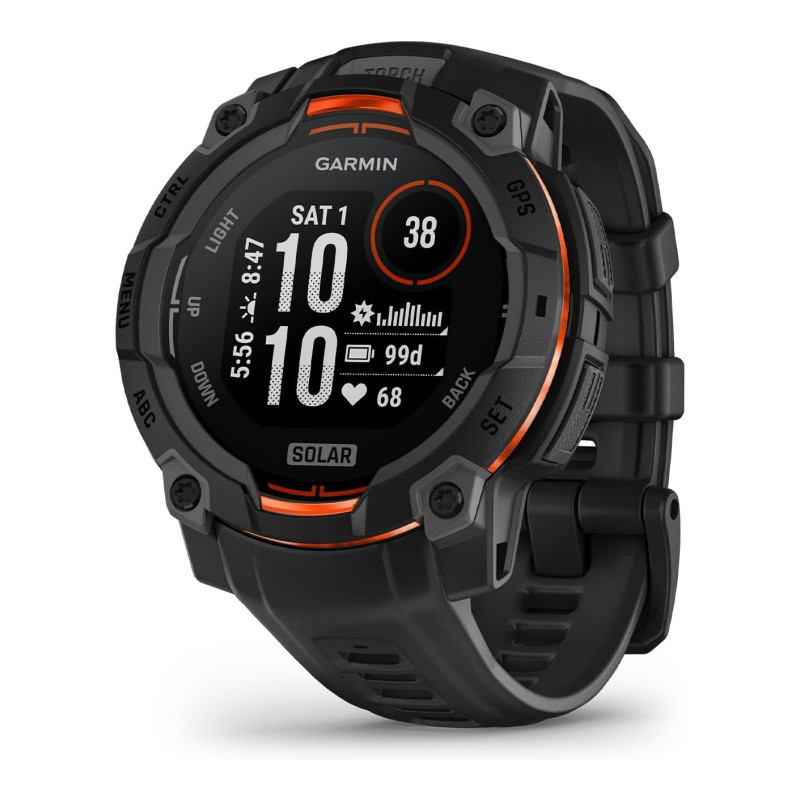
The Instinct 3 Solar is a button-operated GPS watch in a fibre-reinforced polymer case with a metal-reinforced bezel. Its screen is a monochrome display that is easy to read in direct sun and uses very little power, and the lens over it is a solar panel. It comes in two case sizes, 45 mm and 50 mm.
For navigation it has multi-band GPS, which holds a more accurate position under trees and between rock walls, a barometric altimeter and a 3-axis compass. It records your track, shows distance, pace, ascent and time, navigates to saved waypoints and along routes you load from the Garmin apps, and has TracBack, which leads you back along the path you walked. It stores 1,000 waypoints and 30 routes. There are no maps on the watch: a route appears as a line on a blank screen with your position on it.
A small LED flashlight is built into the case, with several brightness levels and a strobe. The watch is rated to 10 atmospheres for water, which covers swimming, and is built to a military standard for heat, cold and shock. It also tracks heart rate and sleep, shows phone notifications, and pairs with a Garmin inReach to send messages and trigger SOS from the wrist.
Battery life, and what solar adds
Garmin rates the 45 mm watch at up to 28 days as a watch and 40 hours of continuous GPS tracking, and the 50 mm at 40 days and 60 hours. With enough sun those figures rise, to 130 and 260 hours of GPS, and in watch mode Garmin calls the battery life unlimited.
“Enough sun” means three hours a day in bright, direct light, which is more than a wrist under a sleeve or a forest canopy receives. In practice the solar lens slows the drain and does not replace the charger. Tracking a full day’s hike uses roughly a quarter to a third of the battery on the 45 mm watch, so plan on about three days of all-day tracking between charges, and carry the cable and a small power bank on a longer trip. The 50 mm case is the one to choose if battery life matters most.
What verified buyers say
Across verified-purchase reviews, the same points come up:
- Battery life. The first thing owners mention. One who uses GPS often charges about every three weeks.
- Solar helps but does not replace charging. Owners who measured it found the watch gains charge on bright days outdoors and loses it on days with long GPS sessions.
- Rugged, with a readable screen. Owners describe it as tough, and the display as easier to read than the previous model.
- The flashlight is handy. A feature owners did not expect to use and do.
- Menus take learning. Navigation features are there but not obvious; owners recommend the online manual and video tutorials.
- Update it first. A new watch has to be updated through Garmin’s computer app before it gives its full battery life, which several owners found out late.
- A minority had faults. Restarting during an activity, a frozen screen and a lost phone connection each appear in a small number of reports.
Worth knowing
There are no maps on this watch. It shows where you are relative to a route or a recorded track, not the terrain around you, so it is a companion to a map and compass or a mapping device, not a replacement. The solar figures assume more sun than most hikes provide; treat the non-solar numbers as the ones to plan with. Load routes and waypoints from the phone app before you leave coverage. Update the software through Garmin Express on a computer when the watch is new. The 45 mm screen is small, and data fields with several numbers are hard to read at a glance. A wrist heart rate sensor and a GPS track are estimates, and the watch’s SOS functions work only when it is paired with a phone or an inReach.
Who it is for
The Instinct 3 Solar is for hikers, backpackers and paddlers who want to record their trips, check distance and elevation, and have a reliable way back, on a watch that survives hard use and does not need charging every night. It suits people who already navigate with a map, a phone app or a handheld and want the wrist for quick checks.
If you want maps on the wrist and still longer battery life, see the Garmin Enduro 3. If you want maps on a larger screen, a handheld such as the Garmin GPSMAP 65s has a larger screen and replaceable batteries. To send messages and call for help beyond cell coverage, pair the watch with the Garmin inReach Messenger or the inReach Mini 2. Carry a compass such as the Suunto M-3 as well; our guide to map and compass navigation covers using them together. Our guide to choosing a hiking watch explains how the three kinds of watch differ.
Specs at a glance
- TypeGPS watch, solar, button-operated
- Sizes45 mm and 50 mm
- Receptionmulti-band GPS
- Sensorsbarometric altimeter, 3-axis compass, heart rate
- Mapsnone (breadcrumb navigation, TracBack)
- Battery, 45 mmup to 28 days; 40 h GPS
- Battery, 50 mmup to 40 days; 60 h GPS
- Water rating10 ATM
- Listed weight1.8 oz (52 g) · 45 mm
- Best fortracking and simple navigation on long trips
Wilderness Experts is reader-supported. As an Amazon Associate we earn from qualifying purchases; when you buy through links on our site we may earn a commission at no extra cost to you. It never changes what we recommend.
The Verdict
The Garmin Instinct 3 Solar is a durable GPS watch with accurate tracking, a compass, an altimeter and a flashlight, and a battery that lasts days of all-day tracking and weeks of ordinary wear. It has no maps and its menus take time to learn. For hikers who want reliable tracking and a way back without nightly charging, it is a sound choice. For a map on the device, see the Garmin GPSMAP 65s; for messaging and SOS, add an inReach Messenger.