
Choosing and setting up a safe backcountry campsite
A good campsite is chosen, not stumbled into. Where you pitch decides how warm you sleep, whether you wake up in a puddle, how hard the wind hits you at two in the morning, and whether anything comes looking for your food. It is one of the highest-leverage decisions of the day, it costs nothing but twenty minutes of attention, and almost all of the mistakes are made by people who arrived too late and too tired to look properly.
The governing idea is that you are picking a site for the night you might get, not the evening you can see. A hollow that is pleasant at six in the evening is a frost pocket at four in the morning. A gravel bar in a dry channel is fine until a storm falls on ground you cannot see, miles upstream. Judge a site for safety and drainage first, comfort second, and view a distant third.
Why the site beats the tent
People spend a great deal of money on shelter and very little attention on where they put it, which is backwards. A modest tent on a well-chosen site will give you a better night than an expensive one pitched badly. The site determines how much wind actually reaches you, whether water runs under you or around you, how cold the air sitting on your tent is at dawn, and what falls on you if the weather turns. Your tent only has to handle whatever the site lets through.
This matters more as conditions get worse. In still, dry, mild weather almost anywhere works and nobody learns anything. The value of site selection shows up on the night it rains hard, or blows, or drops well below what the forecast promised, and by then the choice has already been made. Practise choosing carefully on the easy nights so the habit is there on the hard ones.
Arrive with daylight to spare
Most bad campsites are chosen in the last twenty minutes of usable light by someone who has stopped caring. Plan your day so you reach camp with at least an hour of daylight in hand, and preferably two. That margin is what lets you reject the first flat spot you see, walk another ten minutes to a better one, scan properly for hazards, pitch taut rather than approximately, and cook before you are cold.
Build it into the plan rather than hoping for it. Work backwards from dusk the way you would set a turnaround time, and treat the arrival hour as a commitment. If the day has gone badly and you are going to be late, start looking for a site much earlier and lower your standards deliberately rather than pushing on toward a site you have never seen. A mediocre site chosen in daylight beats a theoretically better one found by headlamp.
The same logic applies to weather. If something is coming in, stop early and pitch while you can still use your hands and see what you are doing. Setting up in driving rain or in the dark is where tents get pitched on slopes, guylines get skipped, and people end up wet for two days. See reading backcountry weather for reading the signs early enough to act on them.
Reading the ground
Walk the area before you drop the pack. Ten minutes of looking usually finds something better than the first candidate, and it is much easier to move now than at midnight.
- Flat, or very close to it. A slope you barely notice standing up will slide you into the corner of the tent all night. If you cannot find level, sleep with your head uphill and accept it, but keep looking first.
- Slightly raised. A gentle rise or a low mound sheds water. Hollows and depressions collect both water and cold air, which are the two things you least want gathering around you.
- Durable surface. Rock, gravel, sand, dry grass, forest duff, or an existing bare site. Not fragile meadow, wet vegetation, cryptobiotic desert crust, or alpine plants that take decades to recover. Where established sites exist, use them and concentrate the impact rather than creating a new scar.
- Free of what is under you. Clear the sticks, cones and stones you would otherwise find with your hip at midnight, and put them back when you leave.
- Not a drainage line. Look for the shallow channels and flattened vegetation that show where water runs when it rains. They are easy to miss when dry and obvious at three in the morning.
- Legal. Many parks require designated sites, permits, or minimum distances from trails and water, and some have seasonal closures for wildlife. Check before you go, because “it looked fine” is not a defence and the rules usually exist for a reason.
Where dispersed camping is allowed, the Leave No Trace instinct is to pick a site that is either already hardened or completely resilient, and to avoid the in-between: the faintly used spot that your night will turn into a permanent one. Our guide to the seven principles covers the reasoning in full.
The overhead and uphill scan
Before you commit, stand where the tent will go and look up, then look uphill. This takes two minutes and is the part of site selection that is actually about survival rather than comfort.
Look up before you look at the view
Widowmakers are dead standing trees, broken hanging limbs, and heavy dead branches still caught in the canopy. They come down without warning, they come down in wind, and they are heavy enough to kill through a tent. Scan the full canopy above your site and the trees close enough to reach it if they fell. Dead trees, leaning trees, trees with obvious rot or fire damage, and anything already hung up in the branches above are all reasons to move. Fire-killed stands are especially dangerous and drop trees for years afterwards.
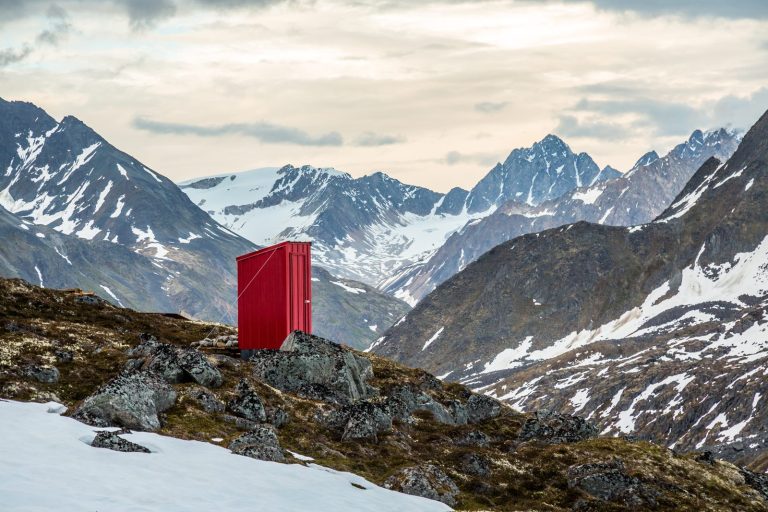
Then the rest of the list. Avoid the base of cliffs and steep loose slopes, where rockfall lands, and note that freeze and thaw make it worse at dawn and dusk. Avoid dry washes, gullies, canyon floors and gravel bars, which flash-flood from rain you may never see, sometimes from storms a long way upstream; this kills people in desert country every year. Avoid exposed ridgelines and summits, which take the full wind and are the worst place to be in a thunderstorm, per our lightning safety guide. Avoid the runout below snow slopes in winter and spring. And avoid game trails, which are roads, and camping on one means putting your tent in traffic.
One more that people miss: look at the high-water mark if you are anywhere near a river or a lake. Debris lines, scoured banks and flattened grass tell you where the water has been, and rain upstream or a warm night on a snowpack can raise a river fast. Camp above the line, not on the pleasant flat sand below it. Our river crossing guide covers how quickly mountain water levels move.
Microclimate: cold air, wind, and sun
Cold air is denser than warm air, so it flows downhill at night and pools in valley bottoms, hollows, and behind anything that dams it. A site in a low spot can be many degrees colder than ground a short way up the slope, which is why the classic advice is to camp on a bench or a gentle rise rather than in the valley floor or a meadow. Meadows are particularly cold and particularly damp, and they are usually fragile ground you should not be on anyway.
Wind is the other half of the trade. Some shelter is good, and terrain features, boulders, or a stand of healthy trees can take the edge off. But a completely sheltered hollow is a cold trap, and a totally exposed site is a windy one, so you are usually looking for partial shelter on slightly raised ground. Remember that a breeze also keeps condensation down and keeps insects moving, so the perfectly still site is not always the prize it seems.
Think about the sun in both directions. An eastern aspect gets early light, which is a real gift on a cold morning and helps dry a wet tent before you pack it. A western aspect stays warm into the evening but bakes in summer. Under dense canopy you stay cooler, get less condensation from radiative cooling, and dry out much more slowly. In snow, the sun tells you where the surface will soften and refreeze.
Condensation is mostly a site problem rather than a tent problem. Cold, still, damp air near water in a hollow with no airflow will wet the inside of any tent. Pitching slightly higher, slightly more exposed, and away from the water usually solves what no amount of venting will.
Near water, not on it
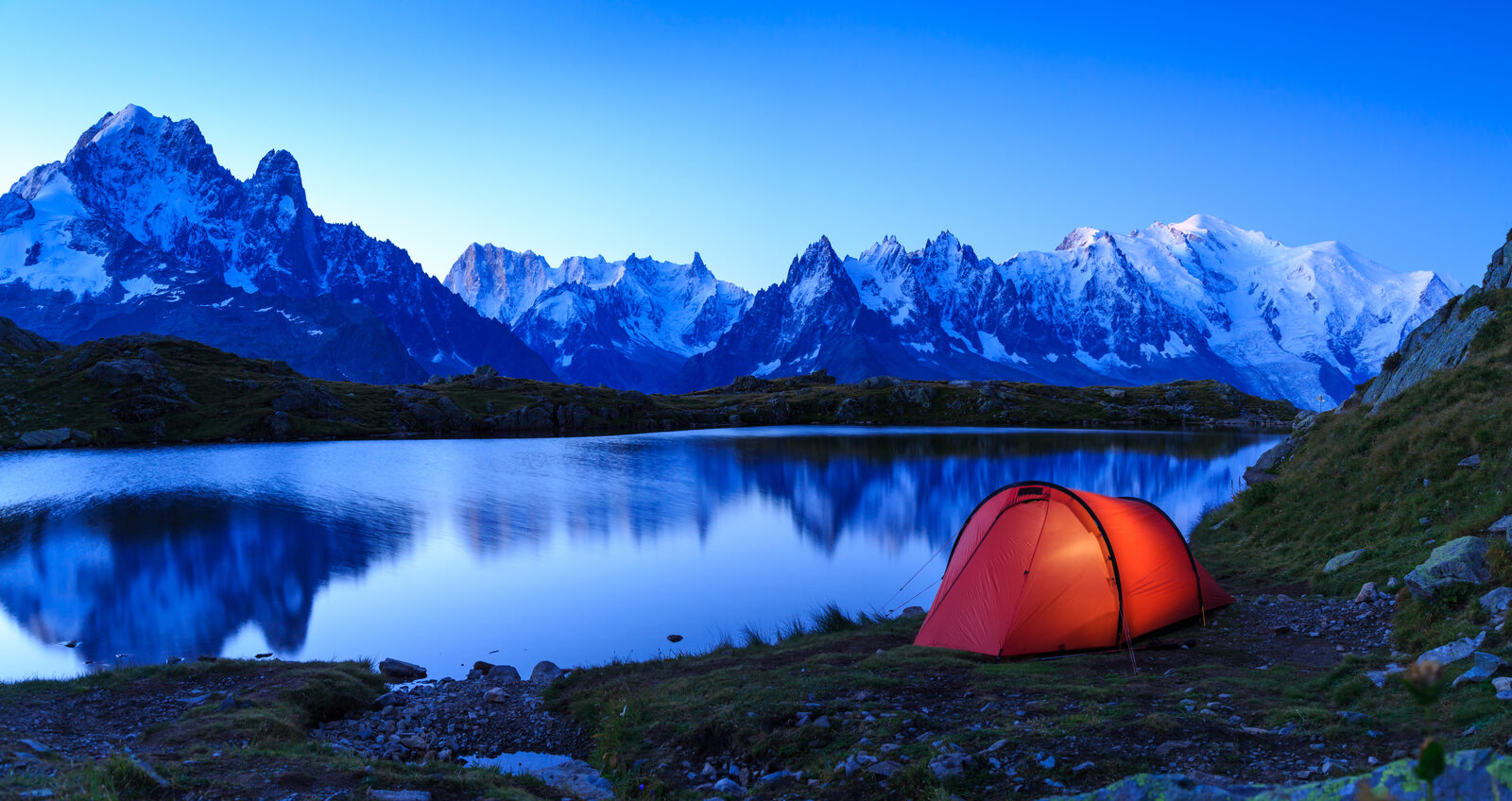
Camp at least 200 feet (60 m) from lakes, streams and springs, which is about 70 adult paces. The distance protects the water from contamination, keeps you off the fragile ground at the margin, keeps you above any overnight rise, gets you out of the coldest and dampest air, and leaves the shoreline available to wildlife that needs to drink. It also gets you away from the noise, which matters more than people expect when you are trying to hear something moving at night.
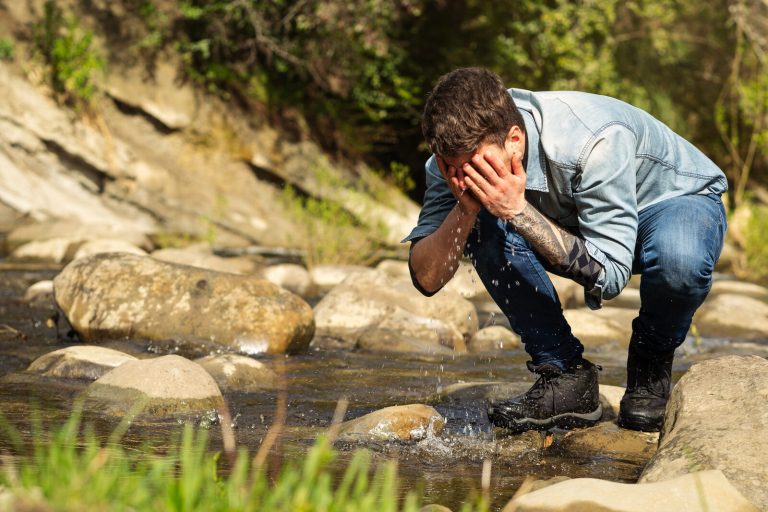
Being near water still matters practically, so the aim is convenient access rather than proximity. Camp within an easy walk, collect what you need in one trip using a container, and do all your washing, cooking and tooth brushing well away from the source rather than at its edge. Treat everything you collect per our water purification guide, and see finding water if the source is not where the map promised.
In desert country the calculus changes, because water is scarce and wildlife depends on the few sources absolutely. Camp further back rather than closer, and never camp between animals and the only water for miles.
Pitching for the weather
Pitch as though the forecast is optimistic, because it usually is at altitude and on ridges.
Orientation
Point the strongest, lowest, most aerodynamic end of the tent into the prevailing wind, which on most designs means a narrow end rather than a broad side. A tent presenting its long flank to real wind will flex, flap, and eventually fail. Put the door on the sheltered side so you are not opening it into the weather, and think about where wind-driven rain will run when you unzip. If you are cooking, keep the door away from where the stove will sit.
Tension
Stake out every guyline, every time. This is the single most skipped step and the one that most often turns a windy night into a broken pole. A taut pitch sheds wind and rain, keeps the fly off the inner so condensation does not transfer, and stops the drumming that keeps everyone awake. Angle stakes at roughly 45 degrees away from the pull, push them fully in, and in soft ground use rocks, buried stakes, or deadmen. Retension before bed, because fabric and cord relax as they cool and wet out.
Rain and drainage
Make sure your footprint or groundsheet does not extend beyond the fly, because any lip sticking out becomes a gutter that funnels runoff straight under you. Tuck it under slightly. Check the fly reaches low enough on the windward side, and look once more at where water will actually flow if it rains hard for hours. Do not dig trenches around your tent: it is a scar that outlives your visit, and it is banned in most places. Choosing better ground is the answer.
Serious wind
If real wind is coming, get lower and get behind something solid, accepting a colder or damper spot in exchange for shelter. Use every guy point, add rocks to the stakes, and lower the profile if the design allows it. Put heavy gear inside so the tent cannot lift, and keep boots and anything loose inside or weighted. A four-season design like the MSR Access 2 exists for these nights, but siting still does more than the tent does.
The ground is what makes you cold
Most of the heat you lose at night goes into the ground by conduction, not into the air. A sleeping bag works by trapping loft, and the loft underneath you is crushed flat by your own weight, so it insulates almost nothing. This is why people with expensive bags still have miserable nights on thin pads, and it is the most common cold-night mistake there is.
The number that matters is your pad’s R-value, which measures resistance to heat flow. Roughly speaking, an R-value around 2 is summer, around 4 is three-season, and 5 or above is what you want for cold ground, frozen ground or snow. Pads stack, and their values add, so a closed-cell foam pad such as the Therm-a-Rest Z Lite Sol under an inflatable like the NeoAir XLite is both warmer than either alone and a hedge against a puncture. For genuinely cold conditions the NeoAir XTherm is the dedicated answer.
Improvise if you have to. A spare pack, a rope coil, dry leaves, spruce boughs where it is legal and ethical to cut them, or an emptied backpack under your legs all beat bare ground. Our guide to staying warm on a cold night covers the whole sleep system, and emergency shelter covers building one from nothing.
Laying out the camp
Once the tent is up, the rest of the camp has a shape. In bear country that shape is a triangle, with your tent, your kitchen, and your food storage at three separate points, each ideally about 100 yards (90 m) from the others, with cooking and storage downwind of where you sleep. The point is to keep food smells away from the place you are lying unconscious for eight hours.
Food storage itself is a subject of its own, including canisters like the BearVault BV500, provided lockers, and how to hang a bag properly if no canister is required. Our guide to protecting food from wildlife covers the mechanics, including the target of at least 12 feet (3.7 m) up and 6 feet (1.8 m) out from the trunk for a hang, and the long list of things that count as smellables beyond food.
Beyond the triangle, give the camp some order so it works in the dark. Keep a single approach path rather than trampling in every direction. Put your headlamp, water and shoes in the same place every night so you can find them without waking anyone. Decide where the toilet area is and which direction people walk to it, well away from water and camp, per our guide to human waste disposal. In a group, keep tents close enough to communicate and far enough apart not to trip over each other’s guylines.
Siting the kitchen
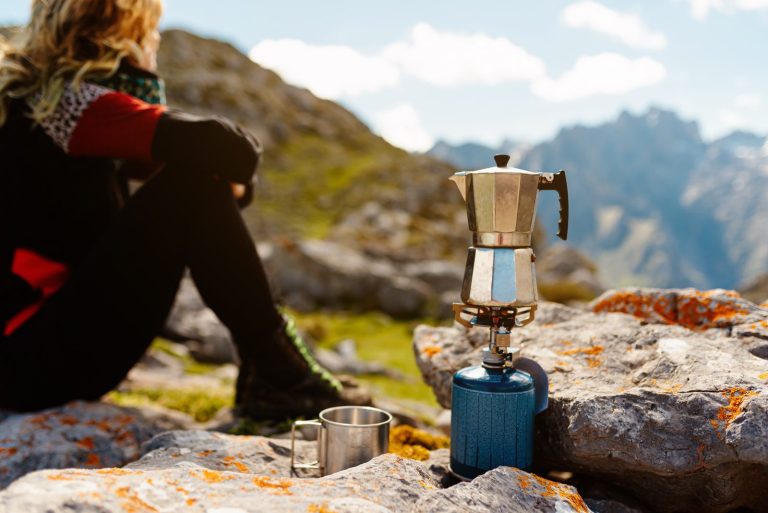
Cook and eat well away from where you sleep, and downwind of it, so the smell of dinner is not sitting on your tent all night. Pick a spot with a stable, level base for the stove, ideally on rock or bare ground rather than dry grass, and shelter it from wind, which is where most of a canister stove’s fuel goes. A compact stove such as the MSR PocketRocket 2 is cleaner, faster and lower impact than a fire, and is often the only legal option under fire restrictions.
Never cook inside a tent or a closed vestibule. It is the standard way people get carbon monoxide poisoning and set their shelter on fire, and both happen faster than you would think. If the weather is genuinely bad, cook in the open under a tarp with airflow on all sides.
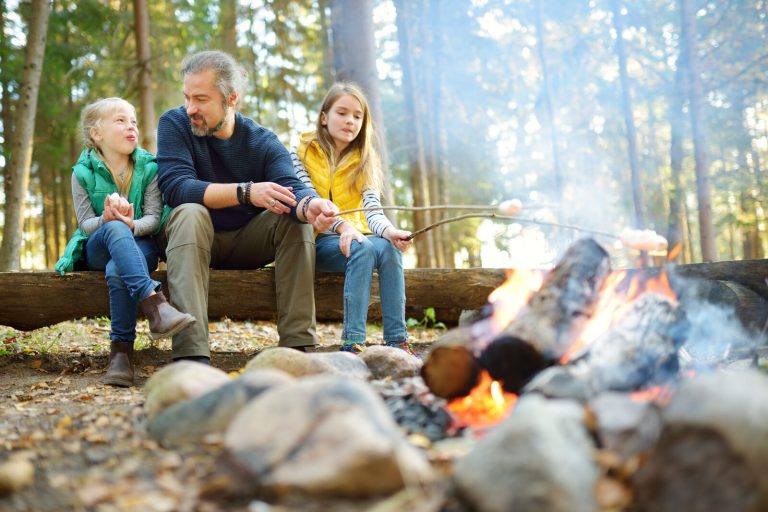
If you do have a fire and it is legal, use an existing ring, keep it small, and drown it until you can put your hand in the ashes, per building and extinguishing a fire. Clean up thoroughly: strain out food scraps, pack out every crumb, and wash away from water. The bits of noodle in the dishwater are exactly what draws rodents, and rodents chew through packs and tents to get them. Our guide to camp hygiene covers the washing routine.
Snow, desert, alpine, and forest
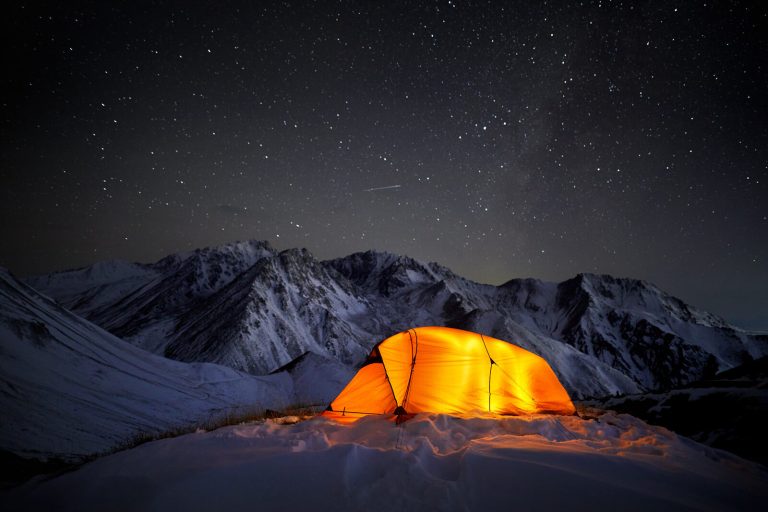
Snow. Stamp out a platform and then let it sinter and harden for twenty minutes before pitching, or you will melt into a lumpy trough overnight. Use snow stakes, buried deadmen, or stuff sacks filled with snow instead of pegs. Build a low wall on the windward side. Check what is above you for avalanche runout, and remember that snow is superb insulation but that the ground beneath it is cold, so R-value matters more than anywhere else. Mark your camp so you can find it in a whiteout.
Desert. The overwhelming hazard is water in the wrong place: never camp in a wash, a canyon floor, or on a gravel bar, whatever the sky above you looks like. Camp on cryptobiotic crust nowhere at all; use rock, sand, or an established site. Expect a very large swing between day and night temperatures, and pitch for shade in the afternoon and warmth at night. Anchor for wind, since sandy ground holds pegs poorly.
Alpine. Wind and exposure dominate, and vegetation is fragile and slow to recover, so use rock and gravel wherever possible. Get off the ridge and out of the highest terrain before evening. Expect the temperature to drop hard as soon as the sun goes off the slope, and expect the weather to arrive earlier than forecast.
Forest. Generally the friendliest option, with shelter, wind protection and duff to sleep on, but it is where the widowmaker scan matters most. Watch for standing dead timber, and be aware that a forest floor traps damp and gives you a slower morning dry-out.
The last check before dark
Do a short round of camp before you get into the tent. It takes three minutes and prevents most of the things that wake people up.
- Everything scented is in the canister or the hang, including toothpaste, lip balm, sunscreen, wrappers and the clothes you cooked in.
- Guylines are tensioned and stakes are firm, and anything loose is inside or weighted down.
- Nothing is left out that wind can take, and nothing sits where rain would run.
- Boots, headlamp and water are where you can reach them without getting up.
- The fire, if there was one, is dead out and cold to the touch.
- You know the forecast for the night and where you would go if the weather turned, and you have had a last look at the sky.
Breaking camp and leaving it right
In the morning, dry what you can before packing, because a wet tent stuffed into a pack is heavier, colder to pitch tonight and quicker to fail over a season. Ten minutes of sun or breeze while you eat is usually enough to make a real difference, and shaking the condensation out of the inner takes seconds.
Then leave the site better than you found it. Pack out everything, including food scraps, micro-litter and the small bits of plastic that come off packaging. Replace the stones and sticks you moved, scatter any disturbed duff, and if you were on grass, fluff it up. If you built anything, dismantle it. The aim is that nobody can tell you slept there, so the next party arrives at a site rather than a scar. Our Leave No Trace guide covers the full standard.
Before you walk away, do the sweep that everyone thinks they do not need: a slow line-abreast walk across the whole site looking down. Stakes, pot lids, socks and headlamps are found on that walk every single time. Note your route and check the day’s weather before you set off, so you are not breaking camp into a surprise.
Common mistakes
- Arriving too late to choose. Nearly every bad site is a late site. Give yourself an hour of light, preferably two.
- Camping in a hollow. It looks sheltered and it fills with cold air and water. Get onto a slight rise.
- Not looking up. A dead limb over the tent is the one hazard that can kill you in your sleep, and it takes two minutes to check for.
- Camping in a dry wash. Flat, soft, sheltered, and the single most dangerous ground in desert country.
- Skipping guylines in calm weather. The wind arrives at two in the morning, not at bedtime.
- A groundsheet sticking out past the fly. It collects runoff and channels it under your tent.
- Relying on the bag and skimping on the pad. The ground takes your heat, not the air.
- Cooking or storing food near the tent. Separate sleeping, cooking and storage, downwind.
- Trenching around the tent. Unnecessary, damaging, and usually prohibited. Choose better ground.
- Camping at the water’s edge. Colder, damper, harder on the site, and in the way of animals that need to drink.
Key takeaways
Give yourself daylight to choose, because nearly every bad campsite was picked in the last twenty minutes of light. Look for flat, slightly raised, durable ground, and reject hollows, which collect both cold air and water. Do the two-minute scan before you commit: look up for dead limbs and standing dead trees, look uphill for rockfall and avalanche runout, and never camp in a dry wash or below the high-water mark. Camp at least 200 feet (60 m) from water, which protects the source and puts you in warmer, drier air. Pitch the tent’s strongest end into the wind with the door leeward, stake every guyline even on a calm evening, and keep the groundsheet tucked inside the fly line. Remember that the ground steals your heat rather than the air, so the pad matters as much as the bag. Keep tent, kitchen and food storage apart and downwind, and do a last round before bed. In the morning, dry what you can, sweep the site, and leave it so nobody can tell you were there.
Site selection, hazard scanning and pitching practice follow standard backcountry camping instruction, with Leave No Trace guidance on durable surfaces, the 200-foot setback from water, and site restoration. Sleeping-pad R-value bands follow the ASTM industry standard now used across the industry.
Wilderness Experts is reader-supported. As an Amazon Associate we earn from qualifying purchases; when you buy through links on our site we may earn a commission at no extra cost to you. It never changes what we recommend.