
Lightning safety in the backcountry
A mountain thunderstorm can build in under an hour, and lightning kills more people in the backcountry than most hikers realize, usually on exposed ridges and summits in the early afternoon, right where the views are best. The threat is real but highly avoidable, because lightning follows patterns you can read and outrun. The whole game is timing and position: be off the high, exposed ground before the storm arrives, and know what to do if it catches you. This guide covers how to plan around lightning, recognize when a strike is imminent, and take the safest position available when you can’t escape.
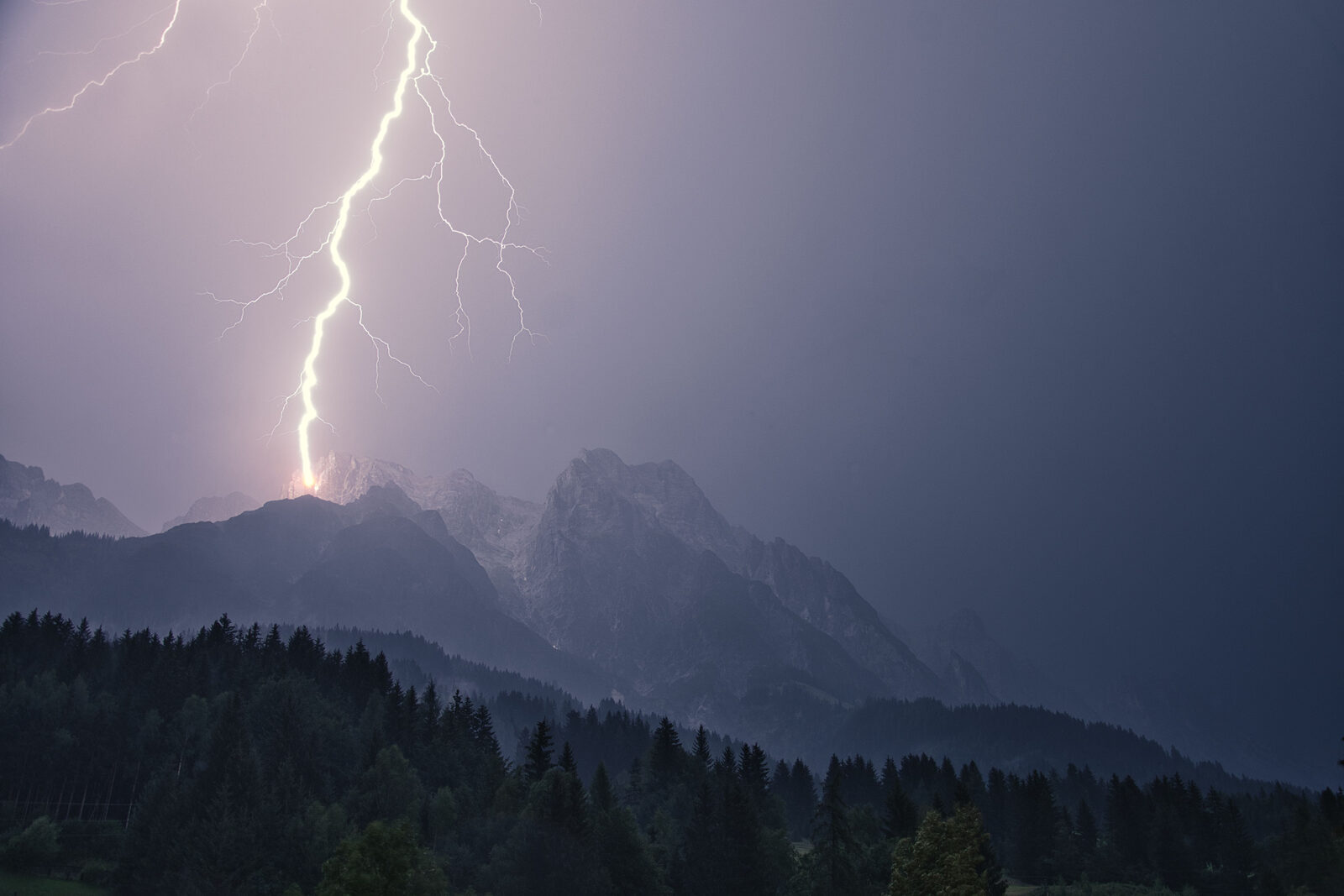
The underlying principle is that lightning seeks the easiest path to the ground, which tends to run through the tallest object in an area and through anything that concentrates the charge, a lone hiker on a bald summit, a solitary tree, a ridgeline. Your job is to never be that object. You do that first by timing . Being below treeline and off exposed terrain before storms build, and second, if you’re caught, by making yourself small and low and getting away from the tall, isolated, and conductive. Prevention through planning is worth far more than any last-second maneuver, which ties directly to our guides on reading backcountry weather and forecasting by the clouds.
Plan the storm out of your day
The best lightning safety happens before you leave the trailhead. In mountains, thunderstorms famously build in the afternoon as the day heats up, so the classic tactic is to start early and be done with exposed terrain by early afternoon . Summit in the morning and be heading down by noon or shortly after. Check the forecast for thunderstorm risk, and build a plan with a bad-weather backstop: know where you’ll turn around and where you can drop to safer, lower ground if the sky turns. Treat a forecast chance of afternoon storms as a hard deadline to be off the ridge, not a suggestion. Our guide to reading backcountry weather and staying ahead of storms covers building that plan.
Reading an approaching storm
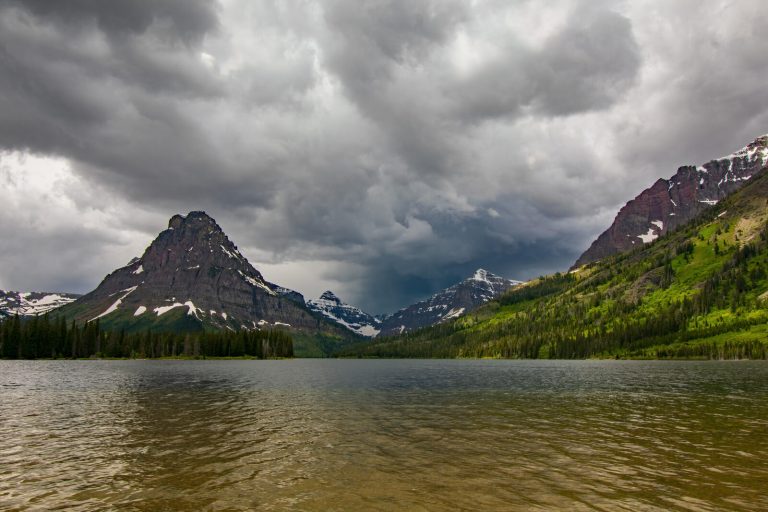
Learn to see a thunderstorm coming while you still have time to act. Watch for towering, cauliflower-shaped clouds building upward into tall anvils. Cumulus growing into cumulonimbus is the classic thunderhead. Rapidly shifting or gusting winds, a sudden temperature drop, darkening skies, and distant rumbles all signal an unsettled, storm-prone atmosphere. Our guide to forecasting weather by the sky details the cloud sequence. Don’t wait for rain, lightning routinely strikes 10 miles (16 km) or more from the storm cloud, from skies that still look partly clear (“a bolt from the blue”). When thunderheads are building, start descending from exposed ground before the storm is overhead.
Lightning outruns the rain
Strikes can reach 10 miles (16 km) ahead of a storm, under blue sky, before the first drop falls. If you can hear thunder at all, you are already within strike range. Begin moving to safety when the storm is still distant, not when it arrives.
The 30/30 rule
Two simple thresholds tell you when to take cover and when it’s safe to come out:
- Flash-to-bang. Count the seconds between a lightning flash and its thunder, then divide by five for the distance in miles, five seconds equals about one mile (1.6 km). If that count is 30 seconds or less, the storm is within about six miles (9.7 km) and close enough to strike you. Take safe position now.
- Wait 30 minutes. After the last thunder you hear, wait a full 30 minutes before returning to exposed ground. Most deaths from the tail of a storm happen because people move too soon; the trailing edge of a storm is still dangerous.
The plainer version: when thunder roars, get low. If you can hear it, you’re in range.
Where to go, and avoid
The goal is to stop being the tallest or most exposed thing around and to avoid what concentrates or carries a charge.
Get away from:
- Summits, ridgelines, and any high, exposed ground, descend as fast as safely possible.
- Lone trees and isolated tall objects, which draw strikes and throw dangerous side-splash and ground current.
- Open fields, meadows, and wide ledges where you’re the high point.
- Water and wet areas. Lakes, streams, and saturated ground carry current well; get out of and away from water.
- Long conductors and metal. Fences, cables, wet ropes, and clustered metal gear.
- Shallow overhangs and cave mouths, where ground current can jump the gap across your body.
Head toward: lower elevation, and uniform cover such as a dense stand of similar-height trees or a low, rolling area, not the biggest tree, but a spot down among many. A deep, dry cave or a substantial building is better still. The safest single option, if reachable, is a fully enclosed metal vehicle or a real building.
The lightning position, and why we no longer teach it
If you have taken an outdoor course, you were probably taught the lightning position: crouch low on the balls of your feet, heels together so current passing through one foot exits the other rather than crossing your heart, head tucked, sitting on a dry pack or sleeping pad to insulate yourself from the ground. It is the single most widely repeated piece of lightning advice in the outdoors, and you will still hear it on trail.
The National Weather Service stopped recommending it in 2008, and we do not teach it either. The reason is simple: it does not work well enough to matter. If a lightning channel comes down on or very near you, you are likely to be killed or injured whether you are crouching or standing. The posture does not meaningfully change that.
The NWS goes further, and their objection is worth understanding, because it is about behaviour rather than physics. Teaching the crouch even as a last resort implies two things that are false: that you will get a warning, and that there is something you can do about it once you are caught. Both beliefs make people slower to leave, and leaving early is the only thing that actually saves lives. Lightning-injury research points the same way: no configuration of the body, no sitting on a pad, no getting inside a tent, and no removing metal from your pockets has been shown to lower risk in the open.
Some outdoor schools still teach the position as a last-ditch option once everything else has failed. We have left it out because the evidence does not support it and the false confidence costs more than the posture gives. There is no safe place outside in a thunderstorm. What changes your odds is where you are and when you left, not how you are standing when the storm arrives.
Two pieces of the old teaching do still hold, and they are worth keeping:
- Do not lie flat. This one is real. Lying down maximises your contact with the ground and with the current spreading through it, and ground current causes most lightning injuries. Stay on your feet and keep moving toward better terrain.
- Spread the group out. The NWS still recommends this explicitly. Separate by at least 50 feet (15 m) so a single strike cannot injure everyone at once, which leaves people able to treat the injured and call for help.
So if you are caught in the open with a storm overhead, do not stop and crouch. Keep moving, fast and deliberately, toward the terrain described in the section above: lower ground, away from the high point, away from lone trees, out of and away from water, and down among uniform cover rather than under the biggest tree. Get to a building or a hard-topped vehicle if either is reachable. Movement toward safer ground is worth more than any position.
Spread your group out
In a group caught in the open, separate by at least 50 feet (15 m). Spacing means a single strike is far less likely to injure everyone at once, and it leaves people able to help the injured. Never huddle together in a storm.
Groups, shelters, and vehicles
A hard-topped vehicle or a large enclosed building is genuinely safe. The structure carries the charge around you. A small tent, a tarp, a picnic shelter, or a lone hut offers essentially no lightning protection; a tent’s metal poles can even make things worse, so a tent is for rain, not lightning. If you’re camped and a storm hits, the tent doesn’t protect you. Get to a vehicle or building if you can. If you cannot, do not rely on the tent or on any position inside it: spread the tents out so a single strike cannot reach everyone, and if there is better terrain within reach, such as lower ground or uniform cover away from the tallest trees, moving to it is worth more than anything you can do inside the tent. Set your gear (trekking poles, metal-frame packs) a short distance away from where people are.
When a strike is seconds away
Sometimes lightning telegraphs an imminent strike. If your hair stands on end, your skin tingles, you hear a crackling or buzzing, or metal objects hum or you see a faint blue glow, a strike may be about to happen right where you are. These signs mean seconds, not minutes. Do not stop to crouch. Move immediately away from whatever makes you or your spot the high point, a summit, a ridge, a lone tree, open water, and get to lower ground among uniform cover. Treat these signs as confirmation that you left far too late rather than as a cue you can act on, because they are not reliable and many strikes give no warning at all.
If someone is struck
Lightning-strike victims carry no residual charge, it’s completely safe to touch and treat them immediately, and fast action saves lives. A strike can stop the heart and breathing, so check responsiveness and breathing at once. If they’re not breathing or have no pulse, begin CPR without delay; lightning victims often respond to prompt resuscitation because the heart may restart. With multiple casualties, reverse the usual triage and treat the still, unmoving ones first . Those who appear “dead” from cardiac arrest are the ones CPR can bring back, while those moving and moaning are already breathing. Then treat burns (entry and exit points), check for other injuries from the blast or a fall, treat for shock, keep the person warm, and evacuate, activate your beacon or satellite messenger for any strike victim. Our guide to backcountry first aid covers the life-threats.
Common mistakes
- Summiting late. Afternoon is prime storm time on peaks. Start early and be off exposed ground by early afternoon.
- Sheltering under the tallest tree. A lone tree draws strikes and side-splash. Get low among uniform cover instead.
- Lying flat. Sprawling maximizes ground-current exposure. Stay upright and keep moving toward safer ground.
- Moving too soon. The back edge of a storm still kills. Wait 30 minutes after the last thunder.
- Trusting a tent or tarp. They stop rain, not lightning, and a tent offers no measurable protection. Seek a building or a hard-topped vehicle.
- Counting on the crouch. It was withdrawn in 2008 and does not meaningfully protect you. Leaving early does.
- Hesitating to touch a strike victim. They hold no charge. Start CPR immediately, it’s what saves them.
What to carry
- A checked forecast and a turn-around time . The most important lightning gear is the plan you made before leaving.
- A foam sleeping pad or dry pack , to crouch on and insulate yourself from ground current.
- A watch , to time flash-to-bang and the 30-minute all-clear.
- A satellite messenger or beacon . To summon evacuation if someone is struck.
- A first aid kit , and CPR knowledge, the true lifesaver for a strike victim.
Learn to read backcountry weather
Key takeaways
Lightning is one of the most avoidable backcountry killers, because it obeys patterns you can plan around. Start early, be off summits and ridges before afternoon storms build, and treat the first distant thunder as your cue to descend, strikes reach miles ahead of the rain. Use the 30/30 rule: take cover when flash-to-bang is under 30 seconds, and wait 30 minutes after the last thunder. If you’re caught, keep moving to lower ground among uniform cover, off the high ground and away from lone trees, water, and metal. Do not stop to crouch: the lightning position was withdrawn by the National Weather Service in 2008 and does not meaningfully protect you. And if someone is struck, touch them at once and start CPR. Respect the timing and the terrain, and you’ll watch most storms roll by from safe ground.
Drawn from the U.S. Army Survival Field Manual (FM 3-05.70 / FM 21-76) weather-reading guidance (Chapter 15) on recognizing storm signs, combined with modern lightning-safety practice from the National Weather Service and wilderness-medicine sources (the 30/30 rule and strike-victim resuscitation), and updated in 2026 against current National Weather Service guidance, which withdrew the lightning crouch in 2008.
Wilderness Experts is reader-supported. As an Amazon Associate we earn from qualifying purchases; when you buy through links on our site we may earn a commission at no extra cost to you. It never changes what we recommend.