
Garmin inReach Mini 3 Plus review: satellite SOS with a real screen, voice and photos
A satellite communicator is the device you hope never to need and must be able to trust when you do. The Garmin inReach Mini 3 Plus is the successor to the Mini 2, the compact standard for backcountry SOS: the same global coverage on the Iridium network and the same small size, now with a colour touchscreen you can type on, 30-second voice messages, photo messages and a stronger satellite antenna.
Quick take
The compact satellite communicator to buy now. Interactive SOS and two-way messaging work anywhere on Earth, the colour touchscreen makes the device usable without a phone, and voice messages are far quicker to send than typed text. Battery life is several days of tracking rather than the two weeks the specifications suggest, a subscription is required, and the built-in map is too basic to navigate by. For a light, dependable way to call for help and stay in touch, it is the best of its kind.
What it does
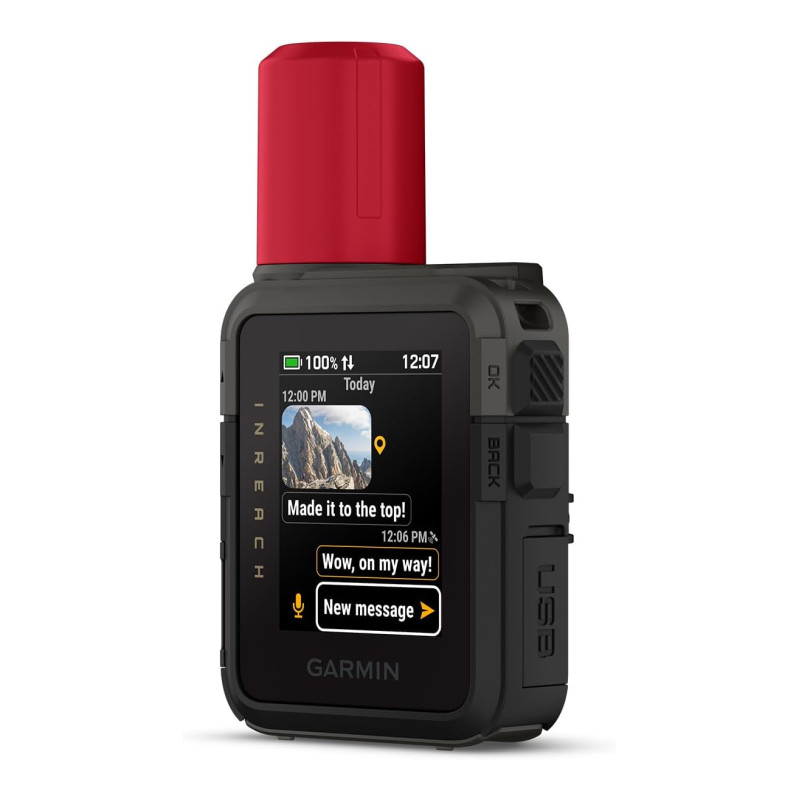
The Mini 3 Plus is a two-way satellite communicator. Press and hold SOS and it contacts Garmin’s 24/7 emergency response coordination centre with your location, and you can message back and forth about your situation until help arrives. Day to day, it sends texts of up to 1,600 characters to any phone number or email, shares your track on a web page that family can follow, and checks in with preset messages. The Plus model adds 30-second voice messages, which arrive transcribed as well as recorded, photo messages sent from your paired phone, a speaker and microphone, and a siren. Its satellite module is Iridium’s newer one, which sends faster than the Mini 2’s and may hold a connection better under trees and in canyons. The 1.9 in (4.8 cm) colour touchscreen carries a full keyboard, the buttons still work on their own, and the case is rated IP67 against dust and immersion to 3.3 ft (1 m) for 30 minutes. It weighs about 4.4 oz (125 g), measures 2.2 x 3.9 x 1.1 in (5.5 x 9.8 x 2.7 cm), and charges by USB-C. TracBack retraces your route, and you can navigate to saved waypoints, but the built-in basemap shows towns and cities, not trails or terrain.
What verified buyers say
Across verified-purchase reviews, the same points come up:
- Small enough to always carry. Owners describe forgetting it is clipped to them, and long-time inReach users moving down from larger models find the small screen surprisingly clear and easy to read.
- Quick to find satellites. Several owners report faster satellite fixes than their previous units, and one completed test messages indoors.
- Easy to use, with or without a phone. Owners value that it works through the app or entirely on its own, and that firmware updates now run from the phone.
- Messages go through. Owners who have texted from the backcountry report most messages sending quickly; one noted the service was occasionally down.
- The cost of ownership stings. The subscription and activation fee are the most common complaint, and one owner wanted to share a single unit among family members on separate accounts, which the service does not allow.
- Isolated faults. One owner’s screen cracked in a drop, one unit would not acquire satellites and was returned, and one owner found that the clip mount can slip off a pack strap.
Worth knowing
Plan on several days of steady tracking from a charge, not the two weeks quoted for the most frugal settings: tracking every 10 minutes with the screen in normal use drains the battery in roughly two to three days, so carry a small power bank on longer trips. A subscription is required for anything beyond navigation, and there is an activation fee. People you message need Garmin’s app to hear voice messages or see photos. The standard tracking interval is 10 minutes, so the track your family sees is coarse. The basemap is too basic to navigate by, so carry a paper map and compass and use your phone’s map app for trail navigation. Secure it to your pack with a tether as well as the clip. Like any satellite device, it needs a clear view of the sky, and it supplements a shared trip plan rather than replacing one.
Who it is for
The Mini 3 Plus is for hikers, backpackers, paddlers and hunters who travel beyond cell coverage and want two-way SOS and messaging in the smallest practical package. If you only need a way to call for rescue, with no subscription at all, a personal locator beacon such as the ACR ResQLink is simpler and cheaper to own. If you want detailed topographic maps on the device itself, a handheld GPS such as the Garmin GPSMAP 67 is the better tool. The Mini 3 Plus replaces the inReach Mini 2, which Garmin has discontinued; if you already own a Mini 2 or find one in good condition, it remains an excellent SOS device and that review still applies.
Specs at a glance
- Typecompact two-way satellite communicator with SOS
- NetworkIridium, global, subscription required
- Screen1.9 in (4.8 cm) colour touchscreen plus buttons
- Messagingtext up to 1,600 characters, 30-second voice, photos
- Listed weight4.4 oz (125 g) · device without carabiner
- Size2.2 x 3.9 x 1.1 in (5.5 x 9.8 x 2.7 cm)
- Water and dustIP67
- ChargingUSB-C
- Best forgo-anywhere SOS and messaging
Wilderness Experts is reader-supported. As an Amazon Associate we earn from qualifying purchases; when you buy through links on our site we may earn a commission at no extra cost to you. It never changes what we recommend.
Check price on Amazon In Canada, find it at MEC
The Verdict
The Garmin inReach Mini 3 Plus keeps what made the Mini 2 the standard, global two-way SOS in a device small enough to carry every time, and fixes its biggest weakness, a screen too small to use without a phone. Voice messages and the stronger antenna are real improvements in the field. Budget for the subscription, carry a power bank on long trips, and navigate with a map rather than its basemap, and it is the satellite communicator we would carry. Always pack the basics too: an emergency whistle and mirror.