
Brooks Cascadia 20 (men’s) review: more cushion and Vibram grip for mountain trail
On a rocky, rooty trail a thin, light shoe leaves the soles of your feet aching by afternoon. The Brooks Cascadia has long been the trail runner for that ground, and the Cascadia 20 changes more than most updates do: thicker, livelier cushioning, a Vibram Megagrip outsole for the first time, and a narrower platform that makes the shoe feel less clumsy.
Quick take
A stable, cushioned trail runner for rocky mountain trail and light backpacking. The Megagrip outsole grips far better on wet rock and in mud than the Cascadia 19, the deeper foam keeps long days comfortable, and the outsole wears slowly. It fits snugger and lower in the toe than before, so many hikers should try a half size up, and the collar lining wears faster than the rest of the shoe. For most three-season hiking, it is the trail runner we would choose.
What it does
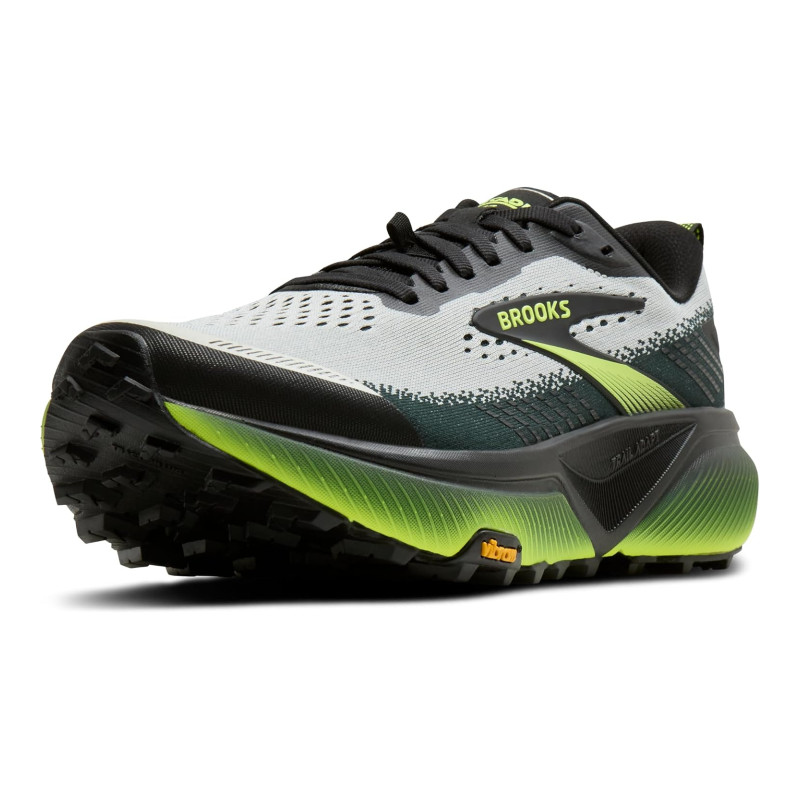
The Cascadia 20 is Brooks’ protective mountain trail shoe. Nitrogen-infused DNA Flash v2 foam replaces the softer foam of the Cascadia 19 and adds about 0.16 in (4 mm) of height under the heel and forefoot, for a stack of roughly 1.5 in (38 mm) at the heel with the same 0.24 in (6 mm) drop. The outsole is Vibram Megagrip, a soft, sticky rubber, with lugs about 0.16 in (4 mm) deep. The 19’s rock plate is gone, and the thicker foam now provides the protection from sharp stones. The platform is narrower than the 19’s, which makes the shoe feel quicker and less clumsy on technical ground, and a mesh upper with printed overlays, a toe cap and a mudguard protects the foot. A men’s pair weighs about 1 lb 5.6 oz (612 g), and the shoe comes in regular and wide.
What verified buyers say
Across verified-purchase reviews, the same points come up:
- Size up a half. The most consistent comment: the Cascadia 20 runs smaller and narrower than the 19, and owners who wore their usual Brooks size often found the toe box tight, including in the wide version.
- Supportive and comfortable once the size is right. Owners describe a secure, supportive shoe with good cushioning, and some call it the best Brooks they have owned.
- Grip is a clear step up. Owners hiking rugged terrain single out the Vibram sole, though one found it slippery on wet ground.
- Narrow, low-volume feet need firm lacing. One owner with a narrow foot found the laces hard to cinch tight enough.
- A few early defects. Isolated reports describe a sole peeling within days and stitches popping where the tongue joins the shoe when it was forced on.
Worth knowing
Fit is the main thing to get right: the toe box is lower and narrower than the Cascadia 19’s, so if your feet are wide or high-volume, start with the wide version or a half size up, and unlace fully to get the shoe on rather than forcing the heel. The fabric lining at the collar and heel wears faster than the outsole or the mesh. Without a rock plate, the shoe relies on foam for protection, which is ample on most trail and less precise on sharp scree and boulder fields. The heel can slip slightly on very steep descents, and the low collar gives no ankle support on loose sidehills.
Who it is for
The men’s Cascadia 20 is for day hikers and light backpackers on rocky, rooty, wet mountain trail who want cushioning, stability and grip in a trail runner. If your feet need a roomy, foot-shaped toe box, the Altra Lone Peak 9 (men’s / women’s) is the better fit. For smooth, maintained trail, the Brooks Ghost Trail (men’s / women’s) is softer and lighter. For heavy loads, snow and cold wet seasons, a boot such as the Merrell Moab 3 (men’s / women’s) is the better tool. The Cascadia 20 replaces the Cascadia 19 (men’s), which Brooks has discontinued; if you find a 19 in your size, that review still applies, and the 19 has the roomier fit.
Specs at a glance
- Typecushioned mountain trail running shoe
- Fitmen’s, snug, size up a half; regular and wide
- Dropabout 0.24 in (6 mm)
- Stackabout 1.5 in (38 mm) heel, 1.3 in (32 mm) forefoot
- Listed weight1.3 lb (612 g) · pair, men's
- SoleVibram Megagrip, 0.16 in (4 mm) lugs, DNA Flash v2 foam, no rock plate
- Trade-offssnug fit, collar lining wears early
- Best forrocky, wet mountain trail and light backpacking
The Verdict
The men’s Cascadia 20 is a bigger change than its number suggests: deeper cushioning that stays comfortable on long days, a Vibram outsole that grips wet rock and mud well, and a narrower, more agile platform. The price of those gains is a snugger fit and a collar lining that wears early. Get the size right, a half up for many hikers, and it is the trail runner we would choose for rocky, rooty three-season trail. The women’s version is covered in our Cascadia 20 (women’s) review, and choosing between trail runners, boots and approach shoes is in hiking boots, trail runners, or approach shoes.