
Garmin Enduro 3 review: the mapping watch for thru-hikes and expeditions
On a trip of two weeks or more, battery life limits which watch you can use. A smartwatch needs a charger every day or two, and many mapping watches need one within a week. The Garmin Enduro 3 shows a topographic map, tracks for about 120 hours on a charge, and weighs less than most watches of its size.
Quick take
A mapping GPS watch for thru-hikes, expeditions, and any trip where charging is difficult. The Enduro 3 has topographic maps that can route you along trails, multi-band GPS, a sapphire solar lens, a titanium bezel, a built-in flashlight, and a rating of 120 hours of GPS tracking, which independent tests have confirmed. It comes in one large 51 mm size, the screen is plain next to a smartwatch display, and it has no speaker, microphone, or satellite messaging. Choose it when days between charges matter more than anything else on the watch.
What it does
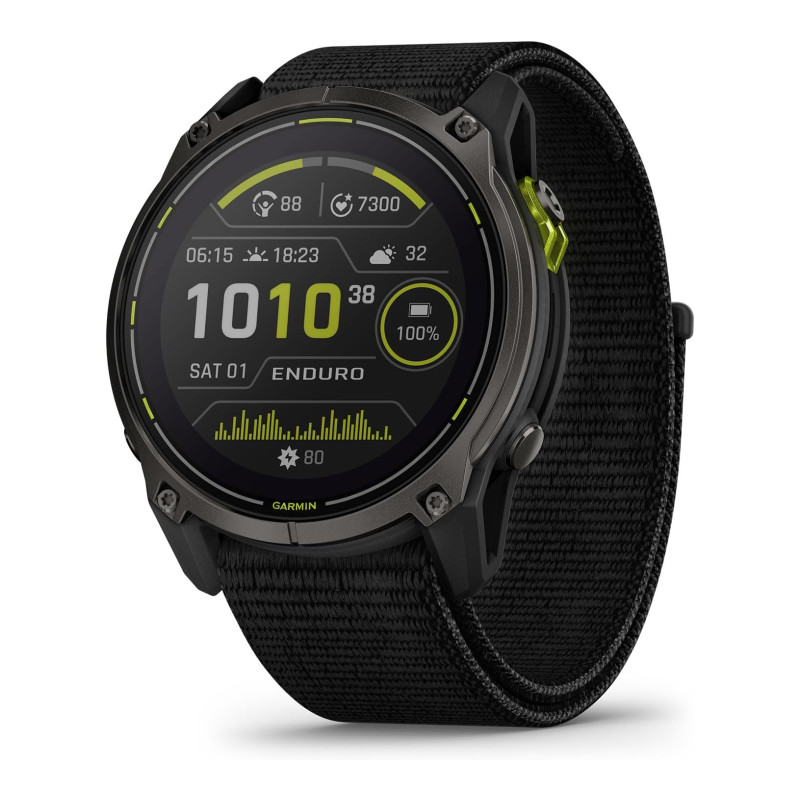
The Enduro 3 is a GPS watch for long-distance hiking, running, and cycling. The case is fibre-reinforced polymer with a titanium bezel, and the lens is sapphire glass with a solar ring around the screen. The screen is a 1.4-inch (3.6 cm) memory-in-pixel colour display: it is always on, easy to read in direct sun, and uses very little power. It is dimmer than a smartwatch screen, and in deep shade you will need the backlight. The watch is operated with five buttons, a touchscreen, or both.
It stores topographic maps with roads, trails, and contour lines, with the maps for the region where it is sold already loaded. The maps are routable: the watch can plot a course along trails to a point you choose, lead you back to the start, and work out a new course when you leave the planned one. An off-course alert sounds when you stray from a loaded route. The GPS receives on two frequencies for a more accurate position under trees and beside rock walls, and there is a barometric altimeter, a compass, and a thermometer.
A flashlight is built into the top edge of the case, with four white brightness levels, a red light that preserves night vision, and a strobe. It is useful for finding gear in a tent and for tasks around camp. The watch is water resistant to 10 ATM, often printed as “100 m”, which covers swimming and river crossings.
Battery life and solar charging
Garmin rates the Enduro 3 at 36 days as a watch and 120 hours of GPS tracking in its standard mode, or 60 hours in the most accurate multi-band mode. Independent tests support the figures. One reviewer measured about 124 hours of standard GPS tracking on a long hike. Another, hiking 12 hours a day, went about five and a half days between charges at the default settings and nearly nine days in the standard GPS mode. A third charged the watch once every several weeks over months of daily use.
Two things reduce those hours. Keeping the map on the screen while you walk uses far more power than a data screen; in one test it roughly halved the tracking time. The multi-band mode does the same. Check the map when you need it, and use the automatic setting that switches to multi-band only where reception is poor.
Garmin’s solar figures, up to 320 hours of GPS tracking and 90 days as a watch, assume three hours a day in direct, bright sun. On the trail the gain is smaller. A tester who wore the watch uncovered through a full sunny day in the desert found that solar charging slowed the drain and did not come close to replacing a charge, and advises against counting on it. Treat the solar lens as a few extra days and carry the cable. The watch recharges in about two hours, and a small power bank holds enough for several full charges.
Size and weight
The Enduro 3 comes in one size, a 51 mm case that is 0.6 inch (16 mm) deep. It weighs 2.2 ounces (63 g) with its nylon hook-and-loop strap, about a third less than Garmin’s comparable metal-cased watch, so it does not feel as heavy as it looks. The case is still large. Reviewers suggest trying one on if your wrist measures less than about 6.5 inches (165 mm) around, and one found the strap too long for a slim wrist.
What verified buyers say
Across verified-purchase reviews, the same points come up:
- Battery life. This is the reason most owners bought it. With regular tracking they report two to three weeks between charges, and one recorded more than 70 hours of GPS in a race.
- Readable in sunlight. Owners who came from colour smartwatch screens found the display easy to read outdoors, and usable in the dark with the backlight.
- Light for its size. The watch is large, and some buyers note that its weight is not a burden on the wrist.
- A handy flashlight. Owners name it among the features they use.
- The screen does not suit everyone. Some buyers returned the watch because the display looked dull indoors next to a smartwatch.
- Menus and software take time. There are many settings, some are hard to find, and a few owners report software faults that needed a restart or a reset.
- Solar adds little in ordinary use. Buyers who expected the sun to keep the battery full were disappointed.
Worth knowing
The Enduro 3 has no way to call for help beyond cell coverage. It has no cellular connection and no satellite messaging, and its emergency alert works only through a paired phone with a signal; carry a satellite communicator on remote trips. The maps loaded on the watch cover the region where it was sold, so load the maps for a trip abroad at home, where you have Wi-Fi or a computer. Weather, messages, and syncing all depend on your phone. The charging cable is Garmin’s own, not USB-C at the watch end, and the plug can be knocked out of the socket, so check that the watch is charging before you leave it. A watch map is small: carry a paper map and a compass as well.
Who it is for
The Enduro 3 is for thru-hikers, expedition travellers, and backpackers on trips of a week or more who want a map on the wrist and as few charges as possible. It also suits anyone who would sooner charge a watch twice a month than twice a week.
For shorter trips you can spend much less. The Coros Apex 4 has offline maps and about 65 hours of GPS tracking in a smaller case, and the Garmin Instinct 3 Solar is a tough tracking watch with no maps. If you want a bright touchscreen and satellite SOS from the wrist, and can charge every day or two, see the Apple Watch Ultra 4. To send messages and call for help beyond cell coverage, pair any of them with the Garmin inReach Messenger. Our guide to choosing a hiking watch explains how the kinds of watch differ.
Specs at a glance
- Typesolar GPS watch with topographic maps
- Size51 mm
- Listed weight2.2 oz (63 g) · 51 mm, with nylon strap
- Casepolymer, titanium bezel, sapphire solar lens
- Screen1.4 in (3.6 cm) memory-in-pixel, colour
- Receptionmulti-band GPS
- Mapsroutable topo, 32 GB storage
- Battery36 days as a watch; 120 h GPS; 60 h multi-band
- Flashlightwhite, red, and strobe
- Water rating10 ATM (100 m)
- Best forthru-hikes, expeditions, and long trips between charges
Wilderness Experts is reader-supported. As an Amazon Associate we earn from qualifying purchases; when you buy through links on our site we may earn a commission at no extra cost to you. It never changes what we recommend.
The Verdict
The Garmin Enduro 3 tracks for about 120 hours on a charge with a topographic map on the wrist, and independent testers who carried it on long trails measured what Garmin claims. It is light for a 51 mm watch, the sapphire lens and titanium bezel resist scratches from rock, and the flashlight is useful in camp. The single large size, the plain screen, and the price are the costs. For a thru-hike or an expedition it is the watch we recommend; for trips of a few days, the Coros Apex 4 does most of the same work for less.