

Carlsbad Caverns National Park
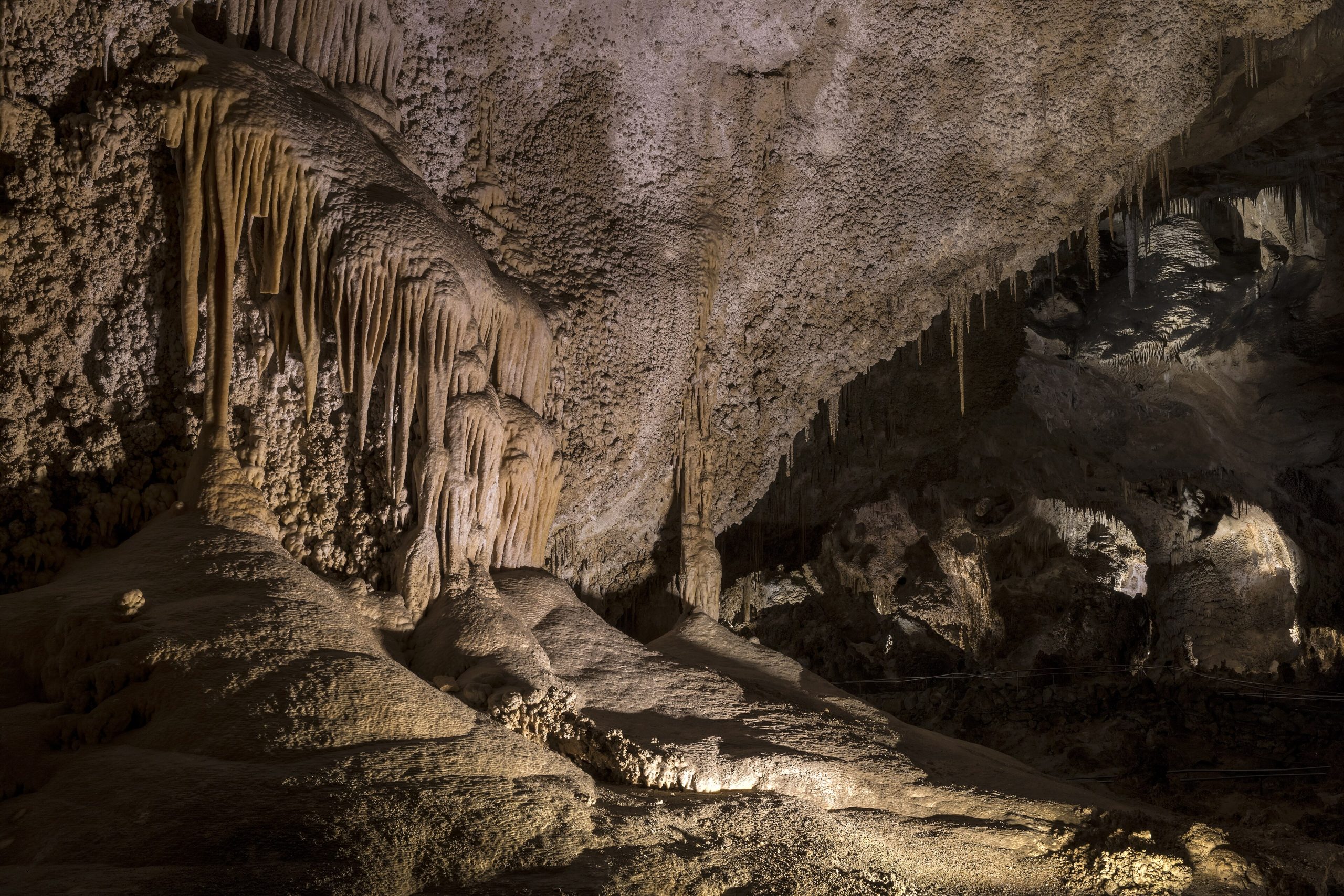
Beneath the Chihuahuan Desert of southern New Mexico lies one of the most spectacular cave systems on Earth, Carlsbad Caverns, where a vast underground chamber called the Big Room stretches beneath the surface amid a wonderland of stalactites, stalagmites and delicate mineral formations. Above ground, each summer evening, hundreds of thousands of bats spiral out of the cave mouth into the desert sky.
Fast facts
- Established: national monument 1923; national park in 1930
- Size: about 46,700 acres (189 km²) above more than 119 known caves
- The Big Room: one of the largest cave chambers in North America
- Bats: a huge summer colony of Brazilian free-tailed bats
- Gateway: Carlsbad, New Mexico
- Managed by: National Park Service
The landscape
The park protects both a rugged slice of Chihuahuan Desert, part of an ancient fossil reef, and the extraordinary cave world below it, dissolved out of the limestone by acidic groundwater over millions of years. The Big Room and its neighboring chambers are draped in every kind of cave formation, while the surface holds desert canyons, cactus and the famous bat colony.
Best time to go
The cave is a comfortable, constant temperature year-round, so any season works underground. The famous bat flights occur from roughly late spring through October, when the colony is present. Summer evenings are the classic time to watch them emerge. The surface desert is hot in summer and mild in the cooler months.
Getting there and around
The park is reached via US-62/180 near Whites City in southeastern New Mexico, with a road climbing to the visitor center. Timed-entry reservations are required to enter the cavern. From the visitor center you descend either by the steep Natural Entrance trail or by elevator to the Big Room; a vehicle is needed to reach the park.
Things to do
Walk the self-guided Big Room loop and the dramatic Natural Entrance route, and book a ranger-guided tour into wilder chambers like the King’s Palace or the strenuous Lower Cave and Left Hand Tunnel. On the surface, watch the evening bat flight in season, drive the desert loop, and hike the backcountry trails.
Staying safe
Cave trails are steep, paved but sometimes slippery, and the Natural Entrance route is a serious descent and climb. Wear good shoes and choose a route matching your fitness. Wild-cave tours involve tight, dark spaces and route-finding. On the surface, guard against desert heat and lightning, and carry water.
Know before you go
An entrance fee and a timed-entry reservation are required to enter the cavern, and guided tours need separate tickets that sell out. Book ahead. This page is a general overview, not a live conditions report; always confirm current reservations, tour availability and conditions with the National Park Service before your trip.
- Coordinates
- 32.1200, -104.5278
- Magnetic declination
- 6.6° E (2026)
Set this declination on your compass, then align it to the map's north lines; it is the angle between true north and magnetic north, refreshed each year.
A spread of the park’s main places shows straight away, and the rest appear as you zoom in. You can also search above, or pick any place from the lists below, and the map will go to it.
Getting there 1
Ranger station
Sights 6
Viewpoint
Point of interests
Peak
Map data comes from third-party sources and may be incomplete or out of date, so carry a current official map (terms).
- Best seasons
- Year-round (bat flights summer to early fall)
- Difficulty
- Easy to strenuous
- Access / trailheads
- In the Chihuahuan Desert of southeastern New Mexico via US-62/180 near Whites City; a park road climbs to the visitor center. Nearest hub is Carlsbad.
- Water
- Water at the visitor center; carry water on surface trails.
- Cell / satellite coverage
- Limited surface cell service and none underground.
- Nearest ranger / SAR / emergency
- Contact park rangers; life-threatening emergencies: 911.
- Permits & regulations
- Per-person entrance fee; timed-entry reservations are required to enter the cavern, and ranger-guided wild-cave tours need separate tickets.
- Leave No Trace
- Do not touch cave formations, stay on trails, pack out all waste on the surface, and follow Leave No Trace.
January
February
March
April
May
June
- Hot days
July
- Hot days
August
- Hot days
September This month
October
November
December
What to bring depends on your trip: how long you’re out, where you sleep, and how far you go from the road. The planner builds the list for yours.
Plan a trip here →Averages for 1991–2020 from NOAA U.S. Climate Normals, measured at the Carlsbad Caverns station, 5 miles (8 km) away at 4,435 feet (1,352 m).