

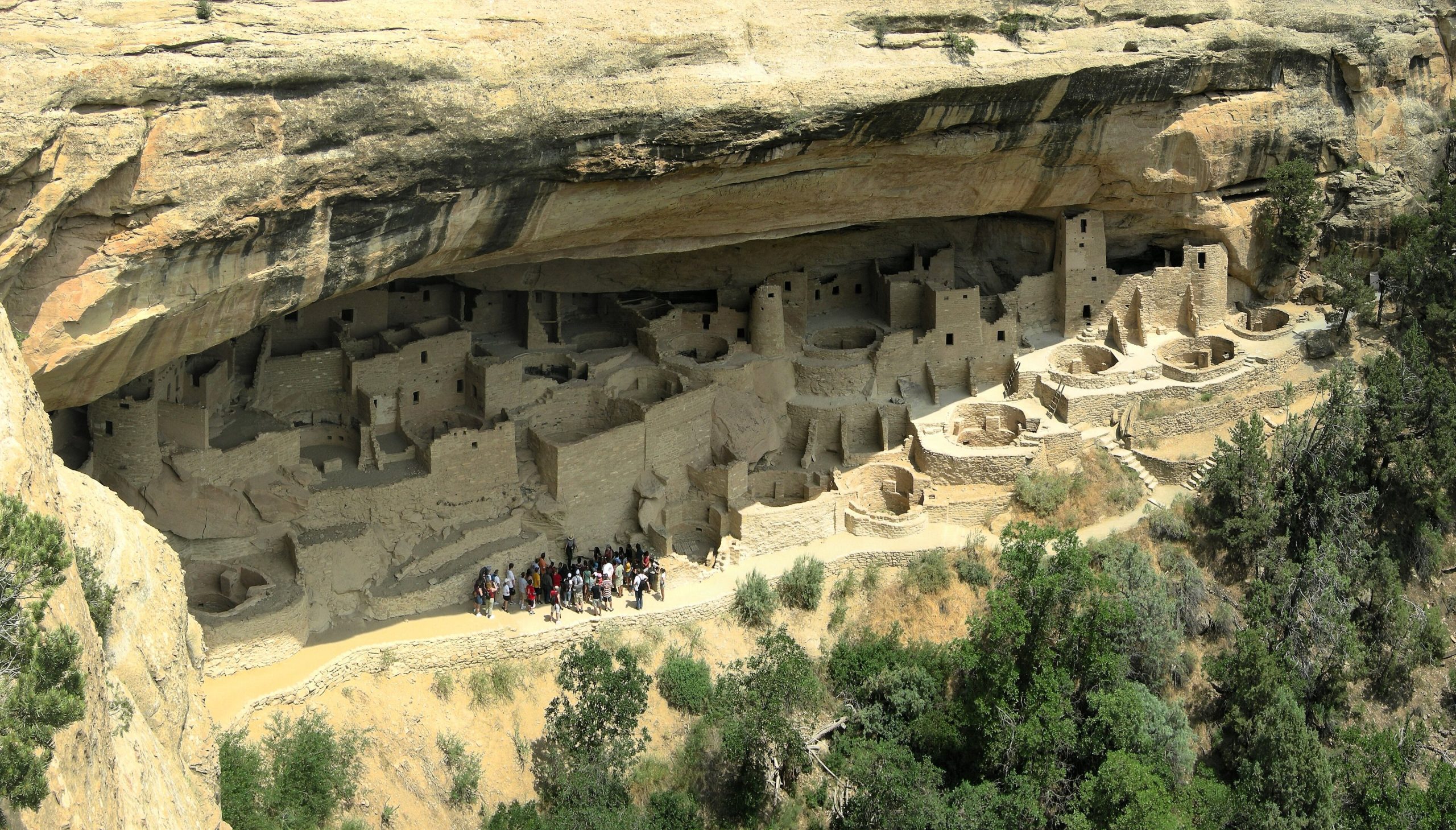
Mesa Verde National Park
Mesa Verde is unlike any other national park. It protects not a landscape but a civilization, the cliff dwellings of the Ancestral Puebloan people who built elaborate stone villages into the canyon walls some 700 to 1,400 years ago. Cliff Palace, Balcony House and hundreds of other sites make this one of the most significant archaeological preserves in the world, set on a high, pine-clad mesa in southwest Colorado.
Fast facts
- Established: 1906, the first national park set aside to protect cultural heritage
- Size: about 52,000 acres (210 km²) of mesa and canyon
- Sites: roughly 5,000 archaeological sites, including 600+ cliff dwellings
- World Heritage: a UNESCO World Heritage Site (1978)
- Gateway: Cortez, Colorado
- Managed by: National Park Service
The landscape
Mesa Verde, “green table”, is a high, flat-topped mesa cut by deep canyons and cloaked in piñon pine and juniper, sitting between about 7,000 and 8,500 feet (2,100 to 2,600 m). Sandstone alcoves in the canyon walls sheltered the cliff dwellings, while the mesa tops hold the earlier pit-house and pueblo sites. The dry, sunny high-desert setting supports mule deer, wild turkeys and the occasional black bear.
Best time to go
Late spring through early fall is the main season, when all the ranger-guided tours run and the roads and sites are fully open. Summer is warm and busy, with the popular tours selling out, so book ahead. Winter is quiet and can be beautiful under snow, but many cliff dwellings close and tours pause, leaving the mesa-top drives and overlooks.
Getting there and around
The entrance is off US-160 near Cortez, and a long, steep, winding road climbs the mesa to the visitor center and the Chapin Mesa sites. Allow time for the drive. A vehicle is essential to reach the widely spaced overlooks, loop drives and trailheads, and the most famous dwellings are seen on ranger-guided, ticketed tours.
Things to do
Join a ranger-guided tour to climb into Cliff Palace or Balcony House, the heart of a Mesa Verde visit, and drive the Mesa Top Loop past overlooks of dwellings tucked in the cliffs. Walk the Petroglyph Point or Spruce Canyon trails, visit the museum, and take in the layered story of a people who thrived and then moved on centuries ago.
Staying safe
The signature tours involve steep ladders, narrow passages and real exposure, so know your comfort with heights before booking Balcony House in particular. The mesa sits at altitude and can be hot and dry, so carry water and sun protection, and get off exposed points when lightning threatens. Drive the mountain road with care, watching for wildlife.
Know before you go
A park pass is required, and the ranger-guided cliff-dwelling tours need tickets bought in advance. They sell out in summer, so plan early. Respect that these are sacred ancestral sites: never touch the walls or remove anything. This page is a general overview, not a live conditions report; always confirm current tour availability, conditions and closures with the National Park Service before your trip.
- Coordinates
- 37.2535, -108.4471
- Magnetic declination
- 8.9° E (2026)
Set this declination on your compass, then align it to the map's north lines; it is the angle between true north and magnetic north, refreshed each year.
A spread of the park’s main places shows straight away, and the rest appear as you zoom in. You can also search above, or pick any place from the lists below, and the map will go to it.
Getting there 2
Park entrance
Visitor centre
On the trail 17
Trailheads
Campground
Picnic site
Sights 58
Viewpoints
Heritage sites
Peaks 11
Map data comes from third-party sources and may be incomplete or out of date, so carry a current official map (terms).
- Best seasons
- Late spring, Summer, Early fall
- Difficulty
- Easy to moderate
- Access / trailheads
- Entrance off US-160 between Cortez and Mancos; a long, winding park road climbs the mesa to Chapin Mesa and the main sites. Nearest hub is Cortez, Colorado.
- Water
- Water at the visitor center and developed areas; carry water on trails, as the mesa is dry.
- Cell / satellite coverage
- Limited cell service on the mesa. Download maps and share your plans.
- Nearest ranger / SAR / emergency
- Contact park rangers; life-threatening emergencies: 911.
- Permits & regulations
- Per-vehicle entry fee (America the Beautiful pass accepted); ranger-guided cliff-dwelling tours require tickets purchased in advance and sell out in summer.
- Leave No Trace
- Never touch or climb on the archaeological structures, stay on trails, pack out all waste, and follow Leave No Trace.
January
- Below-freezing nights
February
- Below-freezing nights
March
- Below-freezing nights
April
May
June
July
August
September This month
October
November
- Below-freezing nights
December
- Below-freezing nights
What to bring depends on your trip: how long you’re out, where you sleep, and how far you go from the road. The planner builds the list for yours.
Plan a trip here →Averages for 1991–2020 from NOAA U.S. Climate Normals, measured at the Mesa Verde National Park station at 7,142 feet (2,177 m). Conditions change with elevation: expect it colder higher up.