
Avoiding and handling wildlife encounters
Almost every large animal in North America would rather you were somewhere else. Serious encounters come from two mistakes: surprising an animal at close range, and teaching it that people mean food. Get those two things right and the rest is rare. This guide covers how to avoid an encounter, how to read the animal in front of you, and the specific response for each species, because the correct move for a grizzly is the wrong move for a mountain lion, and the correct move for a moose is the one you are told never to do with a bear.
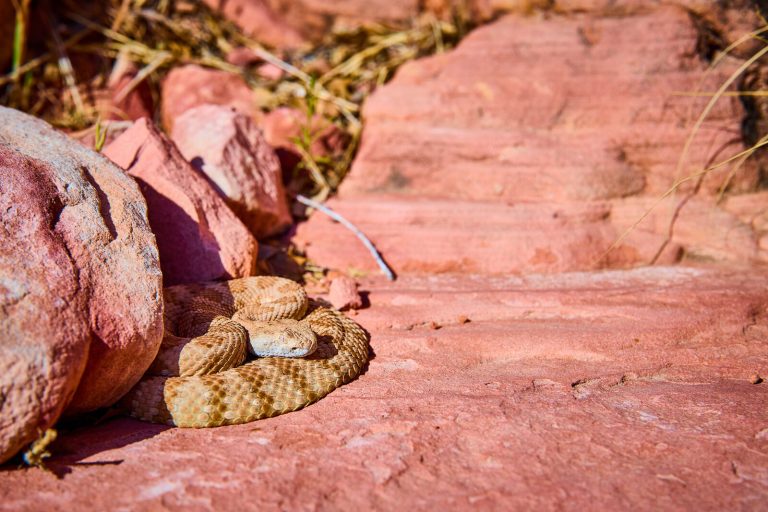
Two principles carry the whole subject. Never let an animal associate you with food, because a fed animal loses its fear, becomes dangerous, and is usually destroyed for it. And never crowd an animal or take away its escape route, because nearly every charge is a startled or cornered animal trying to make space. If you find yourself deciding what to do in the moment, you have already skipped a step that would have made the decision unnecessary. This guide covers the large mammals. The small creatures that actually hurt more people, snakes, spiders, ticks, and stinging insects, have their own guide: avoiding bites and stings.
Avoiding the encounter
Most of your safety is bought before anything happens.
- Make noise where sightlines are short. Dense brush, berry patches, blind corners, and anywhere a loud stream masks your approach. Talking and calling out works better than bear bells, which are quiet and easily lost in ambient noise. The point is to be heard early enough that the animal can leave before you arrive.
- Travel in a group. Groups are noisier, smellier at distance, and physically more intimidating. Serious bear incidents overwhelmingly involve people alone or in pairs.
- Time your travel. Dawn and dusk are peak movement for most large mammals. So is the hour after a storm breaks. Building this into your pacing, as covered in hiking all day, costs you nothing.
- Read the sign. Fresh tracks, warm scat, torn-up logs, flattened vegetation, and clouds of ravens or magpies all say an animal is nearby. A carcass is the single most dangerous thing you can walk up on. Leave the area the way you came, immediately and quietly, because a bear will defend a food cache with everything it has.
- Never get between a mother and her young. This is the common thread in a large share of maulings. If you see a calf, cub, or kit on its own, assume the mother is close and that you may already be in the wrong place. Back out along your own tracks.
- Check local conditions. Trail closures, recent incident reports, and seasonal warnings are posted for a reason. Our national park guides list each park’s wildlife hazards, and a visitor centre will tell you what has been active this week.
How much space is enough
Park regulations put numbers on this, and the numbers are a good field default anywhere.
- 100 yards (90 m) from bears, wolves, and cougars. That is roughly the length of a football field. In Alaska, the guidance for bears goes out to 300 yards (270 m).
- 25 yards (23 m) from everything else large: bison, elk, moose, deer, bighorn sheep, coyotes.
A practical test: hold your arm out and cover the animal with your thumb. If your thumb does not hide it, you are too close. If an animal changes its behaviour because of you, stops feeding, lifts its head, turns to face you, moves away, you are too close regardless of the distance.
These are minimums for an animal that is calm and aware of you. They are not a licence to approach to exactly that line for a photograph. Almost every wildlife injury in a national park each year happens to somebody who chose to close the gap.
Black bear or grizzly
The response to a bear attack differs by species, so you need to know which bear you are looking at before you need to know it. Colour is not the answer. Black bears come in black, brown, cinnamon, and blond, and grizzlies range from near black to almost pale. Use shape instead.
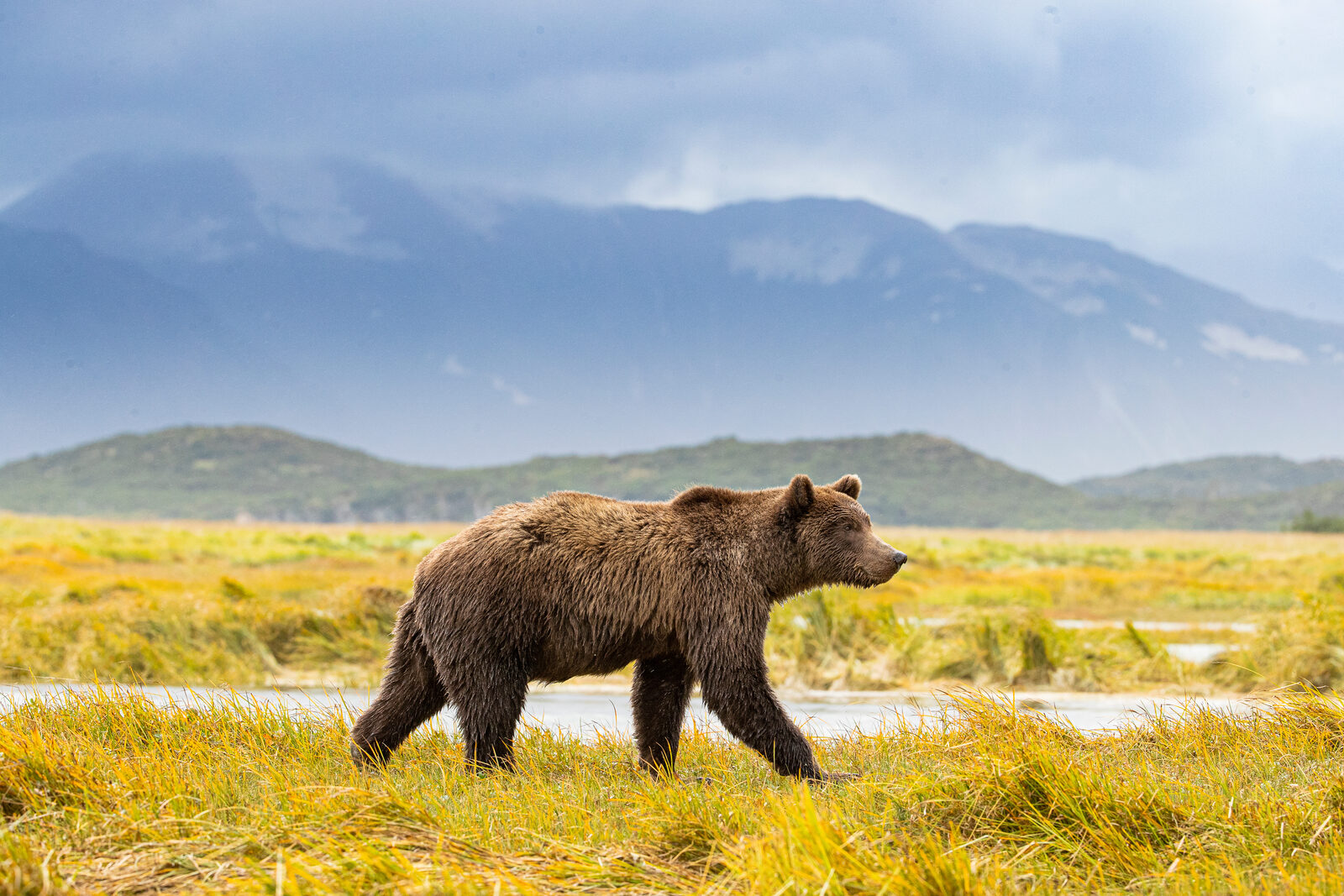
- Shoulder hump. Grizzlies have a pronounced muscular hump over the shoulders that powers their digging. Black bears do not. This is the most reliable single feature.
- Highest point of the body. On a grizzly it is the shoulder hump. On a black bear standing on all fours, the rump is usually the high point.
- Face in profile. A grizzly’s face is dished, curving inward between the eyes and the nose. A black bear’s is a straight line from forehead to nose.
- Ears. Black bears have taller, more pointed ears that stand out from the head. Grizzly ears look short and round against a big skull.
- Front claws. Grizzly claws are long, pale, and fairly straight, often visible at distance and clear in tracks. Black bear claws are shorter and strongly curved, better suited to climbing.
Learn which species live where you are going before you leave. In much of eastern North America there are only black bears, which makes the decision simple. Across the northern Rockies, Alaska, and western Canada, both live in the same country and you need to be able to tell them apart.
One thing to unlearn: the old idea that black bears cannot be dangerous or that grizzlies always are. Both statements are wrong, and the rare predatory attacks in North America are more often by black bears.
Meeting a bear that has seen you
Most bear encounters end with the bear leaving. Your job is to be recognized as a human, not as prey, and not as a threat.
- Stop and stay calm. Do not scream, do not make sudden movements, and never imitate bear sounds or make a high-pitched noise, which can sound like a prey animal.
- Talk. Speak in a low, steady voice so the bear identifies you as human. Keep talking. It also keeps your own breathing under control.
- Get your bear spray out, safety off, ready in your hand.
- Pick up small children immediately and keep them quiet and close.
- Make yourself look large. Stand tall, slowly raise and wave your arms, move to higher ground if it is right there. Group up with your party so you look like one big object.
- Back away slowly and sideways, watching the bear, once it is stationary. Sideways movement is non-threatening and lets you see your footing. Always leave the bear an escape route.
And the things not to do: do not run, because bears run faster than racehorses uphill and down and a fleeing animal triggers a chase. Do not climb a tree, because both species climb better than you do. Do not drop your pack, because it protects your back and it keeps your food out of the bear’s education. And do not stare fixedly, which can read as a challenge, though you should keep the bear in view the whole time.
Read the bear’s behaviour. A bear that stands on its hind legs is almost always curious and trying to see or smell you better, not preparing to attack. A bear that is stressed will woof, huff, salivate, clack its jaws, lay its ears back, or swat the ground. That is a warning, and the right answer is to give ground calmly. Many bears will bluff charge, running at you and veering off at the last moment. Standing your ground during a bluff charge is exactly right, and it is also one of the hardest things a person can do.
The hardest instruction in this guide
Do not run. Every part of you will want to. Running converts an encounter that would almost certainly have ended safely into a pursuit, and you cannot win a pursuit against any of the animals in this article except a moose.
If a bear makes contact
This is where the species matters, and where a single wrong instinct does real harm. The distinction that governs everything is defensive versus predatory.
A defensive attack comes from a bear you surprised, a mother with cubs, or a bear guarding a carcass. It is loud, fast, and it stops once the bear believes the threat is gone. A predatory attack is different in character: the bear is silent and focused, it follows you, it circles, it appears at your tent at night. It is not trying to make you leave, it is assessing you as food. Predatory attacks are rare, and they call for the opposite response.
- Grizzly or brown bear, defensive attack: play dead. Leave your pack on. Lie flat on your stomach, hands clasped behind your neck, elbows in to protect your face, legs spread so the bear cannot roll you over. Stay still and silent until the bear has genuinely left the area, which may be several minutes after you last hear it. Fighting a defensive grizzly usually makes the attack worse. If the attack continues and does not stop, then fight back hard, aiming for the face.
- Black bear: do not play dead. Try to get somewhere secure such as a vehicle or building. If you cannot, fight back with everything available, concentrating blows on the face and muzzle. Rocks, sticks, poles, fists.
- Any bear that stalks you, or attacks you in your tent at night: fight back. This is predatory behaviour and playing dead is the worst possible response. Species does not matter here.
A blunt summary worth memorizing: if it is a surprised grizzly, play dead; in every other case, fight.
Bear spray: choosing, carrying, using
Bear spray stops aggressive bears more reliably than a firearm does, it is far easier to aim under stress, it does not endanger your hiking partners in the same way, and it leaves the bear alive. It is the recommended tool, and it is also the one people carry uselessly.
Buy the right thing. It must be an EPA-approved product specifically formulated and labelled for bears. Personal defence or law enforcement pepper spray is not strong enough and typically fires a narrow stream instead of the wide cloud you need to hit a moving bear. Our review of the Sabre Frontiersman bear spray covers what to look for in range and spray duration.
Carry it where you can reach it. A belt holster or a chest holster, on your body, every hour you are hiking. Bear spray inside your pack is decoration. A charge covers ground in a couple of seconds and you will not get the pack off in time. Keep it accessible in camp too, including in the tent overnight.
Practise before you need it. Pull the canister from the holster and thumb the safety off, repeatedly, until it is automatic. Inert training canisters exist and are worth buying once. Doing this cold, for the first time, with a bear closing, is not a plan.
Deploying it:
- Use it when a bear is charging or attacking, not on a bear that is simply present.
- Start spraying when a charging bear is around 60 feet (18 m) out. Sooner than most people expect.
- Aim at a slight downward angle towards the bear and lay down a cloud between you and it, so the bear runs into the cloud.
- Be ready to spray again, or to empty the canister. Do not fire one short burst and hope.
- Account for wind. Be upwind if you have any choice, since a crosswind or headwind cuts range badly and can blow the cloud back into your own face. Cold, rain, and snow all reduce range.
It is not a repellent. Never spray it on yourself, your gear, your tent, or your pack. Doing so does the reverse of what you want, because the residue can actually attract bears. Do not leave the canister in a hot closed vehicle, and check the expiry date before every season.
Moose: the one you run from
Moose injure more people in Alaska each year than bears do, and they are widely underestimated because they look placid and slow. They are neither. A cow defending a calf in spring, or a bull in the September and October rut, will follow through.
Read the warning signs. The long hairs on the hump raised, ears laid flat back like an angry dog, and licking of the lips. If you can see the lip licking, you are far too close. A moose that sees you and walks deliberately towards you is not being friendly, it is warning you or expecting food, and both are bad.
If a moose blocks the trail, wait. Take another way around if one exists. If not, be patient, because it will move on eventually, sometimes after half an hour. Never approach a moose whose only escape route runs through you, and always keep an escape route of your own.
With a moose, run
Unlike a bear, you should run from a charging moose, and you should put something solid between you: a tree, a boulder, a vehicle. A moose will not usually chase far, and you can go around a tree faster than it can. If it knocks you down, curl into a ball, protect your head with your arms, and hold completely still until it has moved well away, because getting up too soon restarts the attack.
Most charges are bluffs, but treat every one as real. Even a calf in its first winter weighs 300 to 400 pounds (140 to 180 kg), and moose kick forward with their front hooves as well as stomping. Bear spray will often move a moose as a last resort.
Bison and elk
Bison injure more people in Yellowstone than any other animal, bears included. They look slow and indifferent, weigh up to a ton, and run roughly three times faster than you do. Every year, several visitors are gored, and in nearly every case the person walked closer for a photograph.
Warning signs are readable: tail raised or kinked upright, head lowered and swinging, pawing the ground, snorting, and short false rushes. Stay 25 yards (23 m) back, more if there are calves, and never try to walk past a bison on a boardwalk or a narrow trail. Give up the trail, not the margin.
Elk are two different hazards depending on the season. Bulls in the autumn rut are aggressive and will charge people who wander into a harem, antlers first. Cows in spring will attack anyone near a hidden calf, striking with their front hooves. Elk are so habituated in some park townsites that people forget they are wild. Stay 25 yards (23 m) off, put a vehicle or a large tree between you if one approaches, and never walk between animals in a group.
Mountain lions
Mountain lion attacks are genuinely rare, and the response is nearly the opposite of the bear response. A lion that is watching you is evaluating whether you are prey, so the entire goal is to look like something that fights back.
- Face the animal. Never turn your back and never run. Running is what prey does, and it can trigger a chase from a lion that had not decided anything.
- Do not crouch, bend over, or kneel. A standing human is the wrong shape for a lion’s prey. A person bending down looks like a four-legged animal, and this is why lions disproportionately target people who are crouched, small, or moving low.
- Make yourself big and loud. Open your jacket, raise your arms, shout in a firm deep voice. Maintain eye contact, which is right for a lion and wrong for a bear.
- Pick up small children at once, without bending far, and keep them off the ground.
- Back away slowly, facing the animal, giving it room to leave.
- Throw things. Rocks, branches, a water bottle. Anything that lands near it.
- If it attacks, fight. Stay on your feet if you possibly can, and target the eyes and face. People fight lions off regularly. Trekking poles, a knife, a rock, or bare hands all count.
Bear spray works on mountain lions too, and is worth carrying in lion country for that reason alone.
Wolves and coyotes
Wolf attacks on people in North America are extraordinarily rare, and healthy wild wolves generally avoid humans entirely. If one approaches, do not run. Make yourself large, shout, throw things, and back away while facing it. Treat a wolf that shows no fear of people as a serious concern and report it.
Coyotes are the more common problem, precisely because they habituate to people and campgrounds so readily. A coyote that follows you or approaches camp should be hazed aggressively: yell, wave your arms, throw stones near it, make yourself unpleasant to be around. Being nice to a coyote is how it ends up being destroyed later. Keep small dogs and small children close in coyote country, especially at dawn and dusk.
Keeping animals out of camp
Camp is where a fed animal is created, and where the majority of nuisance encounters happen. The full detail is in our guide to protecting your food and camp from animals, but the essentials belong here.
Everything scented is “food” as far as an animal’s nose is concerned. That includes toothpaste, sunscreen, lip balm, insect repellent, deodorant, wrappers, dish water, and the clothes you cooked in. All of it goes into storage, none of it goes into the tent.
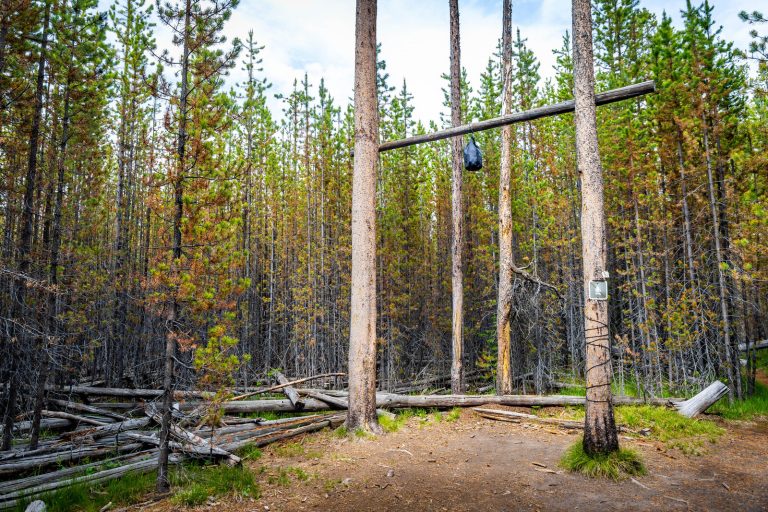
In bear country, a hard-sided canister such as the BearVault BV500 is the simplest reliable answer, and it is required outright in many parks. Store it well away from where you sleep, and downwind. Where canisters are not required, hang food at least 10 to 12 feet (3 to 3.7 m) up and 4 feet (1.2 m) out from the trunk, which is harder to do properly than it sounds.
Set the camp up as a triangle: sleep, cook, and store food in three separate places, ideally 100 yards (90 m) apart, with the cooking and storage points downwind of your tent. Cook early rather than at dusk, clean up completely, and pack out every scrap. Planning meals that generate little waste and no strong smells makes all of this easier, which our guide to what food to bring covers, and camp hygiene handles the rest of what your body leaves behind. Our campsite setup guide covers the layout, and Leave No Trace covers why it matters beyond your own safety.
A clean camp is a safe camp
Never eat or keep snacks in your tent, and change out of the clothes you cooked in before bed. The smell of a granola bar lasts far longer than the bar. In most places the animals that actually get into your gear are rodents chewing through pack fabric for crumbs, and they are drawn by exactly the same carelessness.
Dogs, children, and other complications
Dogs make wildlife encounters worse. A loose dog finds an animal, provokes it, and then runs back to you with it. Moose in particular treat dogs as wolves and will go out of their way to attack one, leash or not. Keep dogs leashed and close, or leave them at home in bear and moose country. Where dogs are prohibited on trails, that is usually why.
Children need a briefing, not a lecture. Teach them the three moves before the trip: stay close, do not run, and come to an adult. Keep them in sight and between adults on the trail, since a small person moving unpredictably at the back of a group is the one an animal notices. Practise it as a game rather than a warning, which our guide to keeping kids engaged at camp covers more broadly.
Hiking alone raises your risk substantially in bear country. If you do it, make more noise than feels reasonable, carry spray on your chest, and make sure someone knows your route. Our pre-trip safety plan covers leaving word properly.
Carrying meat or fish from hunting or angling changes the calculation entirely and demands separate precautions. So does travelling in a berry patch in late summer, or anywhere near a salmon run in season.
After an encounter
Report it. Tell a ranger or the local wildlife agency about any bear that approached you, showed no fear, got into food, or behaved aggressively, and about any wolf or coyote that did the same. This is not paperwork. It is how closures get posted, how problem animals get relocated before somebody is hurt, and how the next party on that trail finds out.
If someone is injured, the wounds from a large animal are deep, contaminated, and prone to serious infection, whether from claws, teeth, hooves, or horns. Control bleeding first, as covered in backcountry first aid, then follow our guidance on cleaning and dressing wounds in the field. Any goring, bite, or deep puncture needs professional care, usually antibiotics, and possibly a tetanus booster or rabies assessment. Do not close a puncture wound in the field.
Get help moving early rather than late. A satellite messenger lets you describe the injury and start an evacuation from somewhere with no cell coverage, and our guide to signaling for rescue covers the rest.
What to carry
- EPA-approved bear spray in a belt or chest holster, in date, with the safety practised until it is automatic.
- A hard-sided food canister in bear country, or a proper hanging kit where canisters are not required.
- Odour-proof bags for scented items, which cost almost nothing and make the canister work harder.
- An emergency whistle for making yourself known in blind terrain and for locating a separated party member.
- A first-aid kit with enough gauze and irrigation capacity to handle a deep dirty wound, not just blisters.
- A satellite messenger or beacon for the evacuation you hope not to need.
- A bright headlamp kept in the tent, so you can identify what is moving outside instead of guessing.
Read our full guide to food storage in animal country
Key takeaways
Nearly every dangerous encounter traces back to a surprised animal or a fed one, so make noise in blind country, travel in a group, keep 100 yards (90 m) from bears, wolves, and cougars and 25 from everything else, and store every scented item away from where you sleep. Learn to tell a grizzly from a black bear by the shoulder hump and the dished face, never by colour. With any bear: do not run, do not climb, keep your pack on, talk calmly, look large, and back away sideways with your spray in hand. If contact happens, play dead only for a surprised grizzly, and fight in every other case, including any bear that stalks you or comes into your tent. Carry bear spray on your body rather than in your pack, and start spraying at about 60 feet (18 m). Run from a moose and put a tree between you, curl up if it knocks you down. Stand tall and never crouch in front of a mountain lion, and fight if it comes. Give bison the whole trail, because they injure more people than bears do. Then report what you saw, so the next party knows.
Verified against current National Park Service bear safety and bear spray guidance, NPS mountain lion and wildlife viewing distance guidance, and the Alaska Department of Fish and Game guidance on aggressive moose. Recommendations vary by park and by local animal behaviour, so always check with the nearest visitor centre or backcountry office before your trip. This is general education and not a substitute for local instruction.
Wilderness Experts is reader-supported. As an Amazon Associate we earn from qualifying purchases; when you buy through links on our site we may earn a commission at no extra cost to you. It never changes what we recommend.