

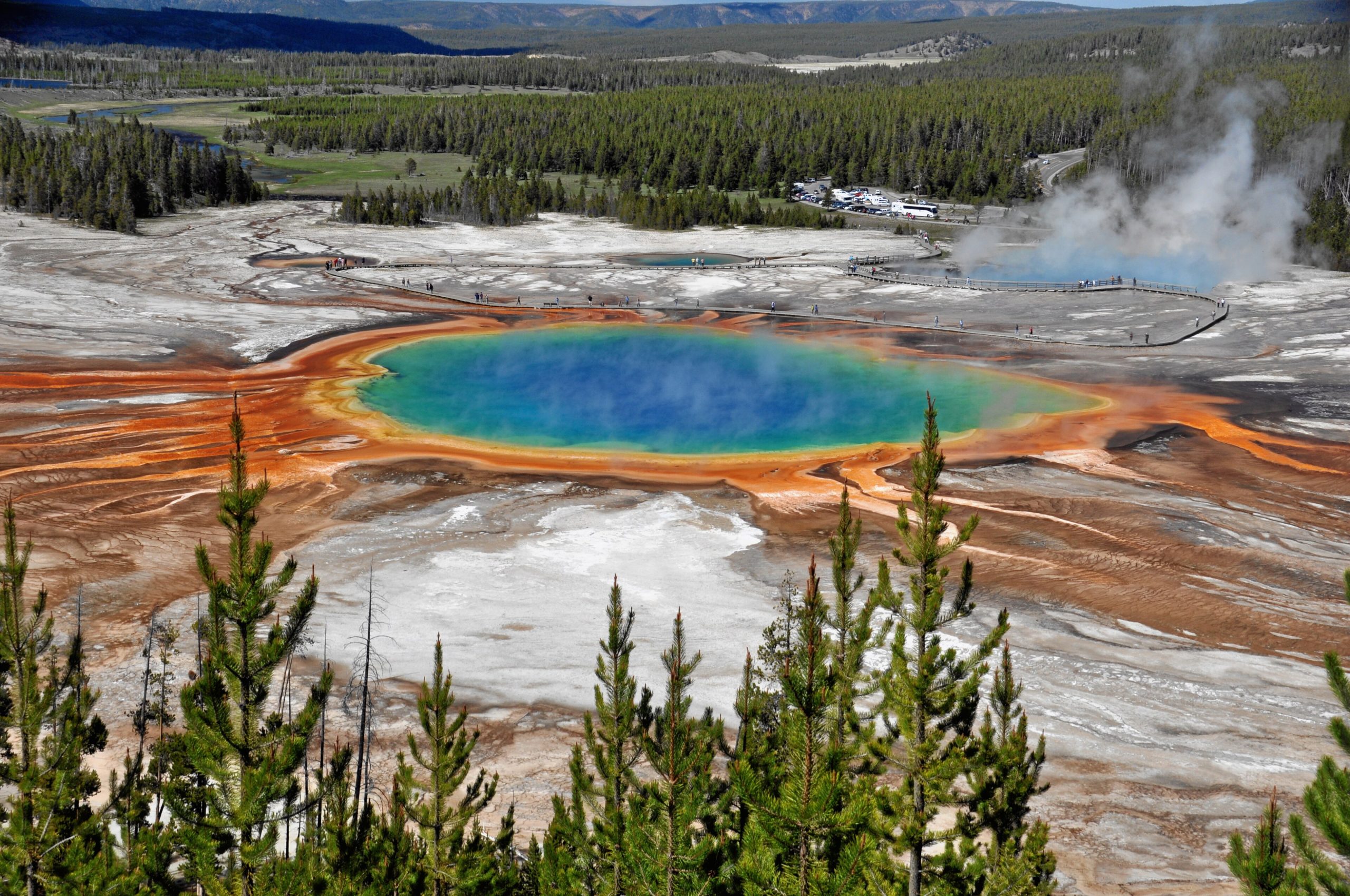
Yellowstone National Park
Yellowstone is the world’s first national park and still one of its most extraordinary, a vast volcanic plateau where half the planet’s geysers erupt, hot springs blaze in impossible colors, and one of the largest intact temperate ecosystems on Earth teems with bison, wolves, grizzlies and elk. Old Faithful, the Grand Canyon of the Yellowstone, and endless wildlife make it a bucket-list park like no other.
Fast facts
- Established: 1872, the world’s first national park
- Size: about 2.2 million acres (9,000 km²) across Wyoming, Montana and Idaho
- Geothermal: more than 10,000 hydrothermal features, half the world’s geysers
- Wildlife: bison, grizzly and black bears, wolves, elk and more
- Gateways: West Yellowstone and Gardiner, Montana; Jackson, Wyoming
- Managed by: National Park Service
The landscape
Yellowstone sits atop a giant volcanic hot spot, and its restless geology is everywhere, geyser basins, bubbling mud pots, rainbow-rimmed hot springs, and the yellow-walled Grand Canyon of the Yellowstone with its thundering falls. Around the thermal wonders spread high forests, sagebrush valleys, alpine peaks, and Yellowstone Lake, all supporting the famous wildlife of the Greater Yellowstone Ecosystem.
Best time to go
Summer through early fall is the prime and busiest window, with all roads and services open, warm days and superb wildlife viewing. September adds the elk rut and thinner crowds. Snow closes most roads much of the year; winter offers a magical, frozen park accessible by snowcoach and snowmobile to Old Faithful and the interior.
Getting there and around
Five entrances, from Montana, Wyoming and (via West Yellowstone) the Idaho side, feed the figure-eight Grand Loop Road that connects the major sights. A vehicle is essential given the enormous distances, and the nearest airports are Bozeman and Jackson. Plan for long drives, wildlife jams and full parking in summer.
Things to do
Watch Old Faithful and walk the boardwalks of the Upper Geyser Basin and Grand Prismatic Spring, take in the Grand Canyon of the Yellowstone and its falls, and watch wildlife in the Lamar and Hayden valleys, among the best places on Earth to see wolves and bears. Hike, camp, fish and paddle across a park that rewards weeks of exploration.
Staying safe
The hydrothermal areas are deadly. The ground is often thin crust over boiling, acidic water, so stay strictly on the boardwalks. This is core grizzly country: carry bear spray, keep 100 yards (90 m) from bears and wolves. Bison injure more people than any other animal here, so keep 25 yards (23 m) away and never approach. Weather turns fast at altitude, and rivers run cold and swift.
Know before you go
A park pass is required, backcountry and fishing permits are needed for those activities, and lodging and campgrounds book up many months ahead. This page is a general overview, not a live conditions report; always confirm current road status, conditions and permits with the National Park Service before your trip.
- Coordinates
- 44.6203, -110.4907
- Magnetic declination
- 10.7° E (2026)
Set this declination on your compass, then align it to the map's north lines; it is the angle between true north and magnetic north, refreshed each year.
A spread of the park’s main places shows straight away, and the rest appear as you zoom in. You can also search above, or pick any place from the lists below, and the map will go to it.
Getting there 25
Park entrances
Ranger stations
On the trail 127
Trailheads
Campgrounds
Hut or shelter
Picnic sites
Sights 136
Viewpoints
Waterfalls
Heritage sites
Point of interests
Islands
Peaks 30
Map data comes from third-party sources and may be incomplete or out of date, so carry a current official map (terms).
- Best seasons
- Summer, Early fall
- Difficulty
- Easy to strenuous
- Access / trailheads
- Mostly in northwest Wyoming, spilling into Montana and Idaho; five entrances feed the Grand Loop Road. Nearest airports include Bozeman, MT and Jackson, WY.
- Water
- Abundant rivers, lakes and streams; filter or treat all backcountry water.
- Cell / satellite coverage
- Little to no cell service across most of the park. Carry a map and a satellite messenger.
- Nearest ranger / SAR / emergency
- Contact park rangers; life-threatening emergencies: 911.
- Permits & regulations
- Per-vehicle entry fee (America the Beautiful pass accepted); backcountry camping and fishing require permits, and some areas need timed permits or reservations.
- Leave No Trace
- Stay on boardwalks in thermal areas, keep 100 yards (90 m) from bears and wolves and 25 yards (23 m) from other wildlife, use bear-proof storage, and follow Leave No Trace.
January
- Below freezing all day
February
- Below freezing all day
March
- Below-freezing nights
April
- Below-freezing nights
May
- Below-freezing nights
June
July
August
September This month
October
- Below-freezing nights
November
- Below-freezing nights
December
- Below freezing all day
What to bring depends on your trip: how long you’re out, where you sleep, and how far you go from the road. The planner builds the list for yours.
Plan a trip here →Averages for 1991–2020 from NOAA U.S. Climate Normals, measured at the Lake Yellowstone station, 18 miles (29 km) away at 7,892 feet (2,405 m). Conditions change with elevation: expect it colder higher up.