
Low-visibility navigation: fog, whiteout, and darkness
Navigation gets exponentially harder the moment you can’t see where you’re going. Fog rolls in, a whiteout erases the horizon, or darkness swallows your landmarks, and the tricks most hikers rely on, following the trail by eye and steering toward a distant peak, stop working. Worse, low visibility is exactly when people walk off cliffs, onto thin ice, or in slow circles for hours. This guide covers how to navigate when you can’t see: in fog, cloud, whiteout, and darkness, using your compass, your map, and disciplined technique rather than your eyes.
The underlying principle is that when vision fails, you stop navigating by landmarks and start navigating by instruments and dead reckoning . A compass bearing to hold your direction and a measured distance to know how far you’ve gone. Your eyes lie in fog and snow; your compass doesn’t. And when you can’t verify your position, the safest move is often to stop moving. Slow, deliberate, instrument-based travel is what keeps you from the cliff edge you can’t see. This builds directly on our guides to map and compass navigation and finding direction without a compass; here we handle the case where you can barely see your own boots.
First decision: move or wait?
Before you navigate anywhere in poor visibility, decide whether you should move at all. If you’re in dangerous terrain. Near cliffs, cornices, steep drops, crevasses, or thin ice, and you can’t see your footing, the safest choice is often to stop, shelter, and wait for the murk to lift. Whiteouts and fog frequently clear within hours, and a night’s wait beats a fatal misstep. Move only when you’re confident of the terrain, you have a reliable bearing to follow, and staying put is riskier than going. When you do move, slow right down.
Don't walk blind toward hidden edges
In whiteout or thick fog you cannot see a cliff, a cornice, a crevasse, or thin ice until you’re on it. If you can’t verify safe ground ahead, stop and wait it out. No destination is worth walking off an edge you never saw.
Navigate by bearing, not by sight
When you can’t pick out landmarks, your compass holds your direction for you. Take a bearing from your map toward your objective (or the next safe waypoint), then walk that bearing precisely. Because you can’t sight on a far-off feature in fog, use short, near-field targets: aim at the nearest thing you can see on your bearing. A rock, a bush, a rise. Walk to it, then take the bearing again and pick the next one. This “leapfrogging” keeps you on a straight line when your eyes have nothing distant to lock onto.
If you’re completely blind, dense fog, dark, or featureless snow, send a companion ahead to the limit of visibility, line them up on your bearing, walk to them, and repeat. Alone, hold the compass steady in front of you and trust it: humans drift and circle badly without a reference, always veering toward their dominant side. The compass is the reference. A quality baseplate or mirror-sighting compass like the Suunto MC-2 makes precise bearings far easier; even a simple baseplate compass beats guessing.
Track your distance
A bearing tells you which way; you also need to know how far. This is dead reckoning: hold a direction and measure the distance traveled so you can estimate your position when you can’t see it. Two field methods:
- Pace counting. Know how many of your paces (counting every other step) cover 100 meters, most people fall between 60 and 70 on flat ground. Count as you go; when you hit your count, you’ve gone 100 meters. Distance climbs, deep snow, and rough ground stretch your count, so calibrate for conditions.
- Timing. Estimate your speed and track elapsed time, at a known pace, a watch tells you roughly how far you’ve come. Slower and less precise than pacing, but useful as a check.
Combine bearing and distance and you can navigate a series of legs, “300 meters on 040°, then 200 meters on 110°”, around hazards to a target you can’t see, then know when you should have arrived.
Handrails, catch features, and aiming off
Terrain features you can follow by touch and proximity are gold in low visibility. Use them:
- Handrails. Follow a linear feature you can stay beside, a stream, a shoreline, a ridgeline, a fence, a valley bottom, a trail. It guides you without needing to see far. A stream followed downhill is a classic handrail toward civilization.
- Catch features (backstops). Pick a feature beyond your target that you can’t miss, a road, river, or ridge, so if you overshoot, you know you’ve gone too far and turn back. It stops you wandering past your goal into the unknown.
- Aiming off. When heading for a point on a line (a bridge on a river), deliberately aim to one side so that when you hit the river you know which way to turn to reach the target, instead of arriving unsure.
These techniques let the shape of the land do your navigating when you can barely see it.
Whiteout, the deadliest case
A whiteout, falling or blowing snow merging with a white sky and white ground, is the most disorienting condition in the mountains. Winter brings it on routinely, and the rest of what snow does to a day is covered in winter hiking. There are no shadows, no horizon, and no sense of up-slope or down-slope; the terrain simply vanishes into featureless white, and it becomes impossible to judge the ground in front of you. People walk off cornices and into hidden slopes in whiteouts because they literally cannot see the shape of the snow.
The rule is: if a whiteout catches you in serious terrain, stop and wait. If you must move, navigate strictly by compass bearing and pace count, send a person ahead to give you a reference point on the snow, probe the ground ahead with a pole or ice axe before each step, and cross snow bridges and suspect slopes at right angles at their strongest point. Distances are deceptive in clear arctic and alpine air even without a whiteout, people almost always underestimate them, so trust your pace count over your gut. Our guide to crossing snow and steep ground covers movement on the surface itself.
Fog and low cloud
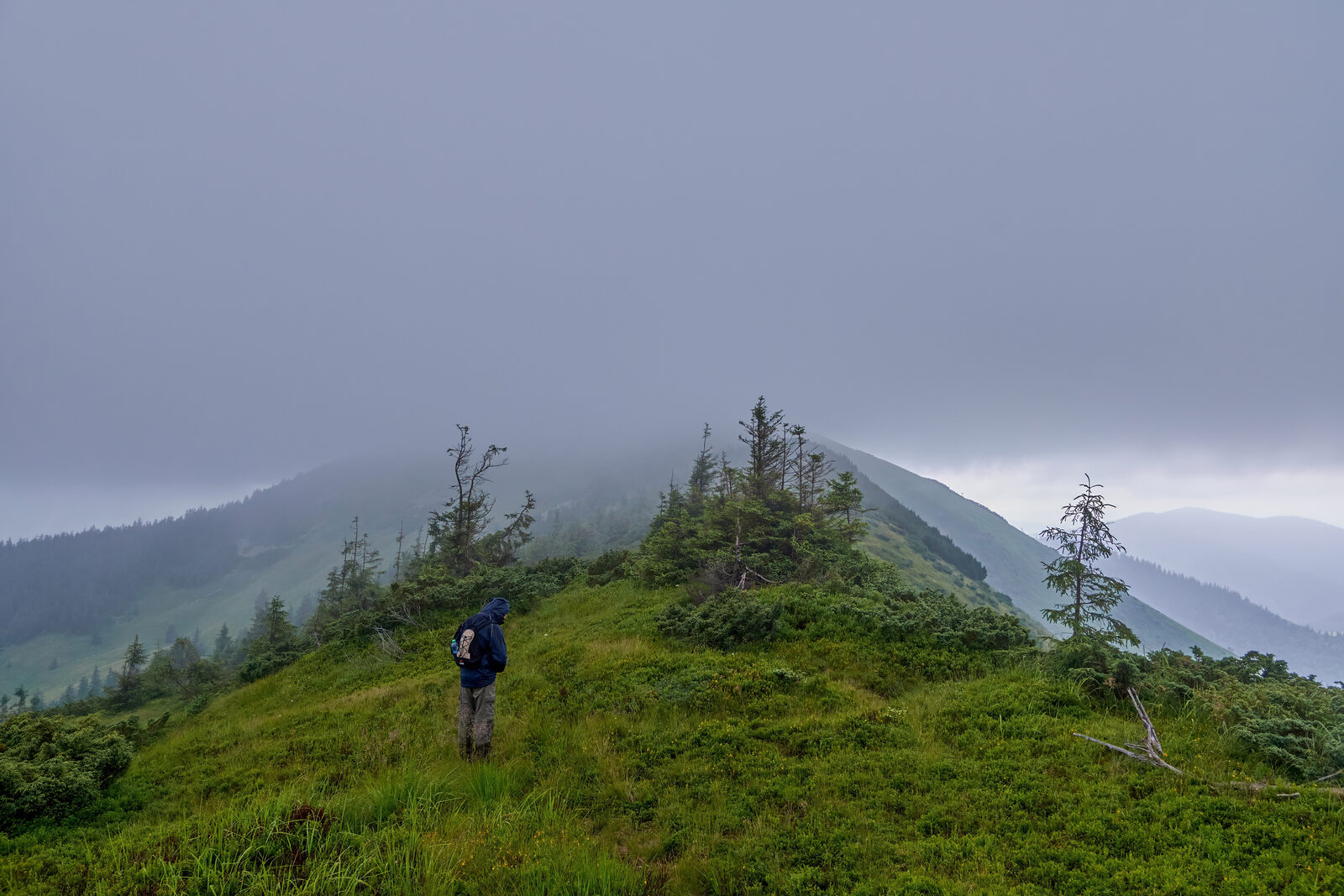
Fog and cloud on a hilltop dull every landmark and flatten the terrain, but the ground underfoot is usually still readable, which makes fog less lethal than whiteout but still a strong nudge toward errors. Slow down, switch to compass-and-pace navigation, and lean hard on handrails and catch features. Sound carries strangely in fog. A stream or road you hear may be nearer or farther than it seems, so verify with your instruments rather than your ears. Mark your route as you go if you may need to backtrack, and don’t be lured into “shortcutting” across open ground when you can follow a handrail instead.
Navigating in darkness
At night you lose landmarks but keep the ground and the sky. A good headlamp lights your footing and the next few yards. Use a wide flood beam for terrain and carry spare batteries, since cold drains them fast. Navigate by bearing and pace count as in fog, and use handrails you can see in the beam. The night sky is a bonus reference: in the Northern Hemisphere, Polaris marks true north and lets you hold a rough direction; the moon’s lit side and rise time give an east-west cue. Our guide to finding direction without a compass covers reading the stars and moon. Above all, slow down. Most night navigation mistakes and injuries come from moving faster than you can see.
Preserve your night vision
It takes your eyes many minutes to fully adapt to the dark and a single bright flash to wipe it out. Use the lowest headlamp setting that works, or a red-light mode, so that when you glance at your map you don’t blind yourself to the terrain around you.
Using GPS wisely
A GPS or phone with offline maps is superb in low visibility. It shows your position when you can’t see a thing, but never make it your only tool. Batteries die in the cold, screens fail, and signal drops under cover, always at the worst moment. Carry a map and compass and the skill to use them, keep your device warm and its maps downloaded for offline use, and use GPS to confirm the position your compass-and-pace navigation already estimated. Two independent methods that agree are far safer than one you can’t check.
Common mistakes
- Walking blind toward a target. Without a reference, humans circle. Hold a compass bearing and leapfrog near-field markers.
- Pushing on through a whiteout in dangerous terrain. Stop and wait. Hidden edges are invisible until it’s too late.
- Trusting distance to your eyes or ears. Fog and clear alpine air both fool your judgment. Count your paces.
- Relying only on GPS. It fails when you need it most. Back it up with map, compass, and technique.
- Moving too fast for the light. Most night and fog errors come from speed. Slow right down and probe ahead.
What to carry
- A reliable compass , a sighting compass for precise bearings, or a solid baseplate model at minimum.
- A topographic map . Waterproof or in a case, so you can navigate by bearing and terrain when screens fail.
- A bright headlamp with a red mode , plus spare batteries for cold nights.
- A GPS or phone with offline maps . To confirm your position, kept warm and charged; a satellite messenger adds an SOS if you’re truly stuck.
- Trekking poles , to probe unseen ground ahead of each step in whiteout or dark.
Master map & compass navigation
Key takeaways
When you can’t see, you navigate by instrument, not by eye. Take a compass bearing and hold it precisely, count your paces to track distance, and lean on handrails, catch features, and aiming off to let the terrain guide you. In a whiteout or thick fog in dangerous ground, the smartest navigation is to stop and wait for it to clear. Keep your GPS as a backup, not a crutch, and slow down in the dark. Master these techniques on an easy day in clear weather, and the fog, snow, and night stop being emergencies and become just harder days at the office.
Adapted in part from the U.S. Army Survival Field Manual (FM 3-05.70 / FM 21-76), Chapter 18, “Field-Expedient Direction Finding” (sun, star, and moon direction) and Chapter 15, “Cold Weather Survival” (whiteout travel, judging distance, and crossing snow bridges), combined with standard map-and-compass dead-reckoning practice.
Wilderness Experts is reader-supported. As an Amazon Associate we earn from qualifying purchases; when you buy through links on our site we may earn a commission at no extra cost to you. It never changes what we recommend.