
How to purify water in the backcountry
You can go weeks without food and only days without water, so in the backcountry water stops being a comfort and becomes a schedule. The problem is that almost every natural source can carry something that will make you sick, and the water gives you no warning at all. Clear, cold, fast water over clean rock is exactly what a contaminated stream looks like. This guide covers what is actually in the water, every method for making it safe, which method to use on which water, and the specific mistakes that put treated water back in contact with the thing you just removed.
One idea runs underneath all of it. There is no single method that handles everything, in every condition, every time. Boiling kills every pathogen but costs fuel. Filters are fast but most of them let viruses through. Chemicals weigh nothing but two of the three common ones do almost nothing against cryptosporidium. Learn what each method actually does, carry two of them, and you will never be standing at a water source with no way to drink.
Life safety
Untreated backcountry water can carry giardia, cryptosporidium, campylobacter, E. coli and norovirus. Symptoms often arrive days later, which means they arrive when you are already deep in a trip or already home. Treat every natural source, every time, including the water you cook with and brush your teeth with.
What is actually in the water
Three families of organism cause almost all waterborne illness, and the differences between them are the whole reason this article is longer than one paragraph. Each family is a different size, and size is what determines whether a filter catches it. Each family responds differently to chemicals. No method is beaten by all three, but every method except heat is beaten by at least one.
Protozoa are the big ones, and the ones North American hikers meet most. Giardia cysts run roughly 8 by 19 microns and cryptosporidium oocysts 4 to 6 microns, which makes both of them enormous by pathogen standards and easy for any real filter to catch. Cryptosporidium is the important one to understand, because its tough outer shell shrugs off chlorine and iodine at the concentrations anyone can use in the field. It is the pathogen that breaks the assumption that a tablet handles everything.
Bacteria such as E. coli, campylobacter and salmonella are around 0.5 microns across and a few microns long. They are caught by any microfilter and killed readily by chlorine, iodine, chlorine dioxide, UV and heat. Bacteria are the easy case.
Viruses such as norovirus and hepatitis A are the small ones, averaging about 0.03 microns. That is roughly a tenth the pore size of a typical backpacking filter, which is why most hollow-fiber filters do not claim virus removal and should not be trusted with it. Viruses are killed easily by chemicals, UV and heat, which is the neat complement to the cryptosporidium problem: the pathogen your filter cannot catch is the one your tablets kill, and the pathogen your tablets cannot kill is the one your filter catches.
Clear water is not clean water
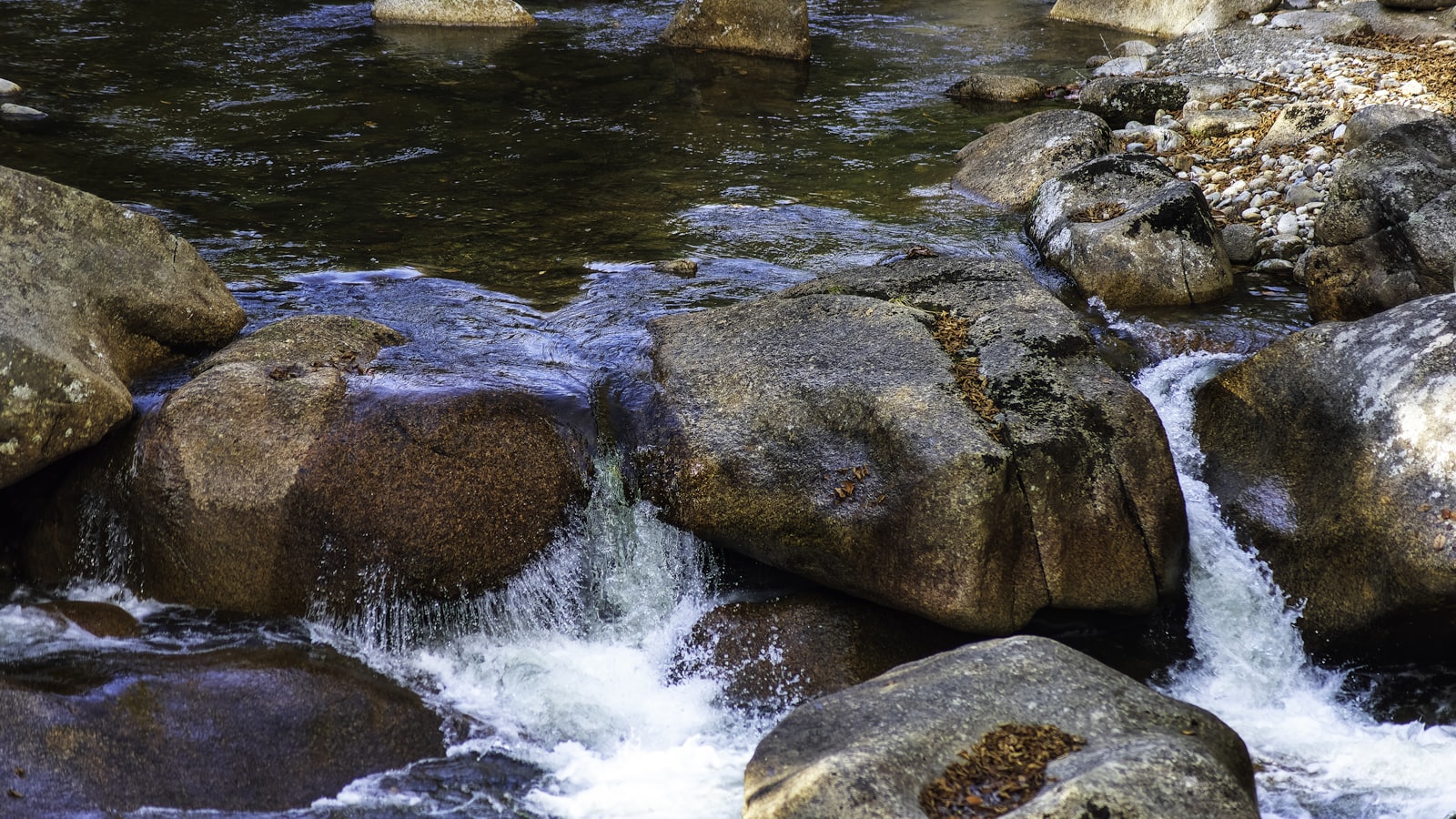
There is no visual, taste or smell test for any of this. A stream can be transparent, ice cold, moving fast over granite and full of giardia from an animal that used it half a mile (800 m) upstream. Water clarity tells you how easy the water will be to treat. It tells you nothing about whether it needs treating.
How much risk you are actually running varies enormously by watershed, and it is worth being honest about it. Water below grazing land, below a busy campground, below a beaver colony or below any settlement carries real risk. High alpine snowmelt above the last trail carries very little. But a good deal of backcountry gut illness turns out to have come from unwashed hands and shared snack bags rather than from the creek, which is why camp hygiene and proper human waste disposal belong in the same conversation as water treatment. Treating your water and then eating with the hands you just used to dig a cathole is not a water treatment plan.
Start with the best source you can reach
Every treatment method works better on better water, and some of them stop working entirely on bad water. Choosing well is free, takes a minute, and saves filter life, fuel, contact time and taste. Our full guide to finding water in the wilderness covers locating a source in every environment; this is about choosing between the sources you have found.
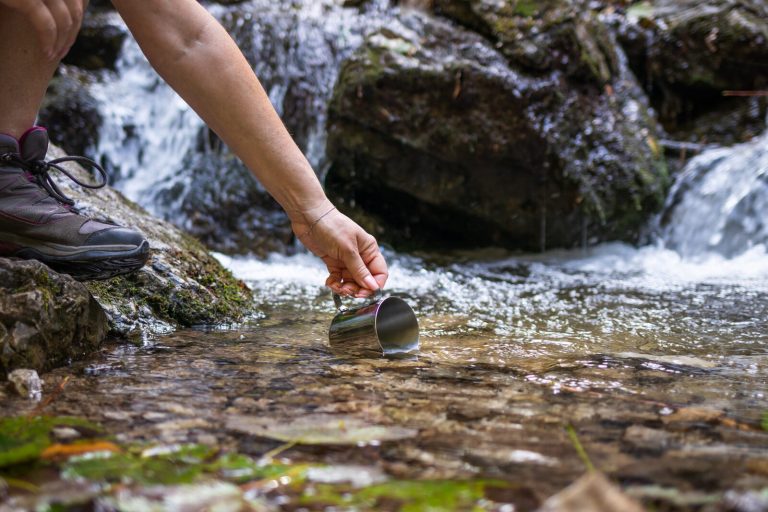
Prefer moving water to standing water, and water over rock to water over mud or through a meadow. A spring emerging from the ground is the best thing you will find, because it has not yet had the chance to collect anything. Take from the upstream end of a pool rather than the outflow, from the middle of the current rather than the bank, and from above your camp rather than below it. Look uphill and ask what is up there: a trail, a stock route, a pasture, a mine adit, a road, a pit toilet, a beaver dam. Water collects the history of everything above it.
Avoid water with a surface scum, a rainbow sheen, unusual colour, foam that persists, or the smell of decay or chemicals. Avoid pools in a dry riverbed with no inflow. In agricultural country, avoid drainage ditches entirely. If your only option is poor, take it and treat it thoroughly rather than pushing on while dehydrated, because dehydration degrades judgment faster than most people expect and a bad decision costs more than a bad water source.
Clear the water before you treat it
Cloudiness, properly called turbidity, is the enemy of three of the four treatment methods. Suspended particles physically shield pathogens from UV light. They consume chemical disinfectant, so the dose you added is partly spent on mud rather than on organisms. They clog a filter in a matter of litres. Only heat is indifferent to them. Clearing the water first is the step most people skip and the one that makes everything downstream work.
The simplest method is patience. Fill a container, set it down, and let gravity do the work for half an hour or more. Sand and silt drop out; then pour or siphon the clear water off the top without disturbing the sediment, or dip it out with a cup. In glacial country, where the suspended rock flour is so fine it can stay in suspension overnight, this takes far longer and often does not finish.
The faster method is to strain the water through cloth. A bandana, a shirt tail, a coffee filter or a clean sock all work; fold the cloth to several layers and pour slowly. This removes nothing microbiological, and it is important not to confuse it with treatment, but it removes the material that would otherwise defeat your actual treatment. Doing this before a filter can multiply that filter’s working life.
For genuinely muddy water there is a chemical shortcut worth knowing. Alum, the same aluminium salt sold in the spice aisle for pickling, causes fine suspended particles to clump together and settle. Add about a quarter teaspoon (1.3 ml) to a quart (1 L) of cloudy water, stir for a few minutes, add a little more if nothing clumps, let it settle, then pour off through cloth. This is a clarification step and not a disinfection step; the water still needs treating afterwards. Some commercial tablets and sachets combine a clarifying agent with a chlorine disinfectant and do both jobs in one packet.
Boiling: the one that kills everything
Heat is the only method with no gaps. It inactivates protozoa, bacteria and viruses alike, its effectiveness is not reduced by cloudy water, and it needs no cartridge, no batteries and no shelf life. If you can only have one method and fuel is not the constraint, boil.
The rule: bring clear water to a rolling boil and hold it for one minute. Above 6,500 feet (2,000 m), hold it for three minutes. Then let it cool before drinking or pouring, because scald burns are a genuine backcountry injury.
The reason for the extra time at altitude is that water boils at a lower temperature as you climb, and the extra minutes restore the margin. It is worth knowing what that margin actually is, because it explains why this method is so forgiving. Every organism that causes waterborne illness is killed within seconds at boiling temperature, and even at about 16,000 feet (4,900 m) water still boils at roughly 182°F (83°C), far above the temperature needed to inactivate them. The one minute is a safety margin for the fact that people are inconsistent at recognising a boil, not a biological requirement. Water that has genuinely reached a rolling boil at any elevation you are likely to be standing at has been disinfected.
That margin has a practical use when fuel is short. Pasteurisation happens well below boiling: 140°F (60°C) held for 30 minutes is enough. So if you are down to your last gas, heat the water only until the first small bubbles rise from the bottom, take it off the heat, put the lid on, and leave it covered for half an hour. You will use a fraction of the fuel. Where possible, do this last thing in the evening on a cooking fire you already have going rather than burning stove gas on it.
Fuel is the real cost, and it is worth doing the arithmetic before you rely on boiling as your main method. Treating four quarts (4 L) a day for a party of two burns through a canister quickly, particularly in wind or cold. An efficient integrated system such as the Jetboil Flash or the wind-resistant MSR WindBurner makes a real difference to that number; a bare burner like the BRS-3000T or the MSR PocketRocket 2 weighs almost nothing but spends more gas per litre in wind. In practice most people boil for cooking and drinks, and filter for drinking water.
Boiling has two other quiet advantages. It leaves no taste, and it is completely unaffected by how dirty the water is, which makes it the right answer for silty glacial melt and stirred-up ponds that would clog a filter in minutes.
Filters, and what a filter is not
A filter is a physical sieve. Water is pushed through a membrane whose pores are too small for the organisms to pass, and what comes out the other side has been strained rather than disinfected. That distinction matters, because it means a filter’s performance is entirely determined by its pore size, and nothing about the water can change that. A filter does not care about temperature, turbidity or contact time. It only cares whether the thing is bigger than the hole.
The pore sizes on the market map onto the pathogens like this. A pore size of 1 micron or smaller reliably removes giardia and cryptosporidium. A pore size of 0.3 micron or smaller removes bacteria as well. Nothing in the typical backpacking range touches viruses, which need ultrafiltration at around 0.01 micron or reverse osmosis. Most backpacking filters sit at 0.1 or 0.2 micron, which puts them comfortably clear of protozoa and bacteria and nowhere near viruses.
On a package, look for the word absolute rather than nominal. An absolute rating describes the largest pore in the membrane; a nominal rating describes an average, which means some pores are larger and some organisms get through. Also look for certification to NSF standard 53 or 58 for cyst reduction. A filter making a bare micron claim with no absolute rating and no certification is making a marketing statement, not a safety one.
The Sawyer Squeeze at 0.1 micron is the default recommendation for North American backcountry and the filter we would put in most packs: palm-sized, no wait time, backflushes clean in the field. The Platypus QuickDraw is the upgrade for people who have grown tired of a slow squeeze, flowing up to 3 quarts (3 L) a minute and threading onto standard bottles for gravity setups. The LifeStraw Personal is the simplest of all, and the honest limitation is that it is a personal straw: you drink through it at the source, and it does not fill bottles for a group.
Filters have two failure modes that matter in the field. The first is clogging, which is slow and obvious: flow drops off until squeezing becomes work. This is fixed by backflushing, which every hollow-fiber filter supports and which you should do before flow gets bad rather than after, and prevented by pre-filtering cloudy water through cloth. The second failure mode is freezing, and it is neither slow nor obvious. It has its own section below because it is the one that can hurt you.
Two habits keep a filter honest. Keep the clean side clean: the output nozzle, the clean bottle and the cap threads must never touch untreated water or the ground at a muddy bank. And carry the filter where it stays wet between uses rather than drying to a hard crust, which shortens its life.
Purifiers: when viruses matter
The word purifier has a specific meaning. To make the claim in the United States, a manufacturer must demonstrate removal of 99.9999% of bacteria, 99.99% of viruses and 99.9% of protozoa. A device that removes protozoa and bacteria but not viruses is a filter. The distinction is the whole reason both categories exist.
For most travel in the Canadian and American backcountry, a filter is genuinely sufficient. Waterborne viruses spread through human sewage, and a watershed with little human presence carries little viral risk. The situations that change the answer are: water downstream of towns, villages or any settlement without functioning sanitation; water in heavily used areas with poor human waste practice; travel outside North America, particularly anywhere with limited water infrastructure; and flood or disaster water, where sewage and drinking water have mixed.
The Grayl GeoPress is our pick when the water is genuinely untrustworthy. It works like a French press, taking about eight seconds, and removes viruses, bacteria, protozoa and a useful range of chemicals and heavy metals in one action. It is heavier than a squeeze filter and holds less, which is exactly the trade you make when the risk profile changes.
There is a cheaper route to the same protection: use a microfilter and then add a chemical disinfectant to the filtered water. The filter takes out the cryptosporidium the chemical cannot kill, and the chemical kills the viruses the filter cannot catch. Between them they cover everything, in either order, using gear most people already carry. It costs a wait rather than money.
Chemical treatment, done properly
Chemicals are the lightest, cheapest and most compact way to treat water, they scale to any volume, and they are the only method that leaves a residual to protect the water while it sits in your bottle. They are also the method most often used wrongly, because the three common chemistries are not interchangeable and the packaging rarely makes that plain.
The correction most hikers need
Iodine and chlorine do not kill cryptosporidium at field concentrations, no matter how long you wait. Both handle bacteria and viruses well and will deal with giardia given a longer contact time, but cryptosporidium is effectively resistant to them. If you treat with iodine or chlorine tablets alone, you are not protected against one of the two protozoa most likely to be in a North American stream. Filter the water first, or use chlorine dioxide.
Chlorine dioxide
This is the one chemical that covers the full range, including cryptosporidium, at doses and contact times you can actually use. It is sold as tablets or as a two-part liquid. The catch is time: killing cryptosporidium takes a prolonged contact time of several hours, typically four, rather than the 30 minutes on the front of the box, which covers bacteria, viruses and giardia. In practice that means dosing your bottles the night before, or at lunch for the evening. Chlorine dioxide also leaves less taste than iodine and holds no lasting residual, so treated water is not protected indefinitely.
Iodine
Potable Aqua tablets are the classic iodine kit and belong in almost every pack as a backup, which is exactly how we recommend them: they weigh nothing, keep for years, and will be there when a filter clogs or freezes. Understand the boundaries. Iodine handles bacteria, viruses and, given time, giardia. It does not handle cryptosporidium. It leaves a taste and a colour, which the second bottle of PA Plus tablets in the kit neutralises after treatment is complete.
Iodine also has medical limits that chlorine does not. It is physiologically active, so it should not be used by anyone who is pregnant, has thyroid disease, or has an iodine sensitivity, and nobody should drink iodine-treated water continuously for more than a few weeks. On a long trip, or with a mixed group, this alone is a reason to carry a different chemistry.
Household bleach
Plain unscented household bleach is the emergency option and is the disinfectant most used worldwide. A couple of drops per quart (1 L) of clear water, stirred and left for 30 minutes, handles bacteria and viruses. Same limitation as iodine on cryptosporidium. It belongs in a car or home kit rather than a pack.
Getting the contact time right
Every chemical needs three things, and hikers routinely shortchange all three. It needs the right dose for the volume, so measure the container rather than guessing. It needs clear water, because cloudiness consumes the disinfectant. And it needs the full contact time, extended when the water is cold or cloudy, which is precisely when people are most impatient. Cold water can double the time required. Set a timer rather than estimating.
Then there is the step almost nobody does. Once the wait is over, loosen the cap and tip the bottle upside down so treated water runs over the threads and the lip. Untreated water sitting in the screw threads is a real route to reinfection, and it makes a perfectly correct treatment pointless. Do the same with a hydration bladder’s bite valve and hose.
UV light
A portable ultraviolet unit is a battery-powered wand or bottle cap that you stir through clear water for a timed dose. UV damages the DNA of everything that matters, including cryptosporidium, so on the pathogen chart it is as complete as boiling. It adds no taste, takes about a minute per bottle, and an extra dose costs nothing but battery.
Its limits are real and worth understanding before you make it your only method. It requires genuinely clear water, because suspended particles cast shadows that organisms hide in, so it always needs a pre-filter on anything but the cleanest source. It leaves no residual, so treated water can be recontaminated by a dirty cap thread. It needs power, and lithium cells lose capacity in the cold. And it is the only method where you cannot tell by looking whether the device delivered the dose it was supposed to, which means a UV unit is a poor sole method on a long trip and a good fast one on a short trip with a backup in the pack.
We do not currently have a review of a UV unit, so treat this section as the general case rather than a recommendation of a specific device.
Which method for which water
This is the section to come back to. Match the method to the water rather than carrying a favourite and using it everywhere.
- Alpine snowmelt or a spring, little human or animal traffic upstream. Primary concern is giardia and bacteria. Any single method works: filter, boil, UV or chemical.
- Clear stream or lake with grazing, pack stock, heavy camping or beaver activity upstream. Now cryptosporidium is on the table. Use heat, UV, or a filter plus a chemical. A chemical alone is not enough.
- Cloudy or silty water, glacial melt, a stirred pond, a dug seep. Clear it first by settling or cloth, then use heat or a filter. Chemicals and UV both perform poorly here even after clearing.
- Water below any settlement, or anywhere outside North America. Viruses are now in play. Use a purifier, an ultrafilter, heat, or a microfilter plus a chemical.
- Flood water, or any water that may have met sewage. Treat as the case above, and be aware that treatment does not address chemical contamination that flood water often carries.
- Rain caught in a clean tarp, or dew. Effectively clean as collected, though anything that has touched the ground or vegetation gets treated.
- Salt water. No treatment above makes it drinkable. Only distillation or reverse osmosis does.
The two method rule
Carry two ways to treat water on every trip: a primary that is fast enough that you will actually use it, and a backup that weighs nothing. A filter plus tablets is the standard pairing, costs a couple of ounces, and covers both the gap in each method and the day your primary fails. This is the single most useful habit in this guide.
Cold, snow, and the filter that freezes
Winter changes water treatment more than most people expect, and it contains the one failure mode in this article that is genuinely dangerous because it is invisible.
A frozen filter fails silently
Once a hollow-fiber filter has been used, water stays inside the fibers. If that water freezes, it expands and tears the membrane. The filter looks identical, feels identical and flows at exactly the same rate, but it now passes the organisms it used to catch, and there is no field test that will tell you. If a used filter has been below 32°F (0°C), the manufacturers say to replace it, and that is the right call. Do not talk yourself out of it because the flow seems fine. Flow is not the symptom.
The prevention is simple and needs to become automatic in shoulder-season and winter conditions. Carry the filter in an inside pocket where your body heat reaches it during the day, and take it into your sleeping bag at night. A filter left in a pack in the vestibule on a clear night at altitude will freeze. This is also the reason tablets earn their place in a cold-weather kit even for people who normally filter, because tablets do not care how cold it gets, and see our guide to staying warm on a cold night for the wider set of things that need to come into the bag with you.
Snow and ice are a separate problem. Melt them before drinking; eating snow costs body heat you need and speeds dehydration, and it is a genuine contributor to hypothermia in people who are already cold. Start the pot with a little liquid water in the bottom rather than packing it with snow, which otherwise scorches the pot and produces a burnt taste. Melting is expensive: budget substantially more fuel per litre than you would for heating an equal volume of water, and take clean snow from below the surface crust rather than the top layer. Melted snow is not automatically safe, since it can carry whatever the snowpack collected, but if you melted it by bringing it to a boil you have already treated it.
When you have nothing
If your filter is gone, your fuel is out and your tablets are in the pack you set down two miles (3 km) back, you still have options. None of them is as good as the methods above, and it is worth saying plainly that improvised water treatment is a survival measure rather than a plan.
Heat, by any means. This is still the first answer. If you have any container that can take heat and any way to make a fire, you can boil. If your only container cannot go on a fire, you can still boil in it by heating fist-sized stones in the fire and dropping them in, replacing them as they cool. Use dry stones from well away from a stream bed, since wet or porous rock can crack violently when heated.
Sunlight. Solar disinfection works, is free, and needs only a clear plastic bottle. Fill it with clear water, lay it on its side in full sun, and leave it for at least six hours; in overcast conditions it needs two full days. It does not work on cloudy water, and the bottle must be transparent rather than tinted. A dark surface underneath and a shiny one behind both help. This is slow, so start it in the morning for the evening rather than treating it as an on-demand method.
What improvised filters actually do. A layered charcoal, sand and gravel filter poured through a bandana or a cut bottle will clear the water and improve its taste and smell considerably, and charcoal from your fire will adsorb some chemicals. It does not make the water microbiologically safe, and it never has. Use it as a clarification step ahead of heat, not as a substitute for it. Presenting it as purification is the most common error in survival content and it puts people at real risk.
If you have reached this point on a trip, the water problem is usually a symptom of a bigger one. Read what to do when lost and think hard about calling for help while you are still capable of doing it well.
What treatment cannot fix
Every method in this guide addresses organisms. None of them addresses chemistry, and boiling actively concentrates it by driving off water and leaving the contaminant behind. If water is contaminated with agricultural runoff, mine drainage, fuel, industrial discharge, heavy metals or road salt, no amount of boiling, filtering or tablets makes it safe. Find another source. Activated carbon, which many filters include, adsorbs some organic chemicals and improves taste, but it is not a solution to serious chemical contamination and it is not rated as one.
Algal blooms: boiling makes it worse
Cyanobacteria, the blue-green algae that form scums and bright green or blue-green streaks on warm still water in summer, produce toxins that are heat stable. Boiling does not destroy them, and worse, it ruptures the cells and releases more toxin into the water. Filters do not reliably remove dissolved toxin either. There is no field treatment for a bloom. If a lake or slow river has a paint-like surface scum, foam gathering on the downwind shore, or an unusual green, blue-green or reddish tinge, do not take water from it and do not let dogs drink or swim in it. Go and find moving water.
Salt water is the other absolute. No filter, chemical or amount of boiling in an open pot removes salt, and drinking sea water accelerates dehydration badly. Only distillation, which means condensing the steam and collecting that, or a reverse osmosis unit, will produce drinkable water from salt water.
The mistakes that undo good treatment
- Treating the water and then reinfecting it from the cap. Untreated water in the bottle threads, on the lip, or in a bite valve puts you straight back where you started. Loosen and invert after chemical treatment; never let a clean bottle’s mouth touch the source.
- Mixing up clean and dirty gear. The dirty bag, the dirty scoop and the filter’s inlet must stay separate from the clean bottle and the filter’s outlet. Mark them if it helps. This is the most common way a correct process produces contaminated water.
- Assuming tablets cover everything. The cryptosporidium gap in iodine and chlorine is the single most widespread misunderstanding in backcountry water treatment. It is why the two method rule exists.
- Cutting the contact time. Thirty minutes means thirty minutes, and cold or cloudy water needs longer. Chlorine dioxide against cryptosporidium needs hours, not minutes.
- Forgetting the water you do not drink. Water for cooking that will not be boiled, water for rinsing a pot, water for brushing teeth, and water for washing vegetables all need treating. A mouthful from a toothbrush is enough to make you ill.
- Letting a filter clog before backflushing. Backflush on a schedule and pre-filter cloudy water. A filter that has become hard work is a filter you will be tempted to skip.
- Treating only enough for right now. Treat at the source, and treat more than you need. Walking away from water with one bottle is how a small navigational error becomes a serious problem. Plan your water carries as part of trip planning.
- Not testing the system before the trip. A new filter, a new bottle thread, a wand with dead batteries. Set it up in the kitchen once, not at a creek in the rain.
If you get sick anyway
Waterborne illness rarely shows up the same day, which is what makes it hard to trace. Giardia typically takes one to two weeks to produce symptoms, so an illness at home may well have come from a trip; cryptosporidium is usually about a week; bacterial illness and norovirus move faster, sometimes within a day or two. The classic picture is diarrhoea, cramping, bloating, nausea and, with giardia, a sulphurous belch that people remember.
In the field, the immediate threat is not the organism but the fluid loss. Keep drinking treated water, add electrolytes if you have them, eat what you can hold down, and slow the trip down. Dehydration compounds everything and is the mechanism by which a miserable illness becomes a dangerous one, particularly in heat or at altitude. Be scrupulous about handwashing, because these organisms pass person to person easily and one sick member of a party can quickly become three.
Get out and get medical care for bloody stools, a high fever, persistent vomiting that prevents you keeping fluids down, severe abdominal pain, or signs of significant dehydration such as confusion or no urine output. Giardia and cryptosporidium both need diagnosis and, usually, prescription treatment, so tell the clinician about the untreated or questionably treated water and roughly when you drank it. That single detail shortens the path to the right test. If you are far out and someone is deteriorating, this is what a satellite messenger such as the Garmin inReach Mini 2 is for, and our guide to backcountry first aid covers the stay-or-go decision in more detail.
What to carry
Two methods, always. Beyond that, match the primary to the trip.
- The one filter for most people. The Sawyer Squeeze at 0.1 micron, light, cheap, backflushable and good for enormous volumes. This is the default.
- The faster filter. The Platypus QuickDraw for higher flow, easier cleaning and gravity setups on longer trips or for a group.
- The emergency straw. The LifeStraw Personal, the simplest thing that works, ideal as a glovebox or day-pack backup as long as you understand it is a personal straw.
- The purifier. The Grayl GeoPress for virus risk, international travel and water you genuinely cannot trust.
- The backup that weighs nothing. Potable Aqua tablets live permanently in the kit. Chlorine dioxide tablets are the better chemistry where cryptosporidium is the concern and you can wait.
- Something to collect and settle water in. A CNOC Vecto scoops from a trickle too shallow for a bottle and threads onto a squeeze filter for gravity filtering. A wide-mouth Nalgene is the easiest thing to dose chemicals into and to measure with.
- A stove, if boiling is part of the plan. The Jetboil Flash or MSR WindBurner for fuel efficiency, or the BRS-3000T when weight matters more than wind performance.
- A bandana. Costs nothing, weighs nothing, and pre-filtering with it can double the working life of your filter.
Plan your trip with our Trip Planner
Key takeaways
Treat every natural source, and treat the water you cook and brush your teeth with too, because clear water tells you nothing about what is in it. Start with the best source you can reach and clear cloudy water by settling or straining before you treat it, since turbidity defeats chemicals and UV and clogs filters. Boiling is the only method with no gaps: a rolling boil for one minute, three minutes above 6,500 feet (2,000 m). Filters catch protozoa and bacteria but almost none of them stop viruses, and chemicals kill bacteria and viruses but iodine and chlorine will not kill cryptosporidium at any contact time, which is exactly why a filter and a chemical together cover what neither covers alone. Chlorine dioxide is the one chemical that does the lot, and it needs hours rather than minutes to do it. Keep a used filter from freezing, because a frozen filter fails invisibly and at full flow. Nothing here fixes chemical contamination, salt or an algal bloom, and boiling makes a bloom worse rather than better. Carry two methods, keep the clean side clean, rinse the cap threads, and treat more water than you think you need.
Verified against the CDC Yellow Book 2026, chapter on Water Disinfection for Travelers, the CDC guidance on water treatment options when hiking, camping or traveling, and the Wilderness Medical Society Clinical Practice Guidelines on Water Treatment for Wilderness, International Travel, and Austere Situations (2024 Update), with the U.S. Army Survival Field Manual (FM 3-05.70 / FM 21-76), Chapter 6, “Water Procurement,” as background. This is general education and not medical advice.
Wilderness Experts is reader-supported. As an Amazon Associate we earn from qualifying purchases; when you buy through links on our site we may earn a commission at no extra cost to you. It never changes what we recommend.